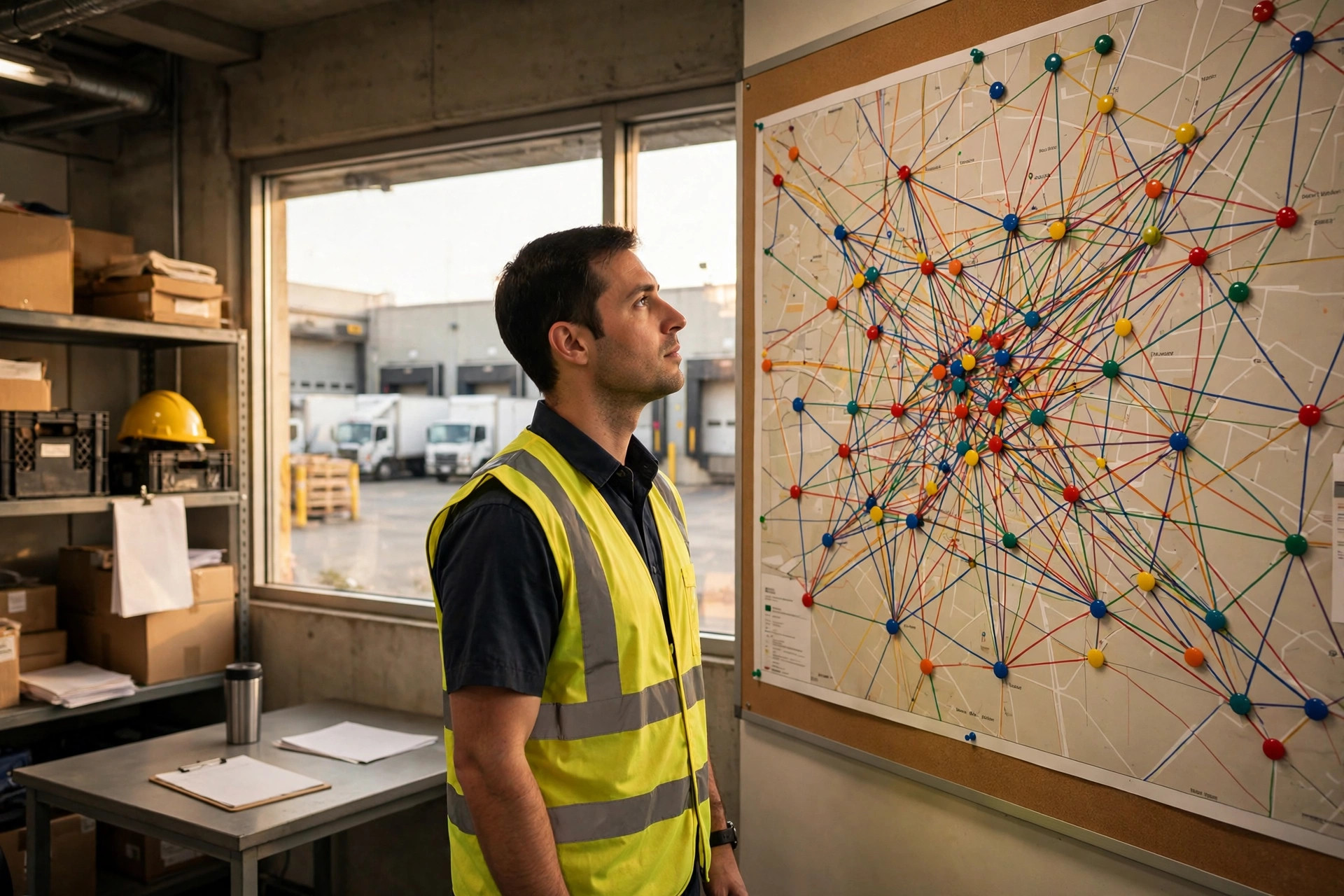
Last year a regional distributor — 60 trucks, 800+ delivery stops a day — ran all its routing through one man. Fourteen years on the job. He started building the next day's routes at 3 p.m., finished around 5:30, and fielded driver calls and last-minute adds in between. When the owner brought up AI routing software, his reaction was instant: "A machine doesn't know which road is under construction or which customer locks up at 4:30."
I've now sat through three pilots like this one. Here's the verdict up front: AI routing does save money — but not by replacing the veteran. It saves the two hours of routing he can't finish, and the chaos of the days he's out sick. Every project I've seen that went in with a "fire the dispatcher" mindset died on arrival.
What the veteran's experience is actually worth
The dispatcher's edge isn't magic. It's three things:
First, unwritten constraints. Customer A's receiving door is on the side street — big trucks can't get in. Customer B's owner is out every Tuesday, so freight goes to the front desk. Dock C has nobody after 4 p.m. Hundreds of rules like these live in the dispatcher's head, not in any system. In week one of the first pilot, the AI produced a beautiful minimum-mileage plan — and three trucks got turned away at the dock. Nobody had told the software.
Second, exception handling. A blowout on the highway, a customer adding 20 cases last-minute — the veteran reroutes in five minutes and calms the driver down on the same call. The AI can recalculate too. It can't make the phone call.
Third, relationships. The rapport with drivers and receiving clerks is the grease that keeps a plan moving.
So step one isn't replacement — it's extracting the rules from the veteran's head. What we did: shadowed the dispatcher for two weeks, wrote down every "you can't route it that way" and why. 127 rules. Hard constraints and soft constraints, all loaded into the system. Those 127 rules were the project's real asset.
And rules aren't a one-time thing. Customers change receiving hours, new truck restrictions appear — the veteran has to feed new rules in. We set a standing half-hour every Friday: the dispatcher and the system admin reviewed the week's new constraints together. What an AI routing system fears most isn't missing rules — it's stale rules. So make sure the vendor contract treats rule maintenance as an ongoing service, not a one-time deliverable.
Where the AI actually wins
Once the rules were in, the AI's advantages showed up fast:
It computes everything at once. A human routing 800 stops works zone by zone, juggling a handful of variables. The AI weighs distance, time windows, weight limits, driver hours-of-service caps, and fuel — and hands you five candidate plans to pick from. Across the pilots, AI plans averaged 6–9% fewer miles than the human-built ones.
It's fast. A new order, a broken truck — full network re-route in three minutes. The veteran needs 40 minutes minimum.
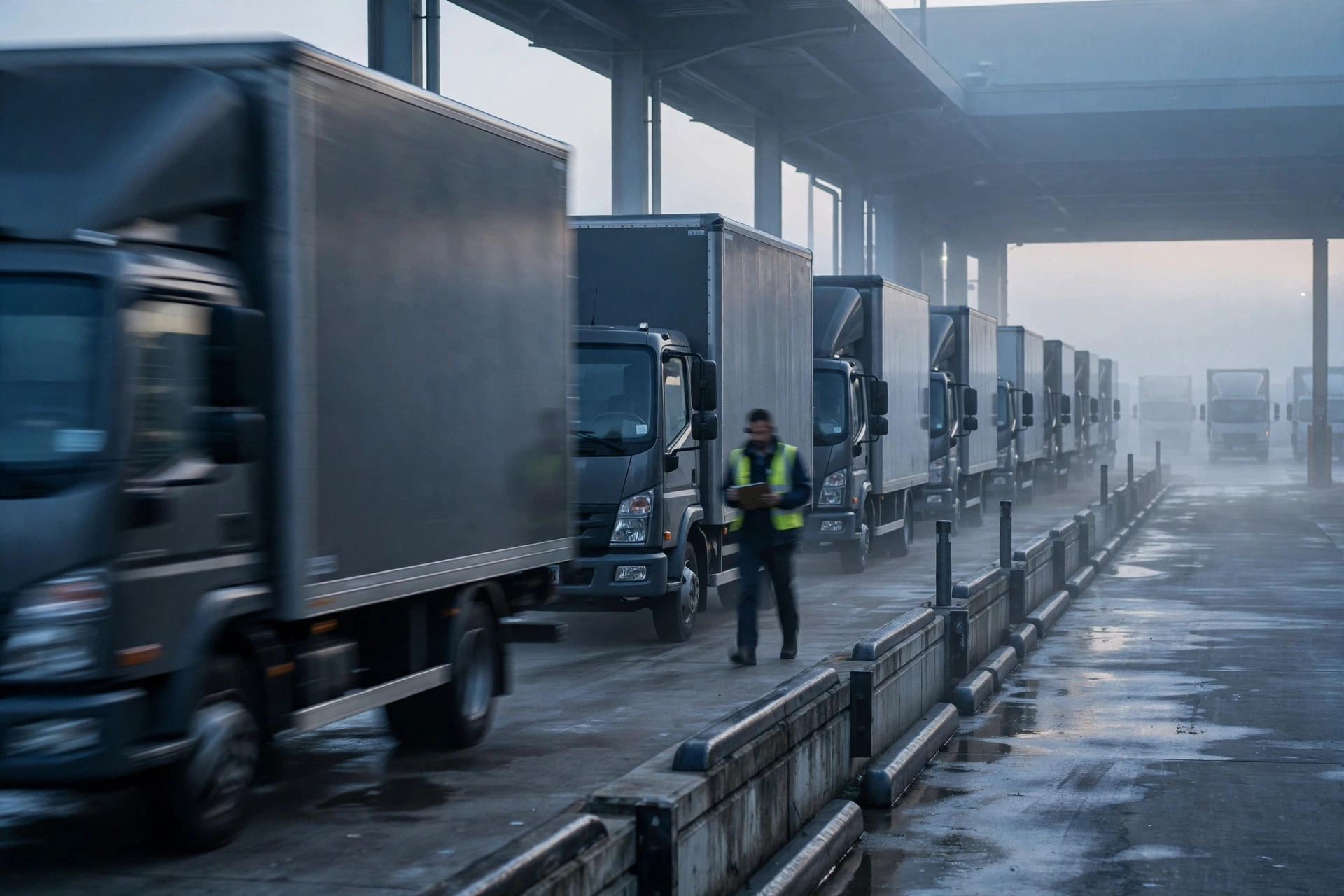
It doesn't take vacation. During the dispatcher's week off, the backup's routes ran 11% more miles and racked up two late-delivery penalties. The AI has no bad days.
Do the math: 60 trucks × 180 km a day × 300 days. At 7% fewer miles, you're looking at well over $200K a year in fuel and driver hours. A routing subscription runs $30–40K a year. The ROI doesn't need a spreadsheet to be obvious.
Put the veteran and the AI side by side and the picture is clear:
| Dimension | Veteran dispatcher | AI routing |
|---|---|---|
| Time to route 800 stops | 2.5 hours | 8 minutes |
| Exception re-route | 40+ minutes plus phone calls | 3-minute automatic recalc |
| Vacation/turnover impact | Backup ran 11% more miles | None |
| Hidden rules | All in his head | Must be entered and maintained |
| Driver communication | Strong suit | Can't do it |
Read that table and you see why "AI computes, the veteran judges" is the winning combo: each side's weakness is exactly the other's strength.
Don't buy the software yet: three gates that come first
I've watched too many companies buy the software and shelve it six months later. Three prerequisites, all non-negotiable:
Gate one: clean address data. Route optimization starts with geocoding. Addresses like "somewhere near 300 Main St" break the whole thing. Spend two weeks scrubbing customer addresses, time windows, and unloading conditions in your master data. That's the foundation.
Gate two: make the hidden rules explicit. The "extract the veteran's brain" exercise above. Skip it and drivers will reject the AI's routes — and a route drivers won't run is no route at all.
Gate three: run shadow mode for three months. Don't hand the AI the keys on day one. Let it route in parallel with the dispatcher every day, then compare: mileage delta, hidden-rule violations, driver feedback. Three months of stable deltas and a completed rulebook, then switch over. Those three months are also the psychological transition — the veteran goes from "the guy being replaced" to "the guy who wrote the rulebook." Get that transition right and the project is halfway won.
My recommendation
If you're considering AI routing, three things you can start tomorrow:
- List every "you can't route it that way" reason your dispatcher knows. If you can't get past 50, you're not ready to buy software.
- Scrub customer addresses and time windows — a two-week job.
- When you negotiate the POC, put a shadow-mode comparison period in the contract and tie acceptance to mileage savings.
- Talk to the drivers early: the AI is here to take load off dispatch, not to cut driver mileage pay. If drivers resist, route compliance collapses and every mile saved exists only on paper.
AI routing and the veteran dispatcher aren't an either-or. The best setup I've seen: the AI computes, the veteran judges — three candidate plans, a ten-minute sign-off, and the dispatcher finally has time for the work machines can't do: managing drivers, visiting customers. That's what technology is for — getting people out of repetitive work and into the work only people can do.
Who builds the routes at your operation — a person, software, or a mix? I'd genuinely like to hear how it's going.