The phone rang at 2 a.m., carrying the kind of alert that fills every AI inventory anomaly detection warehouse conversation. A night supervisor at a third-party warehouse in eastern China picked up to hear that one product category's book stock no longer matched pickable stock, and the gap was not small. His first instinct was to get dressed and drive over. His second instinct was better: he asked how many times this same alert had fired that week. It was the third. The first two times, someone had gone in and found the same story both times, in-transit paperwork that had not posted yet. He stayed home, and by morning the numbers had reconciled on their own. That gap between the first instinct and the second is where this whole subject lives. An alert system that cries wolf every night does not make a warehouse safer. It trains people to ignore alerts, which is worse than having no alerts at all.
This pattern has become more common for a structural reason, not a mysterious one. Warehouses now run more systems than they used to: a warehouse management system, an order system, a transport system, and often a client's own system, each keeping its own books. Every handoff between systems is a chance for a timing gap. At the same time, detection models genuinely have improved. They can spot patterns across millions of movements, like one location short by a few units every Wednesday. The trouble is that a model hands you a probability and a ranking, not a verdict. Treat a probability as a verdict and the 2 a.m. phone calls multiply.
AI Inventory Anomaly Detection Warehouse Alerts Fall Into Three Buckets
Before talking about models at all, it helps to sort discrepancies into three buckets. The first is real loss or damage: units are physically gone, broken, expired, or mixed up with another product. The second is a fake discrepancy: the goods are fine and the books are wrong, because of a keying error, a swapped barcode, or a mistyped location. The third is a timing gap: nothing is wrong with either the goods or the books, but two systems took snapshots at different moments, so in-transit stock, unposted paperwork, batch switches, or a count freeze window make them disagree temporarily.
The distinction matters because the cost of handling each bucket is completely different. Real loss calls for sealing the affected locations, checking camera footage, and pulling movement records. A fake discrepancy calls for fixing the data-entry step and its review. A timing gap calls for the cheapest response available: waiting until the next reconciliation point, when it usually clears itself. A large share of alert fatigue comes from handling the third bucket as if it were the first, sending people out at night to investigate something that would have resolved by breakfast. The reverse error is just as expensive. Treating a real loss as a timing gap lets it surface at month-end stocktaking as one large, hard-to-explain number, with responsibility impossible to trace.
A consumer-goods fulfillment warehouse shared a review that illustrates the point. Over one month of night alerts, more than half had cleared by the next morning without intervention, and only a small fraction required someone on site. Their fix was not a new model. They added two screening questions before any alert reached a human: how often has this gap appeared recently, and are the related documents still unfinished? Those two questions filtered out most timing gaps, and supervisors started taking the remaining alerts seriously again.
What AI Inventory Anomaly Detection Warehouse Data Actually Tells You
Amount is the obvious way to rank alerts, but amount alone misses two dangerous kinds. The first is high-frequency discrepancy: each instance is small, but the same gap recurs, which usually points to a process leak, like one step where small quantities are routinely under-recorded and quietly accumulate. The second is fast-spreading discrepancy: one location today, three tomorrow, a whole category by the end of the week. That pattern usually means something changed upstream, for instance a supplier changed packaging dimensions while the barcode parsing rule stayed the same.
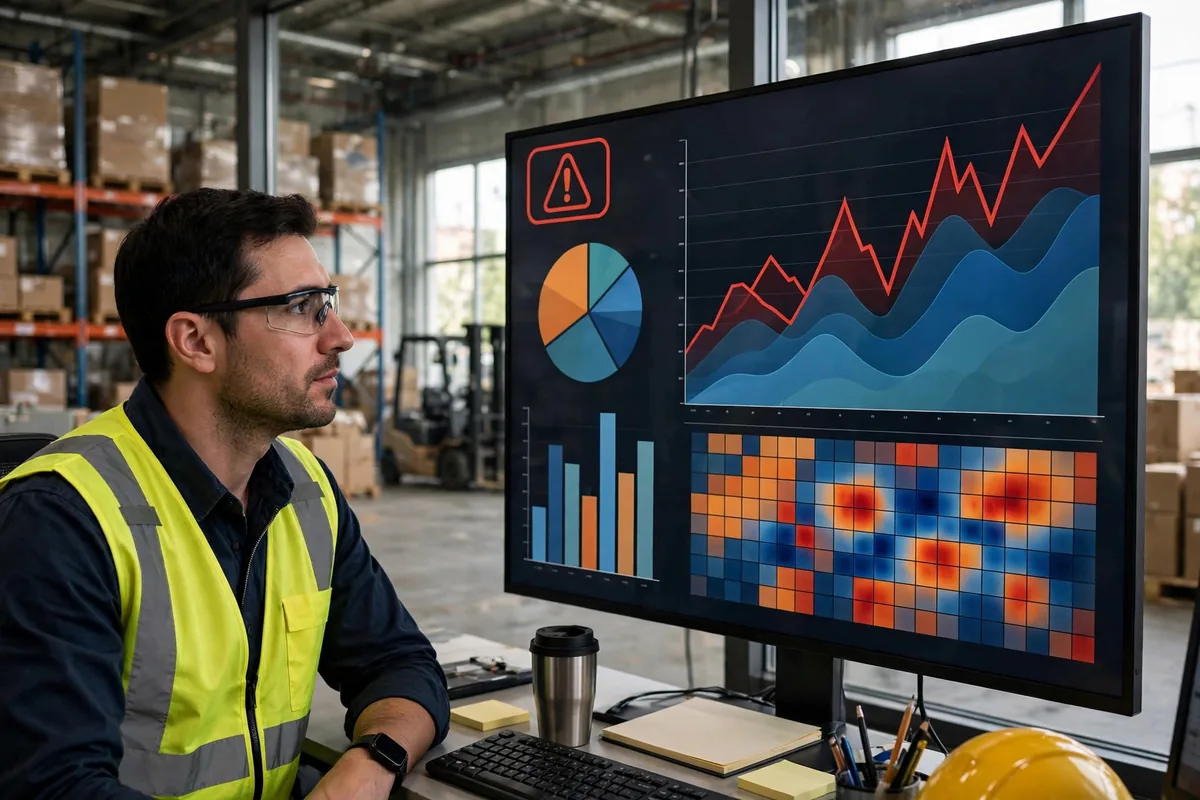
A steadier triage framework scores three dimensions: amount, recurrence, and spread. If two of the three cross their thresholds, the alert escalates to on-site investigation. If only one is high, it goes on a watch list with a scheduled recheck, and the system recomputes it at that time automatically. The thresholds do not need to be precise. What matters is that each tier maps to a concrete action. A watch-list item gets a timed recheck. An escalated item gets an investigation and, where appropriate, a freeze on the affected locations. Once that mapping exists, an alert stops being a notification and becomes a work order with a destination.
Here is the counterintuitive judgment that trips up many teams: a falling alert count is not necessarily good news. If thresholds get loosened, or if staff start correcting the books by hand outside the system, the alert count looks wonderful while real discrepancies accumulate off the books. The health of a detection setup cannot be judged by alert volume alone. Two metrics together tell a truer story: the share of alerts that turn out to be real discrepancies, and the average time from alert to confirmation. When both move in the right direction, the system is genuinely improving. When only one looks good, someone has usually adjusted the definitions rather than the operation.
From One Discrepancy Back to the Broken Step
Models can locate anomalies, but attribution still belongs to people. A useful chain of reasoning runs like this: first confirm the physical state, whether the goods are present and in the right condition; then examine recent inbound, outbound, and transfer records to see whether the gap appeared suddenly or built up gradually; then check whether the same product, zone, or shift shows similar gaps, to distinguish an isolated case from a pattern; then land on the process step most likely responsible, receiving, quality inspection, putaway, picking, checking, or shipping.
The step most often skipped is the sudden-versus-gradual question, and it changes the fix entirely. A sudden gap usually traces to a specific event, like a system switchover or a bulk import. A gradual gap usually traces to process wear, like a checking step that people have quietly stopped performing. Teams that only repair the individual case end up playing whack-a-mole: this product fixed today, another product tomorrow, same root cause untouched. Distinguishing the two kinds of onset is what turns firefighting into repair.
The economics belong in the same conversation. Handling an alert costs supervisor response time, on-site checking, document review, and sometimes idle waiting while locations are frozen. Multiply that by alert volume and you have the running cost of the alert system. On the other side sits the cost of a missed real discrepancy: lost goods, compensation, and damaged client trust. There is a balance point between the two. Alerts set too sensitive drown the team in running costs; alerts set too loose let missed losses detonate at month-end. Every warehouse's thresholds should land near its own balance point, not copied from another operator's settings.
| Triage tier | Trigger | Action |
|---|---|---|
| Watch list | One dimension high | Timed recheck, no site visit |
| Escalated | Two dimensions high | On-site check, freeze affected locations |
| Critical | Real loss confirmed or spreading fast | Full investigation, client notification if required |
The Trend: Alerts Get Sharper, Human Judgment Gets Harder
Looking ahead, detection will evolve along two lines. First, models will draw on more data sources, combining stock records with order waves, transport tracking, and inspection results, so timing gaps get identified more accurately and false alarms shrink. Second, alerts will move closer to the action itself, arriving not as a bare warning but with a suggested next step, such as which documents to check first or which locations to freeze.
But one judgment is worth holding onto: the sharper the model, the heavier the responsibility carried by the few alerts that still reach a human. Routine discrepancies get handled automatically, leaving people with the cases the model itself could not resolve, which tend to be large and complex. Tomorrow's night supervisor may get fewer calls, but each call will be harder to answer.
Back to that 2 a.m. phone call. Whether it deserves an answer never depended on the alert itself. It depended on whether a triage system had already sorted, scored, and screened it before it reached a human. Without that system, even the best model just produces more phone calls. With it, the model finally starts saving people time. What that system should look like in your warehouse is something that only emerges from reviewing your own discrepancies, one case at a time.
By Dr. Chen, Supply Chain Researcher