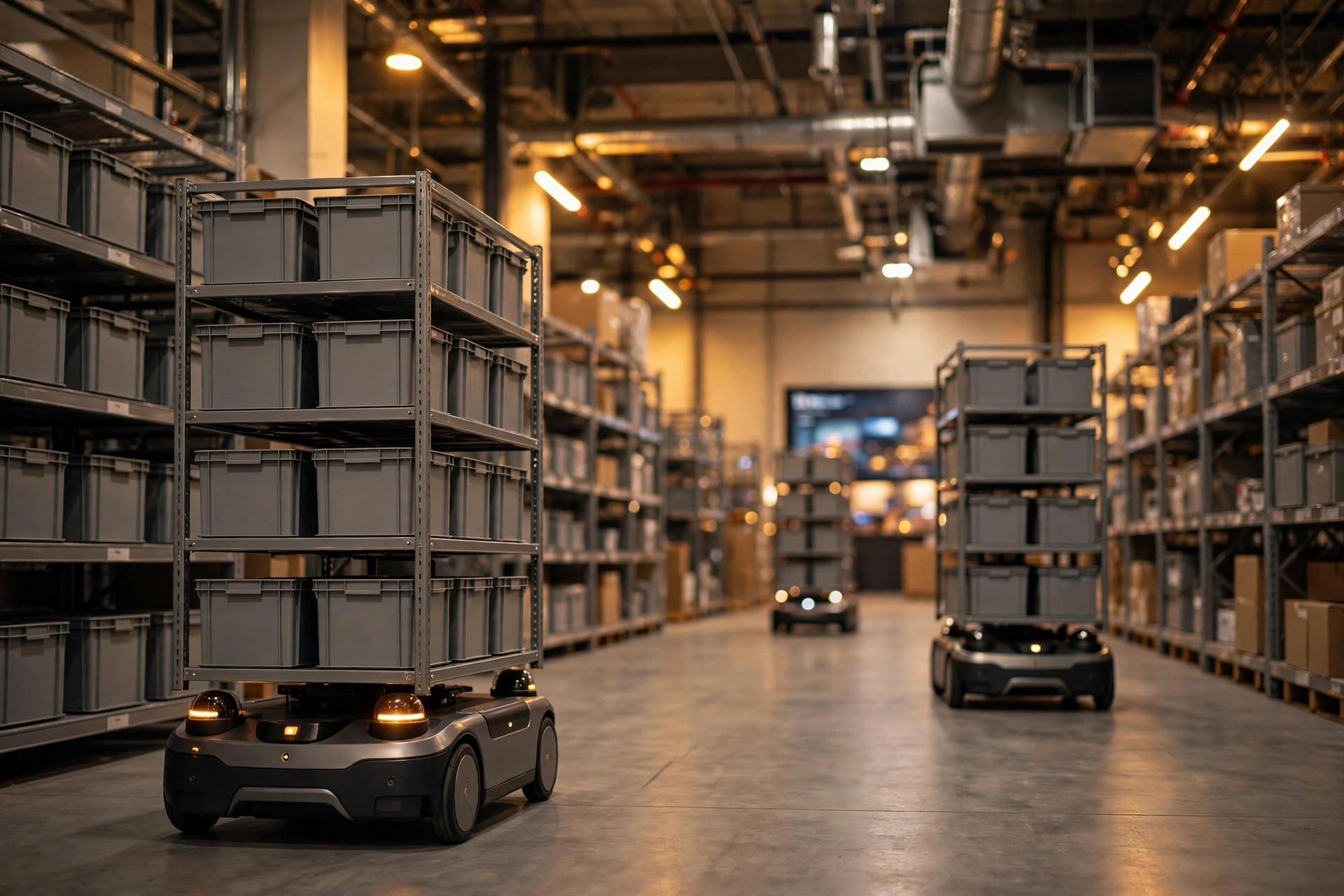
Sometime in the second half of 2025, a new line started appearing in 3PL bid documents: "Describe your use of AI in labor scheduling and demand forecasting." Three years ago, the same RFPs asked whether you had a WMS and what your location accuracy was. The question itself is the signal. Shippers have begun treating technology capability as a qualifying criterion, not a nice-to-have.
The pattern: big 3PLs are spending in three directions
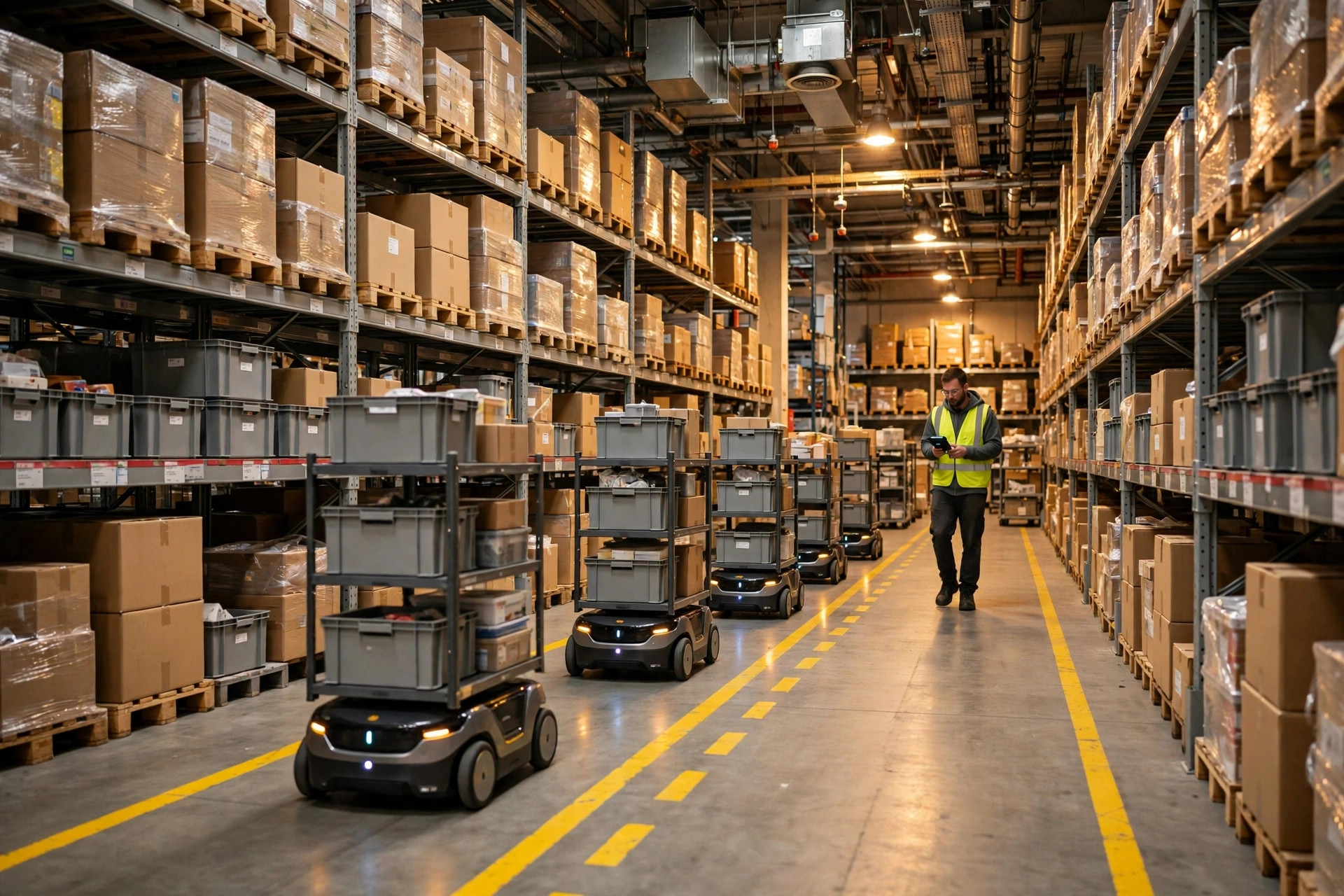
Over the past two years, the technology spending of leading 3PLs has concentrated in three areas, and the playbook is remarkably consistent. First, scheduling intelligence: algorithms replacing supervisor-driven shift planning and wave building, with systems that group orders and assign pick paths automatically based on order profiles. Second, demand forecasting: feeding historical shipment data, promotional calendars, and seasonality factors into models that project outbound volume by SKU two to four weeks out, informing both replenishment and labor planning. Third, AI customer service: large language models handling the high-frequency, repetitive tier of inquiries — "where is my freight," "how was this invoice calculated."
I have reviewed the public filings and investor communications of several listed 3PLs. The disclosure definitions differ enough that direct cross-company comparisons would be misleading, but the direction is uniform: technology and digital investment is growing materially faster than revenue at the top of the market. In plain terms, the leaders are trading margin today for a technology moat tomorrow.
The numbers: what does the spending actually buy?
The critical question is whether this investment converts into pricing power. According to operators' own public disclosures, AI-assisted scheduling has lifted per-warehouse picking productivity by roughly 15 to 30 percent. That range sounds modest until you place it inside the cost structure.
Labor has long been the dominant cost in warehouse operations; a commonly used rough benchmark puts it at fifty to sixty percent of operating cost. Consider a back-of-the-envelope model for a 100,000-square-foot facility shipping 8,000 orders a day: if picking labor runs about $2.4 million a year, a 20 percent productivity gain saves roughly $480,000 annually. Against that, an AI scheduling module — software subscription plus amortized implementation — costs on the order of $150,000 to $250,000 a year. The payback lands inside twelve months, which is why the leaders can pass part of the savings into their bids and reinvest the rest — a self-reinforcing loop between technology spending and pricing competitiveness.
One important caveat: the math above only holds in warehouses with stable order profiles and concentrated SKUs. In facilities with extreme SKU fragmentation and volatile daily volume, long-tail orders erode most of the algorithmic gain, and realized productivity improvements can drop to single digits. That is why the big players deploy AI in their flagship large sites first rather than rolling it out network-wide.
I sat in on a 3PL bid in Southern China in the fall of 2025 that illustrated the shift. The shipper, a home-furnishings e-commerce company moving around three million orders a year, shortlisted three providers. The most technology-intensive bidder came in about 8 percent above the lowest quote — and won. The procurement lead told me privately that they had modeled the difference: the winner's committed pick speeds and exception-response SLAs, translated into customer-service headcount and claims avoided, covered the 8 percent premium within a year. Technology spending is changing how bids are decided — from "who is cheapest" to "who has the lowest total cost of ownership." Once shippers internalize that logic, providers with no technology story to tell will gradually lose even the right to compete on price.
Attribution: where AI actually takes cost out
Breaking the investment apart, AI produces real savings in three specific links of the 3PL operation.
The first is labor scheduling. Traditional warehouses schedule by supervisor instinct: roughly how many orders tomorrow, roughly how many people. The value of algorithmic scheduling is not that it is more accurate in any mystical sense, but that it iterates faster — the system proposes daily headcount based on forecasted volume, and supervisors only fine-tune. An operations director at an East China 3PL told me that after adopting forecast-based scheduling for the 2025 peak season, their temp-labor usage fell by roughly twenty percent — and temp labor costs twenty to thirty percent more per hour than regular staff, so that is where the savings bite hardest.
The second is slotting optimization. ABC classification is textbook advice, but manual ABC reviews happen once or twice a year while SKU velocity profiles change constantly. An algorithm can recompute slotting heat weekly, pulling fast movers into the golden pick zone. The savings never show up as a line item; they show up as footsteps not taken. In an 80,000-square-foot warehouse, a ten percent shorter pick path translates into a meaningful number of labor hours saved over a year.
The third is customer service. A mid-size 3PL's service team fields hundreds of repetitive "track my shipment" and "explain this invoice" tickets a day. LLM-based service has pushed automated resolution of standardized inquiries above seventy percent. One apparel-fulfillment 3PL in East China saw inquiry volume quadruple during the 2025 mid-year shopping festival; in prior years they hired six temporary agents, this year the model absorbed more than eighty percent of standard inquiries and they added only two. What they saved was not just wages but the risk of being unable to hire at all during peak. The displaced agents were not laid off — they moved into exception handling and customer success. That changed cost structure is part of why the leaders can afford to concede margin in their bids.
The trend call: stratification, not consolidation
My read, with evidence and a timeline attached: stratification will happen, but it will not look like "the big eating the small." Between 2026 and 2027, AI scheduling will become a standard line item in large bids — providers without it will struggle to make shortlists. Between 2027 and 2028, the investment will flow through into pricing, with the leaders opening a five-to-ten-point quote advantage on standardized large contracts. At the same time, mid-size and regional 3PLs will not disappear. They will retreat to three positions the giants do not want to fight for.
The first is vertical depth: cold-chain pharma, hazmat, high-value electronics. The know-how there lives in compliance detail and handling craft, not in algorithms. The second is regional density: three or four small facilities inside one metro area delivering same-day service, where local relationships and response speed matter more than a national network. The third is specialty and non-standard work: white-glove delivery with installation, trade-show logistics, reverse logistics. The more non-standard the job, the smaller the standardization dividend of AI, and the larger the value of human experience.
The contrarian point: the biggest risk for a mid-size 3PL is not "we cannot afford AI" but "we buy the wrong AI." I have seen a regional 3PL with under $20 million in annual revenue spend heavily on a demand-forecasting system, only to discover that seventy percent of its orders came from rush additions by three large clients. The model was useless against that kind of pulse-shaped demand, and the system sits idle. AI is an amplifier — it amplifies whatever structural advantage your order profile already has. If your advantage was never scale and standardization, the amplifier does nothing for you.
Three open questions for the industry
First, will the technology arms race raise the industry's overall fixed-cost base and actually thin out 3PL margins further? We have seen this movie before with WMS adoption: the system became table stakes without lifting industry-wide profitability — it merely raised the price of admission.
Second, when the leading 3PLs' scheduling, forecasting, and service all run on similar classes of algorithms, does differentiation disappear? If everyone's AI is fine-tuned from the same foundation models, does competition collapse back into a price war?
Third, a question shippers should be asking now: when your 3PL outsources its core operating intelligence to algorithms, does switching providers get easier or harder? Whoever holds the accumulated data and models holds the leverage at the next negotiating table.
The technology divide is already in motion, not on the horizon. But the historical pattern is consistent: in every technology wave, the winners are not simply the most advanced — they are the ones clearest about what they do not need to win on.
By Dr. Chen, Supply Chain Researcher