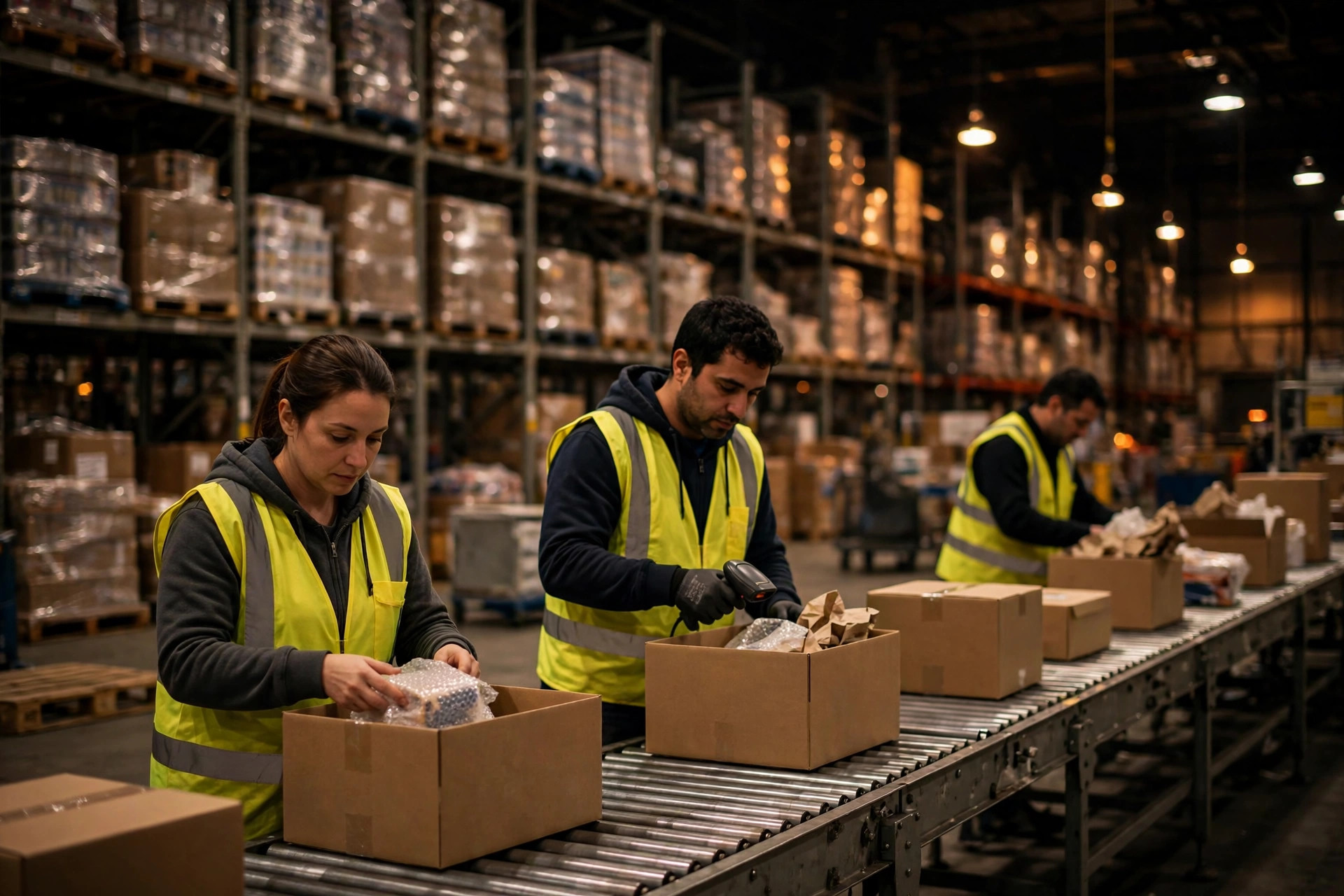
Let me tell you something. Last Singles' Day, I was unloading at a warehouse in Kunshan — waited from 6 in the morning until 3 in the afternoon, while inside the place it was pure chaos, forklifts queued up in the aisles. Finished unloading, stepped out, and the warehouse right next door, same industrial park, was so quiet you could hear the ventilation fans. The shift lead over there was squatting by the door smoking, told me they'd had one truck all week and the crew was bored out of their minds. I'm thinking: is this some kind of joke? One side's dying of work, the other dying of boredom, separated by a single wall — why not just lend a few people over?
Fifteen years on the road, and I've seen this joke play out more times than I can count. Borrowing labor between warehouses in peak season sounds like common sense. In practice, it's full of traps. Here's how the whole thing actually works — or doesn't.
Before You Borrow a Single Person, Settle Three Arguments
Here's a true story. During the 618 shopping festival two years back, a small-appliance shipper had Warehouse A in Changshu drowning in orders while Warehouse B in Zhangjiagang sat idle. The boss waved his hand: "Send ten people over!" What happened? The borrowed crew worked 12-hour days. Changshu's manager said overtime belongs to Zhangjiagang (they're your people). Zhangjiagang's manager said Changshu should pay (they're working for you). The argument dragged on for a month. Overtime pay didn't land until August. Those ten people were furious — next peak season, not a single one volunteered to go back.
Let me tell you: the biggest pitfall in cross-site labor sharing is never headcount. It's the accounting. Three arguments, every time:
First, whose hours are they? When a borrowed worker puts in hours and overtime at the receiving site, which warehouse's books do they land on? Book them to the sending site, and its team metrics get dragged down. Book them to the receiving site, and that manager grumbles, "My people work for me — why should I absorb this?" The cleanest setup I've seen: keep borrowed hours in a separate ledger. The receiving site counts the output; the sending site doesn't count the attendance. Overtime gets settled separately — whoever benefits pays. That's just fair.
Second, who funds the bonus? Receiving sites usually run peak-season overage bonuses. The borrowed folks did the work — do they get a bonus? Pay nothing, and don't expect them to hustle. Pay them, and whose budget does it come from? I talked to an owner running three warehouses in East China. His rule: the receiving site pays a "support incentive" pegged to per-person output, roughly half of what its own crew gets. Not a fortune, but the gesture lands — people who left home to bail you out shouldn't go home feeling shortchanged.
Third, who owns the safety liability? This one's the killer. If someone gets hurt at Warehouse B, whose responsibility is it? Which company holds the workers' comp policy — the sending company or the receiving one? Who runs to the hospital, who foots the bill? Let me be blunt: this has to be written down, on paper, before anyone moves. When nothing goes wrong, anything works. When something goes wrong once, two warehouse managers can end up at each other's throats. My advice: the site using the labor owns on-site safety; workers' comp runs through the sending employer; costs get split per the agreement — and the split gets negotiated up front, not after the accident.

Making It Real: A Request Form and Four Checkboxes
Settling the accounts isn't enough — you need a process. The companies I've seen do this well all run the same playbook. Four things:
One, a request and approval. The site short on labor files a request three days ahead: how many people, for how many days, doing what (picking or QC, muscle work or skilled work). The sending site replies within 24 hours: how many it can spare, names, any skill constraints. Don't underestimate this piece of paper — without it, borrowed workers wander the receiving site like headless chickens, and the manager there won't dare assign them anything serious.
Two, skill matching. This is where it blows up most often. I watched a shipper in Guangzhou lend QC inspectors from Warehouse B to do picking at Warehouse A. The guy couldn't even operate the pick scanner properly — day one error rate was five times the local veterans'. He didn't help; he made a mess. Borrowing people isn't borrowing bodies. Match the person to the job: pickers to picking, certified forklift drivers to forklifts. If there's no match, the receiving site owes the borrowed crew a half-day of coaching. Half a day buys you ten smooth days after — that's cheap.
Three, safety orientation. Every warehouse is different — aisle layouts, fire hydrant locations, emergency exits, forklift routes. Let me tell you, on day one every borrowed worker has to walk the receiving site's safety rundown: which aisles the forklifts use, which zones have height limits, where the muster point is. Sign a sheet. Ten minutes. One warehouse skipped this; on day two a borrowed worker got clipped by a pallet jack on a blind corner. Minor injury, thank God — but if it had been serious, that manager would have had real problems.
Four, cost settlement. End of month, one sheet: how many people, how many hours, how much overtime, how much incentive money. The receiving site signs off, finance books it. The slickest operation I know settles it alongside payroll — the lent-out workers see the money at month-end. Money arrives fast, and next time there's a queue of volunteers.
Here's a simple checklist. Run through it before every borrow:
| Item | Must be settled | If it's fuzzy |
|---|---|---|
| Hour attribution | Receiving site counts output; sending site doesn't count attendance | Sending site's metrics get dragged down |
| Overtime pay | Whoever benefits pays; settled separately | Delayed pay, endless disputes, nobody volunteers again |
| Support incentive | Receiving site pays per per-person output, ~half of its own crew's bonus | Borrowed crew goes through the motions |
| Safety liability | User site owns on-site safety; comp through sending employer | Two managers fighting after an accident |
| Skill matching | Match role to role; coach first if no match | Error rates spike, more trouble than help |
| Safety orientation | Walk-through and sign-off on day one | Injury risk way up |
The Counterintuitive Bit: Sometimes You're Better Off Not Borrowing
After all that, let me tell you something counterintuitive: borrowing labor has a cost, and sometimes grinding through on your own is the smarter move.
Do the math with me. Borrowed workers need about two days to get oriented — learning the bin locations, the process, the rhythm. In those two days, output might hit sixty, seventy percent of a local veteran's. Add transport, lodging (cross-city support means hotel rooms), the incentive money — the all-in cost per person per day often runs higher than hiring a local temp. If the support stint is only three to five days, by the time people get up to speed, the work's already done. Pure churn.
When does borrowing pay? The stint runs longer than a week, the work is standardized picking or packing, and the two sites run roughly the same playbook. All three true — borrow. When not? A short spike of under three days, work needing real skill (high-reach forklifts, system operation), or two sites with very different processes — then you're better off with local temps or a peak-season staffing arrangement with a labor agency.
And one more thing: never force your veterans to go. I've seen it forced — the person shows up, the heart doesn't, work gets sandbagged, and the bad mood infects the local crew. The right move is to make it attractive: pay the support incentive properly, and add something real like "support experience counts toward promotion." People aren't stupid. Treat them right, and they'll genuinely have your back.
Fifteen years on the road, and I'll leave you with this: peak-season labor sharing isn't about borrowing heads. It's about borrowing trust. Settle the accounts clearly, run the process cleanly, and the people will work like they belong. When it goes wrong, ten times out of ten it's because the money and liability were never sorted out. Warehouse managers — print that checklist and pin it on the wall before peak season hits. It beats slamming the table during peak season, every time.
By Shifu Zhao, Trucking Veteran (15 yrs)