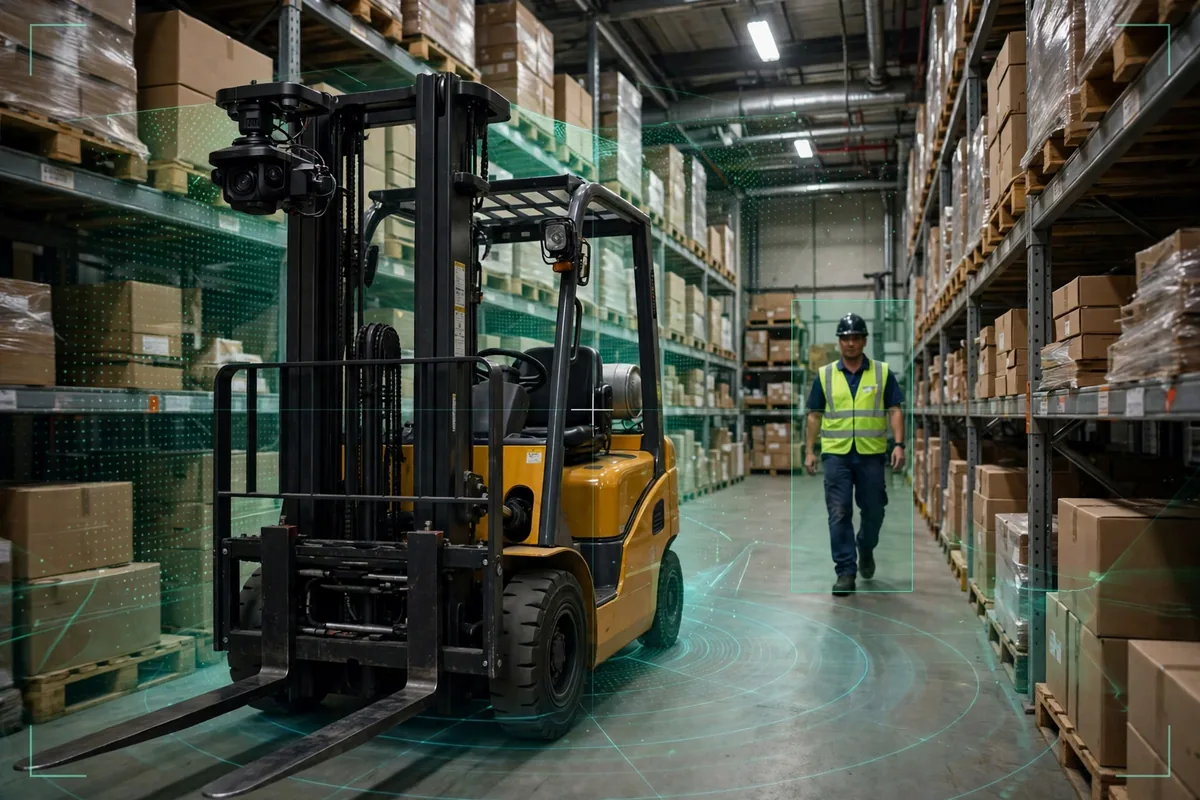
For two years, every warehouse software vendor has told one story: connect promotion calendars, weather forecasts, and social media heat to the system, apply ai demand sensing warehouse inventory methods, and the warehouse will stock fewer wrong items and schedule fewer wrong shifts. According to recent industry surveys and post-implementation reviews from third-party warehouses, the value of demand sensing depends less on model sophistication than on three basic conditions: whether demand for a category is genuinely driven by short-term signals, whether the data entering the system is clean, and whether replenishment and staffing can react within the window the forecast opens. If any condition is missing, a more detailed forecast may simply calculate the error more precisely.
Two Warehouses, Opposite Results From ai demand sensing warehouse inventory
In the first case, a third-party warehouse in eastern China handling beverages and packaged food faced summer heat as its dominant demand variable. Weekly replenishment based on historical sales repeatedly produced the same pattern during heat waves: fast-moving specifications stocked out while slow ones accumulated. After short-term signals were introduced, the system combined seven-day temperature forecasts, confirmed convenience-store promotion schedules, and unusual lifts in regional orders, adjusting safety stock and picking labor two to three days ahead. In its own review, stockouts on leading items fell by a noticeable order of magnitude during hot weeks. The preconditions were plain: weather genuinely moves beverage demand, and the cycle was short enough for a two-day warning to become stock.
The second case points the other way. A consumer e-commerce warehouse in southern China carried tens of thousands of long-tail home goods, many shipping only a few units a day. The team hoped social media heat could refine replenishment. When a storage product trended on a short-video platform, the system raised its suggested stock for the next two weeks and lowered suggestions for several products with no visible heat. The trend faded within days, orders came in well below the suggestion, and two downgraded products stocked out because of routine repeat purchases by existing customers. The review concluded the failure was not in the algorithm: social heat measured attention, not buying within that warehouse's region. Demand sensing, in this light, is not a general-purpose gain. It behaves more like an amplifier. When the signal is real, it amplifies the benefit; when the signal is noise, it amplifies the error, faster than human judgment would.
Which Categories Respond, and Which Mostly Produce Noise
| Category type | Value of short-term signals | Signals that tend to work | Common sources of noise |
|---|---|---|---|
| Weather and event sensitive, such as beverages, sunscreen, rain gear | Relatively high | Weather forecasts, holidays, confirmed local events | National trending topics detached from local weather |
| Promotion driven, such as retail supply and platform campaign staples | Moderate to high | Confirmed promotion calendars, committed traffic plans | Unconfirmed campaign intentions, verbal commitments |
| Long-tail and low-frequency, such as niche home goods, industrial spares | Low | Almost no stable short-term signal | Social heat, one-off viral orders |
| Repeat-purchase cycles, such as pet food, office consumables | Limited | Subscription cycles, customer reorder rhythms | Short promotions that borrow future demand |
Behind this table sits a statistical point that is easy to overlook. A specification shipping several hundred units a day produces fluctuations a signal can plausibly explain. A specification shipping two or three units a day can jump from two to five because one additional customer ordered, yet the system reads that as a surge of more than half. Extending automatic correction to such items means reacting systematically to randomness. Suggestions flip frequently, and trust on the warehouse floor erodes. According to several reviews, when low-frequency items dominate the scope, operators switch off automatic suggestions, and many projects quietly return to their previous method within a year.
Running demand sensing seriously costs more than a subscription. It includes signal integration and cleaning, master data governance, and weekly operator time reviewing exceptional suggestions. If a mid-sized warehouse spends on the order of tens of thousands per month, while holding inventory on the order of tens of millions with already fast turnover, even a few points of forecast improvement may not convert into avoided losses large enough to cover the input. The return tracks inventory scale and volatility far more closely than headline accuracy claims, and specific figures should be checked against the latest vendor and official sources rather than transferred across sites.
Why Dirty Data Makes ai demand sensing warehouse inventory Worse
Post-mortems most often blame model accuracy, but the deeper cause usually sits in the data. According to public accounts from implementation teams, warehouse history typically carries three problems. Promotional sales are recorded as if they were natural demand, so the baseline the system learns is already inflated. Returns and cancelled orders are not removed correctly, so net demand is overstated even when outbound records look healthy. Product master data is fragmented, with the same item split across specifications, bundles, and channel codes, so each record looks low-frequency when the combined product is a stable mid-frequency one.
Demand sensing adds a specific risk because it is a dynamic correction system. If the baseline is wrong and a short-term signal is layered on top, the correction can point away from real demand, and the system will execute that wrong direction more frequently and with larger adjustments. One mechanism is double counting: a promotion may already be reflected in the historical baseline, and if the signal layer adds the same promotion again, stock is systematically overstated. An experienced planner discounts such duplication by instinct; an automated process has no one checking it daily. This is the counterintuitive point: before data governance is done, a more sensitive system can perform worse than the slower manual method it replaced, because slowness itself is protection in a noisy environment.
Staffing carries a similar risk. Using sensing output to adjust labor assumes people can be flexed like inventory, but experienced pickers are constrained by contracts, commuting, and training time. Only temporary labor can move within two or three days, and it does not match trained staff on speed or error rates. If a forecast suggests orders will rise by roughly a fifth tomorrow and the warehouse adds a fifth more temporary hands, output does not necessarily rise by a fifth; congestion at packing and checking can become the binding constraint. A more defensible use is deciding in advance whether a standby overtime shift should be reserved, rather than tuning headcount daily.
A Graded Response Is the More Likely Direction
Demand sensing will not disappear, but its application is likely to narrow from automatic correction across all categories toward a graded response by category. Weather-sensitive items and stable promotion-driven staples will keep using short-term signals, automatically or semi-automatically, because the causal chain is short and results can be verified within weeks. Long-tail items will gradually leave the automatic scope and return to safety stock plus human review, with the system flagging anomalies rather than changing parameters directly. That narrowing will roughly follow master data governance progress.
The ranking of signals is also shifting. In several reviews, external signals such as social heat have been down-weighted, while internal signals, such as changes in order structure over the past forty-eight hours, earlier ordering from a particular region, or unusual return rates, have proved more stable. Internal signals sit closer to actual transactions and carry less noise. The feasible path may be to use internal signals first, then add one or two validated external signals.
So, does ai demand sensing warehouse inventory work? The answer depends on whether a warehouse will first answer a few duller questions: what share of its inventory is genuinely driven by short-term signals, how far the cleanup of promotion, returns, and master data problems has gone, and how fast replenishment and staffing can respond in practice. Without those answers, debating model selection is premature; with them, the range of sensible choices is not large. When more warehouses publish reviews by category rather than as a single overall accuracy figure, the field may finally gain a comparable basis for judgment, and until that day arrives, restraint toward aggregate numbers may be the more responsible position.
By Dr. Chen, Supply Chain Researcher