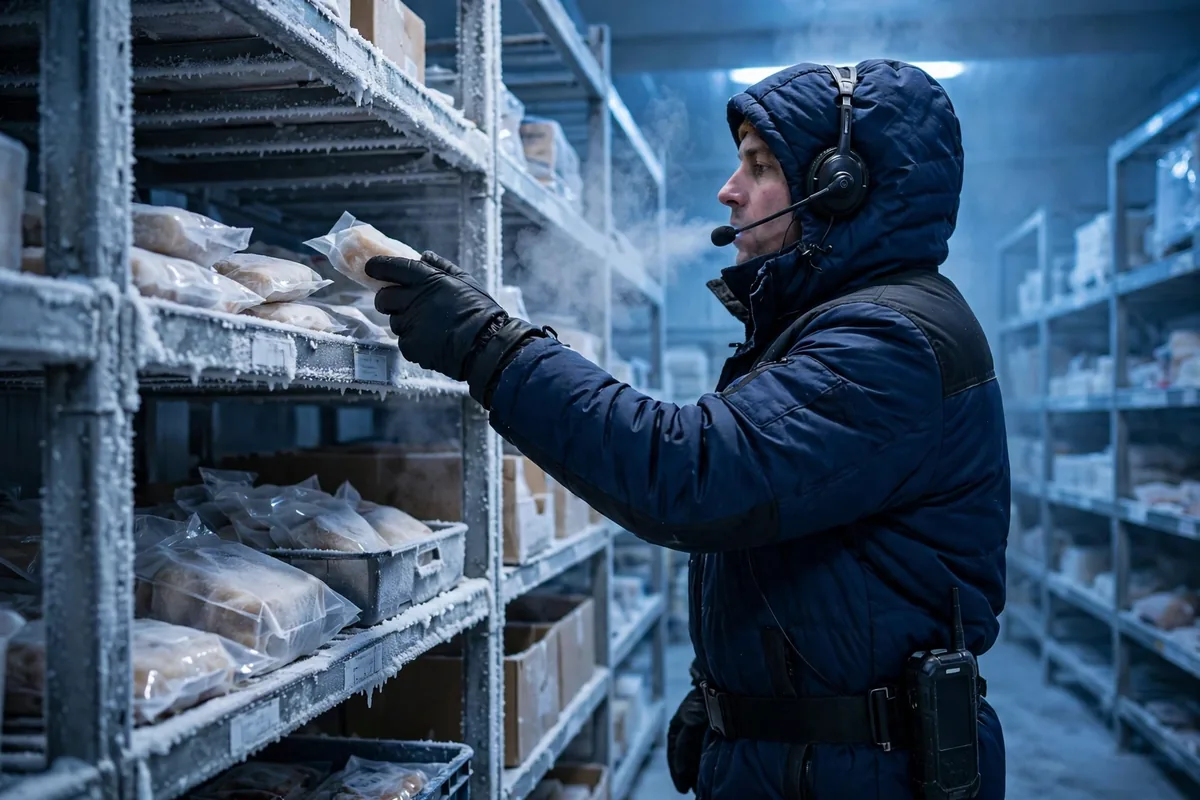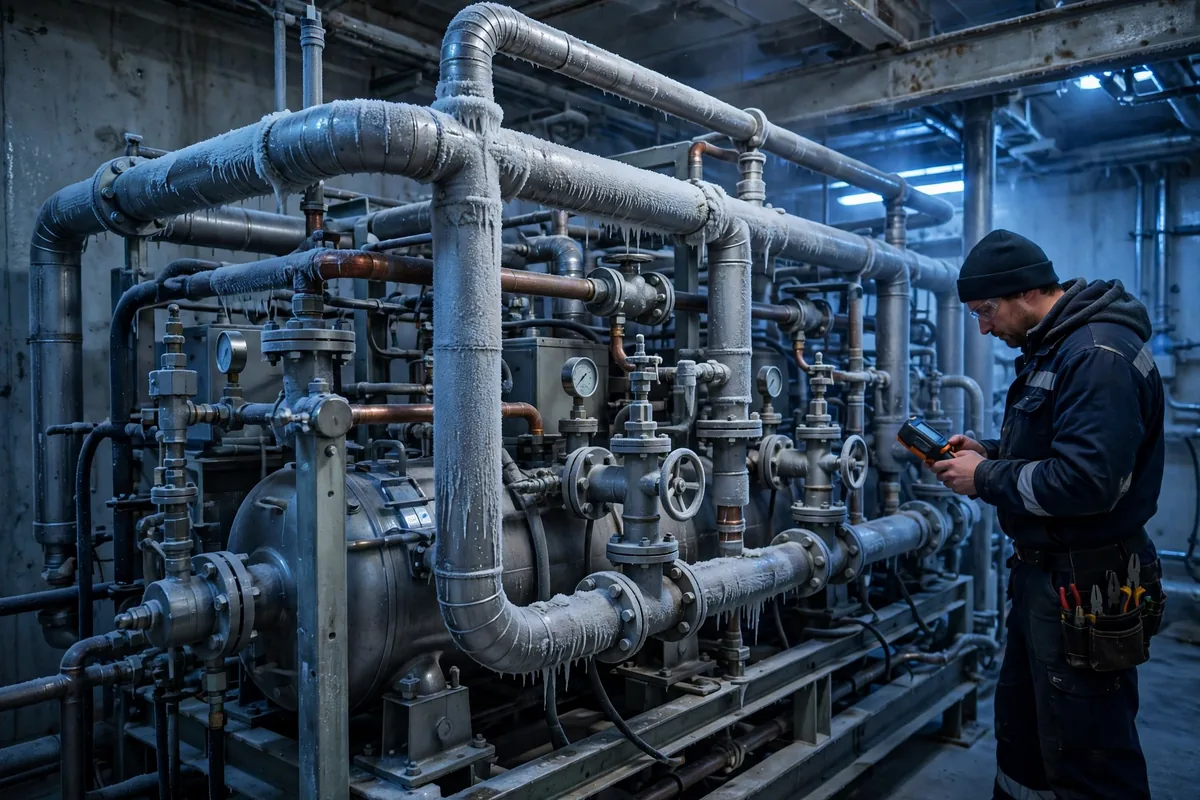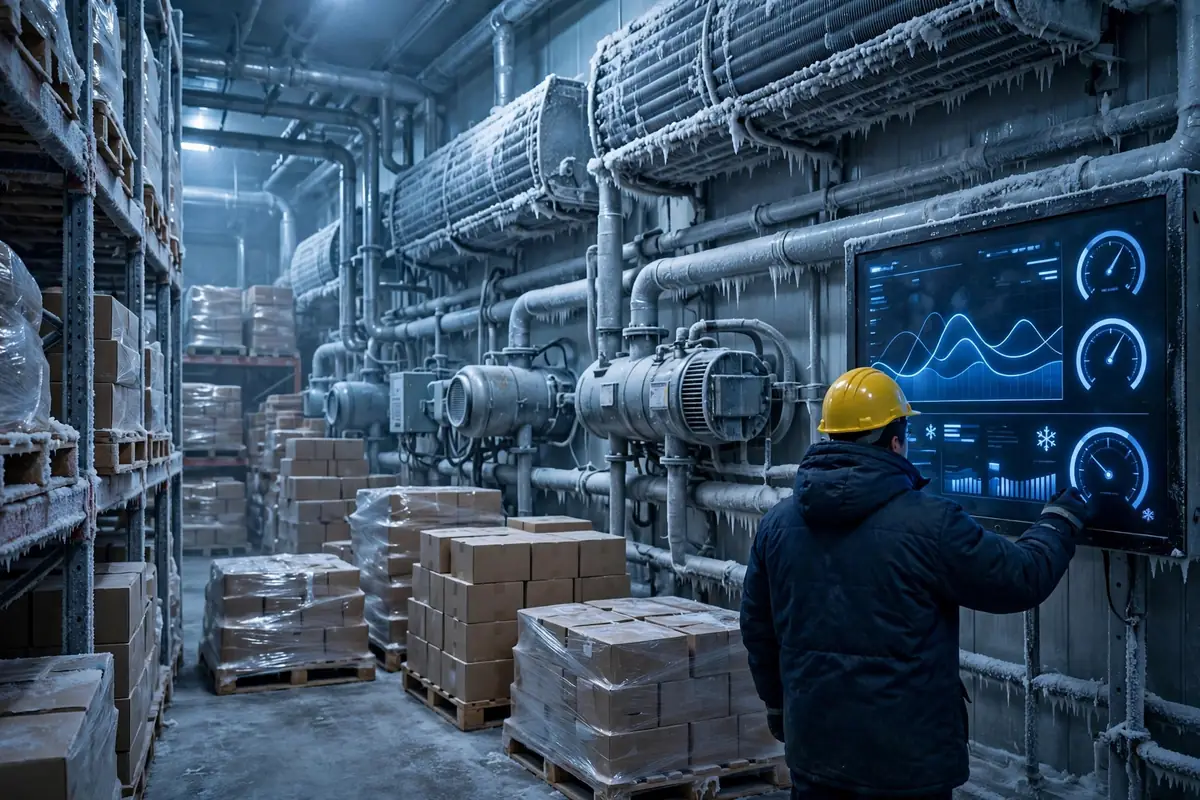
In a survey of 758 cold stores, refrigeration accounted for 60 to 70 percent of total energy use, and a refrigerated warehouse consumes roughly 25 kWh per square foot per year, about four times the consumption of a dry warehouse. Put those two figures together and the case for AI cold storage energy optimization becomes concrete rather than rhetorical: the bulk of the bill sits with a handful of compressors that run around the clock, not with lighting or office equipment, and the serious question is which part of the compressor's workload an algorithm can actually move, and what data it needs before it can move anything at all.
One misunderstanding should be cleared up first. Vendor material often quotes savings of 20 or 30 percent, yet the published breakdown of a cold store's electricity does not support that kind of blanket figure, because the load is split across compressors at roughly 60 to 70 percent of the bill, evaporator and condenser fans at 10 to 15 percent, and defrost at 5 to 8 percent, with lighting and dock equipment making up the remainder. Even a perfect optimization of one component can only touch that component's share, which means the honest starting point for any AI cold storage energy optimization project is a table of where the money goes, not a brochure promising a percentage.
Where the energy money goes is where the algorithm should look
Consider a third-party frozen warehouse in California's Inland Empire, 80,000 square feet, held below minus 18 degrees Celsius year-round. Applying the published benchmark of 25 kWh per square foot per year gives annual consumption of roughly 2 million kWh, and at the 2026 United States commercial average of about 13.5 cents per kWh, that is an annual electricity bill approaching 270,000 dollars, with refrigeration responsible for roughly six to seven tenths of it. The point of this arithmetic is not precision, since every site differs, but orientation: compressor sequencing, temperature set points, and defrost cycles decide the direction of the bill, while lighting retrofits and office air conditioning, however worthy, move only a small remainder.
A cold chain operator in eastern China took a different route when it piloted optimization in 2025. Instead of buying an algorithm first, the team spent two months filling data gaps: temperature and humidity sensors in every chamber, sub-meters on the compressors, and door-open records from the dock wired into the same system. Their reasoning was that a model consumes historical load curves and live operating conditions, and without those it can only guess from experience. Two months later they found that the real consumption peak did not arrive at the hottest hour of the day but between 4 and 6 in the afternoon, the concentrated outbound window, when dock doors opened and closed repeatedly, warm air poured in, and compressors were forced to run at full load to chase the set point. That finding used no AI at all, yet it determined whether the algorithm that followed could deliver anything measurable.
Three energy optimization algorithm families, three different boundaries
The algorithms reaching cold storage today fall roughly into three families, each with its own data requirements and ceiling.
The first is load forecasting: using historical consumption curves, weather forecasts, and outbound plans to predict how cooling demand will move over the next few hours, then scheduling compressor combinations ahead of time. Its value lies in turning compressors from reactive to anticipatory, avoiding the demand-charge spike that comes when several units start at full load together. Industry estimates put demand charges at 30 to 50 percent of some cold storage bills, a range that varies with region and tariff structure, but the direction is clear: shifting load is often worth more than reducing it. The data prerequisite is at least one full season of historical load data, and without that the forecast has nothing to stand on.
The second family is real-time control optimization, covering dynamic temperature set points and defrost scheduling. A frozen store is commonly held at minus 18 degrees, but many frozen goods tolerate a band of one to two degrees, which lets an algorithm drive the temperature slightly lower when electricity is cheap and let it drift back slowly when prices peak, using the building's own thermal mass as a battery against time-of-use tariffs. The boundary here is product safety: temperature drift must stay within the tolerance of the goods, which rules out most pharmaceutical and vaccine storage and leaves ordinary frozen food as the workable case. Defrost follows the same logic, since frost builds at different rates and a fixed schedule wastes energy, but only if the evaporator carries reliable frost-state monitoring.
The third family is anomaly detection and equipment health diagnostics. Compressor efficiency decay, slow refrigerant leaks, and aging door seals barely move chamber temperature in their early stages, yet they show up as a slow upward drift in the consumption curve that manual inspection rarely catches. The value of the algorithm is to flag that drift and prompt maintenance before the problem grows. The return here often sits outside energy savings altogether: an unplanned shutdown in a cold store costs far more in spoiled goods and broken contracts than several months of electricity.
| Algorithm type | Problem it solves | Data prerequisite | Boundary and risk |
|---|---|---|---|
| Load forecasting and peak shifting | Compressor scheduling, demand charges | At least one season of load and outbound data | Forecasts depend on outbound plan accuracy |
| Real-time control optimization | Set points, defrost cycles | Zoned sensors, compressor sub-meters | Temperature drift limited by product tolerance |
| Anomaly detection and diagnostics | Efficiency decay, refrigerant leaks | Continuous operating data, maintenance records | Flags problems, does not replace repair |
Run a pilot budget before deciding to deploy
Whether AI cold storage energy optimization is worth the investment comes down to a calculation, and it helps to label the assumptions openly. Take the 80,000-square-foot frozen warehouse with a 270,000-dollar annual bill used above, and suppose the pilot targets a 5 to 10 percent reduction in the total bill, worth 13,500 to 27,000 dollars a year. That range is a planning assumption for judging how much investment the project can justify, not a measured result; the published literature offers no universal figure, and any vendor that guarantees a fixed percentage should be asked for its evidence.
The cost side needs the same disassembly. Sensors and sub-meters, data integration, algorithm subscription or development, and the internal staff time to support the pilot are routinely underestimated. The practical sequence is to build the data foundation first, run a pilot in a single chamber, validate across one full season, and only then decide on a facility-wide rollout. The pilot also needs a control group: a comparable chamber without the algorithm running under similar conditions over the same period, because without a control there is no way to tell whether the electricity saved came from the algorithm or from cooler weather.
One precondition is organizational rather than technical. If the algorithm's recommendations need an operator to act on them manually every day, execution rates decay over time; the savings that last are the ones written into the control system to run automatically, with people supervising and handling exceptions. That makes the project a change in operating procedure as much as a software purchase, and if the procedure does not change, the gains stay in the pilot report.
Looked at this way, AI cold storage energy optimization is less a technology purchase than a data-led operations project. A refrigeration share of 60 to 70 percent makes the ceiling high enough to take seriously, while the algorithm's boundaries, its data prerequisites, and product safety limits make it impossible to rush. Over the next few years, as sensor costs keep falling and time-of-use price spreads widen, the optimization space in this segment will only grow, which leaves one open question for every operator: by the time the tools are ready, will your facility have accumulated enough clean historical data for the algorithm to use from day one, given that data not collected today cannot be used tomorrow?
By Dr. Chen, Supply Chain Researcher