How Much Does It Cost to Store a Pallet per Month? What That "$20/Pallet/Month" 3PL Quote Actually Includes
Let me open with a bill. In November 2025, a home-appliance seller in Dallas, Texas moved 200 pallets into a local 3PL. The quote said $20 per pallet per month, plain as day. He did the math in his head: 200 × 20 = $4,000 a month. Fine.
The first invoice arrived: $5,830.
He called. They read it back line by line: storage $4,000, correct; receiving, 40 pallets × $8.75 = $350; labeling and handling $780; long-term storage surcharge on 20 stagnant pallets $200; account management fee $500. Not one line was invented — it was all in the contract. He just hadn't read it.
So let's take apart the real question: how much does it cost to store a pallet per month at a US 3PL? What's inside that $20, and what's not?
2026 Rates: $20 Is Just an Anchor
Here is the going range for US 3PL storage in 2026 (ambient facilities, averages — confirm against each 3PL's current rate card):
| Billing method | Price range | Best for |
|---|---|---|
| Full pallet, ambient | ~$18–25/pallet/month, avg ~$20 | Standard palletized freight |
| Full pallet, climate-controlled | ~$28–45/pallet/month | Food, cosmetics |
| Full pallet, frozen | ~$45–75/pallet/month | Frozen goods |
| Bin location | ~$3–12/bin/month | Small items, high SKU count |
| Per cubic foot | ~$0.45–0.70/cu ft/month | Odd-shaped or oversized freight |
Notice the problem with the question itself. Climate-controlled runs about 1.5× ambient; frozen runs 2–3×. Ask "how much per pallet" without asking about temperature zone and you haven't asked anything.
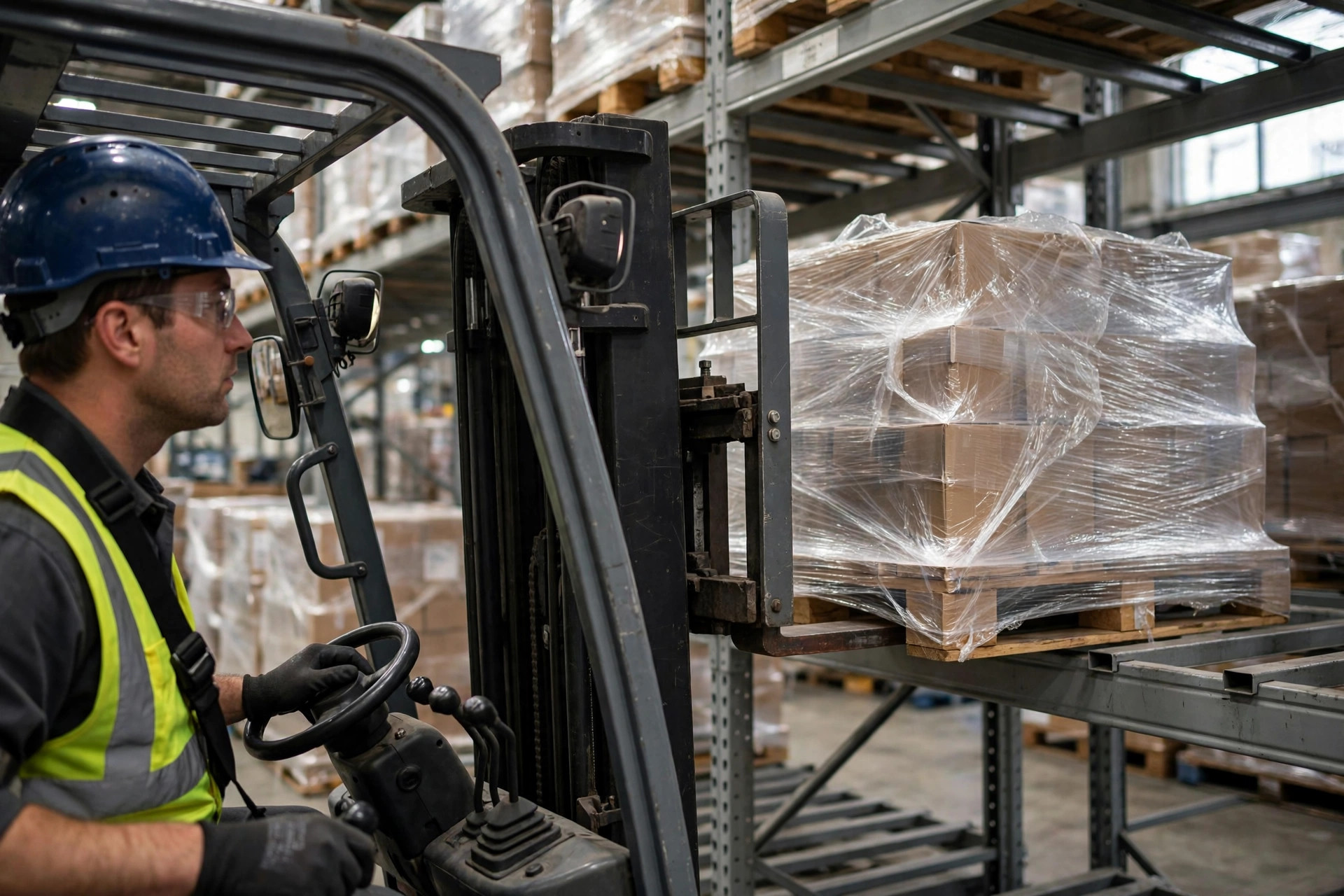
More important: strictly speaking, $20/pallet/month buys exactly one thing — a slot on the rack. No labor is included. From the moment your freight comes off the truck, every human touch after that is billed separately.
What the $20 Covers: The Slot, Nothing More
To be fair to the 3PLs, the included part is real. That $20 buys:
- Occupancy of one standard pallet position (usually rated for a 48"×40" pallet with a height limit)
- The facility's fixed-cost allocation: rent, insurance, security, climate control
- Basic inventory system record — your freight exists somewhere in the WMS
That's it. Everything that happens to your freight after it lands is an accessorial charge.
What the $20 Doesn't Cover: Where the Real Invoice Lives
The usual exclusions on a 3PL rate card, ranked by how often they surprise people:
- Receiving: ~$8.75/pallet (industry average). Unloading, counting, inspecting, putaway — all in this one motion. Note it's charged per inbound event, not per month. Fast-turn freight amortizes it thin; freight that sits still never pays it.
- Labeling / special handling: FNSKU labeling, repacking, stretch-wrapping, QC — usually billed per unit or per pallet on top. Check the current rate card.
- Long-term storage surcharge: Nearly half of 3PLs charge extra for stagnant inventory. The common trigger is 180 days in storage (some use 90), adding roughly $10–15/pallet/month after that. Check the rate card.
- Insurance: Cargo insurance is typically excluded, billed as a percentage of goods value or left for you to carry yourself.
- Account fees / monthly minimums: The average monthly minimum runs about $752 — if your storage plus handling doesn't reach it, you pay it anyway. This is where small sellers bleed without noticing.
Back to that Dallas seller: of the $1,830 above his $4,000 storage line, not a dollar was a junk fee. It was all exclusions he never modeled. The money wasn't stolen. It was mispredicted.
Case Study: The Cheapest Quote Cost the Most
In Q2 2025, a seasonal-toy seller in Ontario, California asked me to review three quotes: 150 pallets, ambient, about 30 inbound pallets a month, 90-day average turn.
| Warehouse A | Warehouse B | Warehouse C | |
|---|---|---|---|
| Storage | $18/pallet/mo | $22/pallet/mo | $25/pallet/mo |
| Receiving | $12/pallet | $7.50/pallet | $8.75/pallet |
| Long-term surcharge | $12/pallet/mo (after 90 days) | None (within 180 days) | $10/pallet/mo (after 180 days) |
| Monthly minimum | $500 | $752 | $1,000 |
His first instinct: take A. Four dollars cheaper per pallet — $7,200 a year in savings.
I made him run the full-year math, including receiving and the surcharge. 150 pallets, 30 inbound pallets a month (360 receiving events a year), roughly a third of inventory aging past 90 days (seasonal stocking):
- A: storage 150×18×12 = $32,400; receiving 360×12 = $4,320; surcharge 50 pallets×12×9 months = $5,400; total ~$42,120
- B: storage 150×22×12 = $39,600; receiving 360×7.50 = $2,700; surcharge $0; total ~$42,300
- C: storage 150×25×12 = $45,000; receiving 360×8.75 = $3,150; surcharge ~$0 (90-day turn never hits the 180-day trigger); total ~$48,150
A and B came out nearly identical — A saved less than two hundred dollars for the year, despite looking 17% cheaper per pallet on paper. The storage line rate is the most visible and least informative number on a 3PL quote. Total cost is decided by your turn velocity matched against their fee structure. Fast-turn sellers are receiving-fee sensitive; slow-turn sellers are surcharge sensitive. There is no cheapest 3PL — only the 3PL whose fee structure fits your velocity.
The Counterintuitive One: Clearing Slow Movers at 30% Off Beats Keeping Them
This is the math I see sellers get wrong most often. Product won't move, they won't mark it down: "it's only twenty bucks a month to keep it."
One stagnant pallet for a year: storage $20×12 = $240; after 180 days, the surcharge at ~$10–15/pallet/month adds another $120–180. Total $360–420 a year — before cost of capital.
Now say that pallet holds $800 of goods. Clear it at 30% off and you lose $240. Keep it a year and you lose $360–420, and it'll be even harder to sell next year.
Clearance loss is certain and one-time; stagnation loss compounds monthly. Finance always picks the former. Most sellers know this and can't pull the trigger — that's emotion, not arithmetic.
Three Levers That Actually Move the Number
1. Push turn days down — the biggest lever by far. The surcharge trigger (90 vs 180 days) directly sets your dead-stock cost. Ask before signing, and set an internal red line: anything unmoved at day 75 goes into clearance.
2. The pallet-vs-bin breakeven. If your pallet really holds only 3 bins' worth of product, a $20 pallet slot costs you $6.67/bin; if bin storage quotes at $8/bin, the pallet still wins. But at 1–2 bins per pallet, bins win. The formula: if actual bins per pallet < pallet monthly rate ÷ bin rate, use pallets; otherwise use bins. Small-parcel, high-SKU sellers should rerun this quarterly.
3. Negotiate the minimum and the receiving fee. The ~$752 average monthly minimum eats 10%+ of total cost for small sellers (under 50 pallets). Negotiate a ramp: half minimum for the first three months, full after volume lands. Receiving is the top negotiation target for fast-turn sellers — $8.75 vs $7.50 across 360 annual inbound pallets is a $450 swing.
The Calculable Conclusion
Stop asking "how much does it cost to store a pallet per month." Before you ask, fill in three numbers: your average turn days, monthly inbound pallets, and slow-mover share. Then:
True monthly cost/pallet = quoted storage + (monthly inbound pallets × receiving fee ÷ total pallets in storage) + (stagnant pallets × surcharge ÷ total pallets) + (monthly-minimum shortfall ÷ total pallets)
If the four lines sum past $30/pallet/month, your freight and that 3PL's fee structure don't fit — change warehouses or fix your velocity first. The $20 is an anchor. The invoice is the truth.
By Lao Zhou, Logistics Cost Analyst