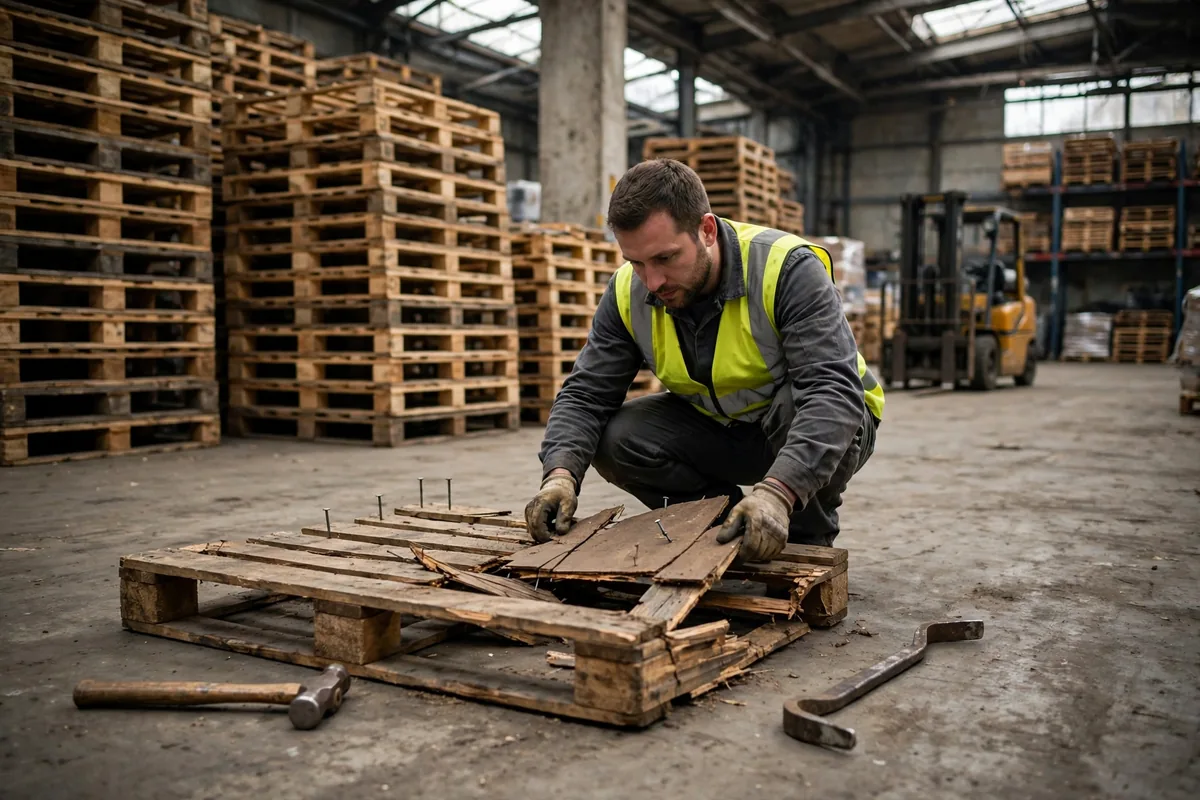
Let me tell you something. After fifteen years on the road, the thing I dread most is not traffic. It is a wood pallet repair done wrong — pulling into a warehouse, watching the forklift slide under a pallet, and hearing the bottom deck crack. One afternoon in the fall of 2023, at a cross-dock east of Los Angeles, I had a full load of household goods. The pallet looked fine from the outside, but two stringers underneath were already split. The forklift tines went in, the pallet came apart, and three cartons slid off and landed on their corners. The warehouse crew and I just looked at each other. Nobody said a word. In the end the shipper ate the loss.
A wood pallet costs next to nothing. A few dollars of lumber and nails. But when one fails, the damaged freight, the lost time, and the arguing afterward all cost far more than the pallet itself. Pallets get used every day and broken every day in a warehouse, and the wood pallet repair decision is usually made on gut feel: fix it if it is handy, toss it if it is not. Making that call on gut feel is the same as spending money on gut feel.
Sort the Damage Before You Decide Anything
In all my years watching this, pallet damage falls into three kinds, and each one gets a different answer. Do not lump them together.
The first kind is light damage: a split top board, a nail sticking up, a chipped corner. The load-bearing strength is untouched, the fix takes minutes — swap a board, hammer a nail — and the pallet goes straight back to work. Most broken pallets are in this group.
The second kind is medium damage: a cracked stringer, two broken bottom boards, a frame that has gone a little crooked. Whether this one can still be used depends on where the crack is. The stringer is the pallet's spine. Crack that and it is like a man with a broken back — the load rating drops by half on the spot. You can repair it by replacing the stringer and reinforcing the frame, but the repaired pallet will never carry what it used to. It gets downgraded to light freight. Heavy loads are out of the question.
The third kind is scrap: wood gone soft and rotten, mold, chemical soaking, or a frame broken into pieces. Forget repairing this one. It is a waste of time, and keeping it around is a hazard. I have seen a warehouse stack rotten pallets at the bottom of a pile to use as dunnage, and the damp wood stained the packaging of the whole layer above it. The entire batch had to be reworked. The saving cost them far more than new pallets ever would have.
The sorting step needs a rule in the warehouse: who judges, by what standard, and what label goes on the pallet afterward. Do not leave it to the forklift driver alone. He is in a hurry, and nine times out of ten his verdict will be "looks fine to me." Back when I ran with a trucking fleet, every pallet got a visual check on arrival — cracked, crooked, and rotten each went to its own pile with a different colored tag. No arguing, no guessing.
Wood Pallet Repair Cost Versus a New Pallet
When you work out the cost, do not look at the pallet alone. Count the labor and the time too. Every figure in this section is a hypothetical example, offered so you can run the comparison yourself — not a market quotation.
A standard new wood pallet runs about 15 to 20 dollars in the hypothetical example I am using here. A light repair — one top board, a few nails — costs about 3 to 5 dollars in parts and labor. That is worth fixing. A medium repair, replacing a stringer and reinforcing the frame, runs about 8 to 12 dollars, which is close to half the price of a new pallet. At that point you have to think: the repaired pallet carries less than it used to, so is it still worth it? A full refurbishment, tearing the pallet down and rebuilding it, runs about 12 to 15 dollars — basically the price of a new one, plus half an hour of a worker's time.
Here is my simple dividing line. If the repair costs more than half the price of a new pallet, scrap it and buy new. If it costs less than thirty percent, repair it. In between, look at the load rating: if the repair restores at least eighty percent of the original capacity, fix it; if it cannot, downgrade it; if nobody wants it even downgraded, throw it out. A warehouse with a large pallet pool can keep its own repair bench and fix broken pallets in batches, which spreads the labor cost thin. A small warehouse should not bother repairing at all — call a recycler who picks them up by the piece and be done with it.
There is one cost most people never count: broken pallets take up space. Hundreds of pallets waiting for repair pile up in a corner, blocking aisles and forcing forklifts to detour. That is real cost too. And a pallet that has sat unrepaired for more than two weeks is as good as scrapped — wood left sitting goes soft, and it only gets worth less the longer it waits.
Wood Pallet Repair or Scrap: A Bad Pallet Hurts Freight, and Worse, It Hurts People
Let me tell you, the scariest part of this is not the damaged freight. It is the injuries. A pallet breaks on a rack and several hundred kilos of freight come down, and that is no joke. I know a forklift driver who had a bottom board snap on him. Freight slid off from over a meter up and landed on his foot. Two broken toes, three months off work. The warehouse paid the medical bills, paid the lost wages, and shut the line down for an inspection. Add it all up and that one broken pallet cost enough to buy thousands of new ones.
So my rule is this: only the best-condition pallets go up on the racks. Ground stacking can take downgraded pallets, light freight can make do, but rack storage is non-negotiable. When a pallet fails at height, the person standing underneath has nowhere to go. Pallet condition should be on the safety checklist the same way the fire exits are — a must-check, not a maybe.
One more thing: mark the repaired pallets. How many times it has been repaired, what load rating it carries now — write it on the side or stick a label on it. Do not mix a repaired heavy-load pallet in with new ones. The forklift driver cannot tell them apart, he will load it like a new pallet, and sooner or later something gives. Labeling costs nothing. It is just a habit.
Pallet pooling and recycling channels are worth a word too. Plenty of places now have pallet recyclers who come to your door, pay by the piece for broken pallets, or trade them in against new ones. Do not throw broken pallets out as trash. Collect them and sell them — it is money back. If you run your own pallet pool, keep one ledger for circulation, repair, and scrap, and count it once a month. Pallets look insignificant, but over a year the repair-or-scrap decisions add up to real money.
There is an old saying that fits here: save money where it counts, but never save it on safety. A pallet that should be repaired, repair it. One that should be scrapped, scrap it. That moment of hesitation in between is usually the most expensive moment of all.
By Shifu Zhao, Trucking Veteran (15 yrs)