Bottom line first: wiring a floor scale into your WMS at receiving is the cheapest fraud detector I have ever implemented. One scale, a few days of integration work, and your suppliers stop shorting you on weight — because now every pallet leaves a record. If your receiving process is still "count the cartons, open a few at random," this one's for you.
Why the extra weighing step exists
In 2023, a 3PL warehouse in Dongguan that handles 3C accessories brought me in for a phase-two WMS optimization. The warehouse manager had a complaint he couldn't prove: one supplier of three years always shipped the right carton count on paper, but downstream customers kept reporting "two or three units missing per carton" — and the 3PL was eating the claims.
I had him pull that supplier's freight aside and run full pallets over the scale. The carton label said 12.5 kg per carton. The scale said 11.8 kg — 5.6% light. Looked like a one-off until we pulled three months of weighing records from the WMS: roughly 80% of that supplier's inbound batches were 4–6% underweight. At purchase cost, three months of missing product added up to a six-figure loss.
I've seen this exact movie three times, and the script never changes: the counts always reconcile, the weight is always a little light. The nasty thing about systematic short-weighting isn't a single incident — it's the pattern. Without a scale, it's just a feeling. With a scale, it's evidence.
Here's the counterintuitive part: spot checks cannot catch systematic short-weighting. Most people think "we open 5% of cartons, that's enough." Spot checks catch random errors — mispicks, damage, mixed batches. But systematic shorting is engineered: shave 5% off every carton, and as long as your sampling rate stays below a certain threshold, the supplier lives permanently inside your blind spot. The only defense against a systematic problem is systematic measurement — weigh everything, store every reading, let the WMS draw the deviation trend automatically.
What WMS scale integration actually connects
"Integration" sounds like an API project. It isn't — it's three layers, and each one has its own trap:
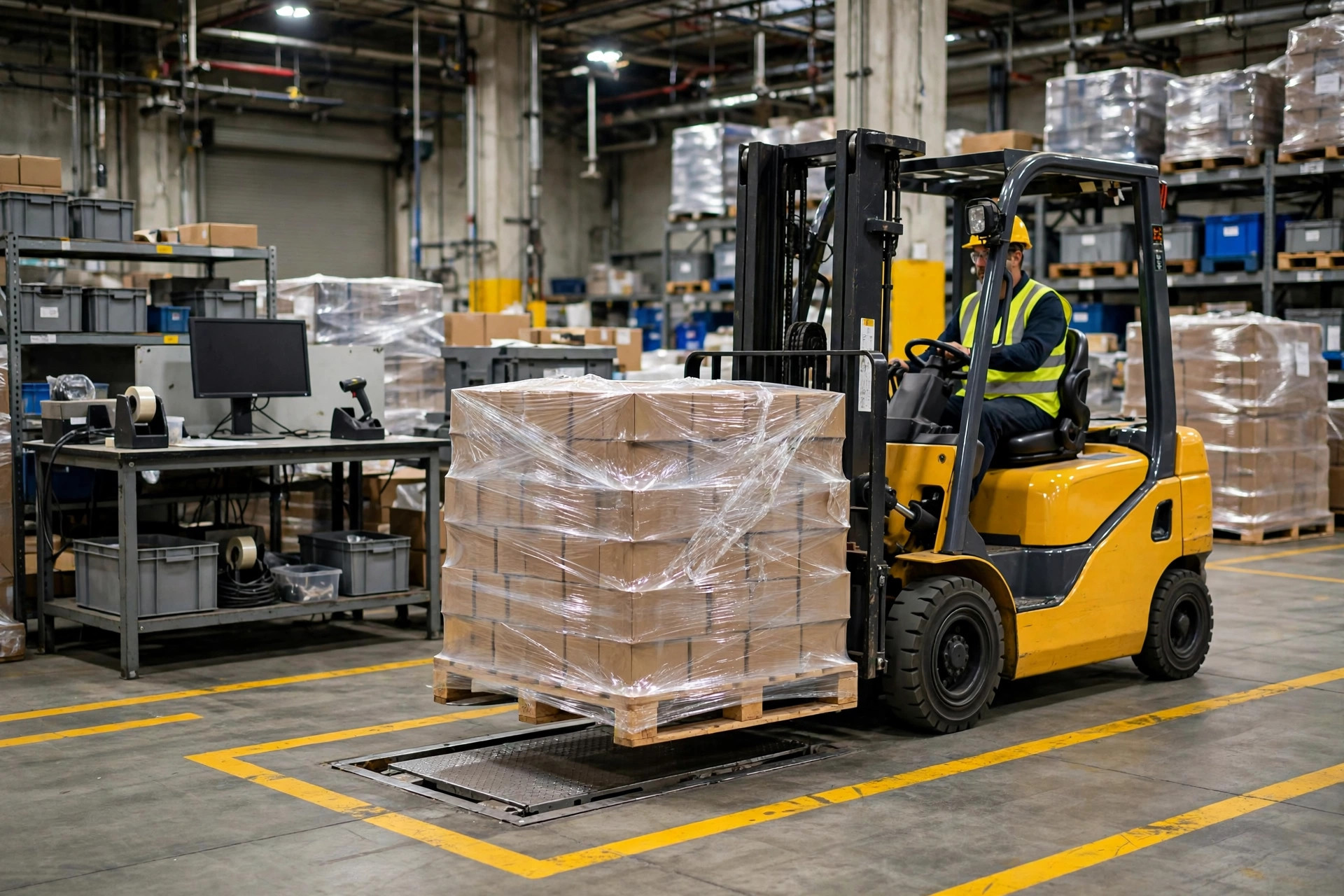
Layer 1: the hardware. Receiving areas typically use a floor scale (full pallets roll over it) or a bench scale (loose cartons, small parts). The scale body feeds a weighing indicator — the little box with the digital display. The weight data comes out of the indicator, not the scale. When selecting equipment, go by the nameplate and the calibration certificate for capacity and division size, not the sales rep's word of mouth.
Layer 2: the transport. The indicator sends weight data out two common ways: older units over RS-232 serial, newer ones over TCP/IP through a network port. For serial connections, verify baud rate and data bits against the indicator's manual, item by item — I've seen this fail three times, and nine times out of ten it's mismatched parameters, not a bad cable.
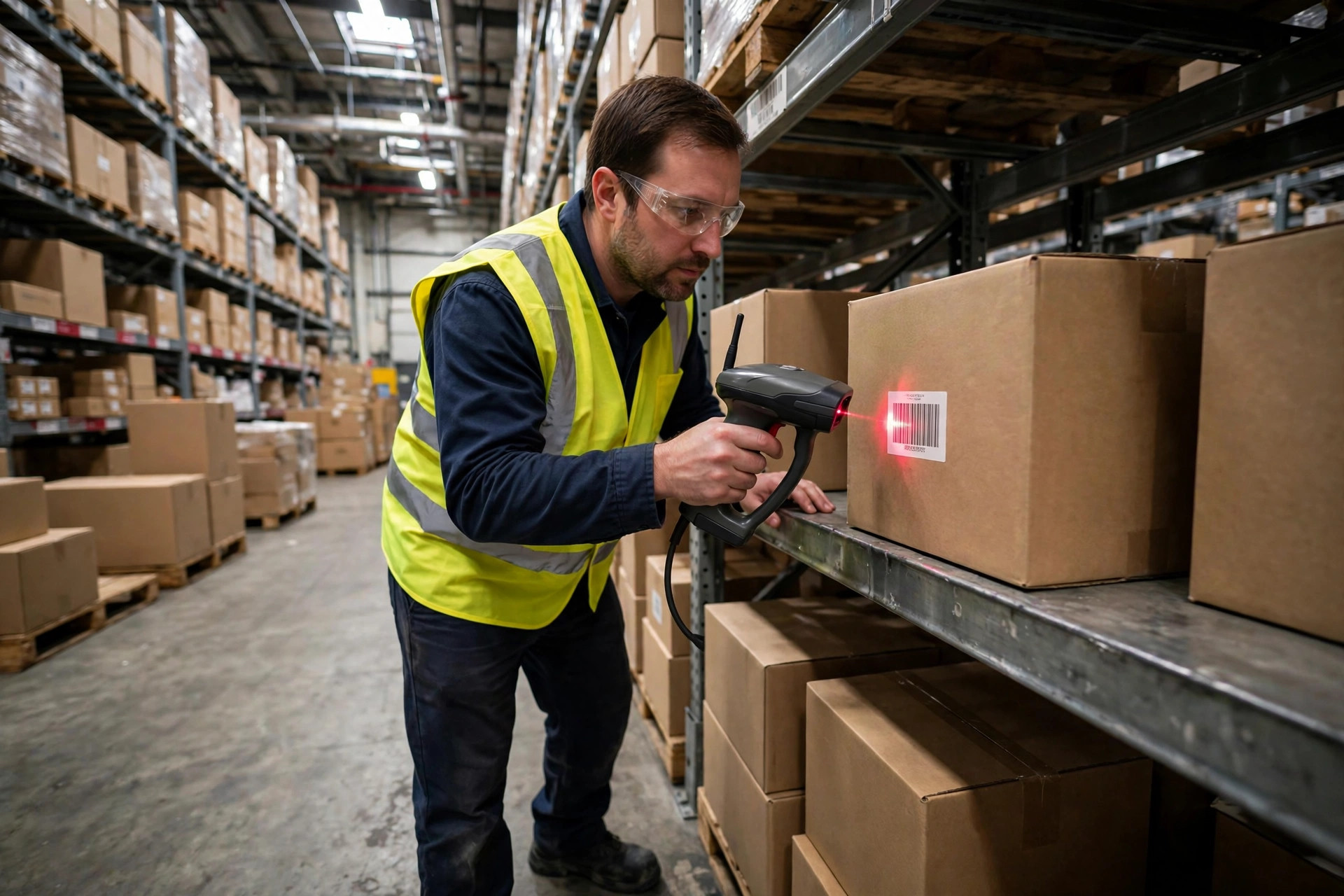
Layer 3: the WMS. The receiving line gets a new "actual weight" field. The flow: the receiver scans the pallet barcode → the WMS knows what the pallet should weigh (SKU master standard weight × quantity + pallet tare) → the scale reading writes back automatically → the WMS judges against tolerance rules: release, warn, or hold.
Tolerances that work: ±0.5% warning, ±2% hold
The integration itself is manual labor. The real engineering is in the tolerance rules — get them wrong and the scale is decoration. Here's a starting table I've validated across several projects:
| Actual vs. expected deviation | WMS action |
|---|---|
| Within ±0.5% | Auto-release |
| 0.5%–2% | Yellow warning, receiver confirms on the spot before release |
| Over ±2% | Full hold, move to quarantine, auto-notify purchasing and QC |
Treat this as a starting point, not a standard. Tolerances must be calibrated against two weeks of your own measured data: carton weight variation, product fill variation, and scale error stack up into your "natural fluctuation band." The rule lines have to sit outside that band, or you get false-alarm hell.
A food warehouse in Chengdu in 2024 is the cautionary tale. The project manager set ±0.3% by gut feel — while their own cartons varied ±1% in tare weight. During inbound peaks the scale screamed on every other pallet, the dock backed up with forklifts queuing, and the receivers eventually "muted" the alarm. An installed scale nobody listens to is the same as no scale. Remember: the hardest part of weighing isn't the integration, it's the tolerances. Too many false alarms and the floor will vote with their feet and bypass the system.
Two more details decide whether the whole thing is accurate:
- Tare weights must be measured, never guessed. Expected weight = standard weight × quantity + pallet tare. Never use folklore like "a wood pallet is 20 kg" — a moisture-absorbed wood pallet can swing 3–5 kg, and plastic vs. wood pallets are different worlds. The practice: build a tare file by pallet type, weigh 10 of each, take the average, re-weigh quarterly.
- Zero drift needs an owner. A forklift clips the scale, day-night temperature swings — a 2 kg zero drift is routine. After that, every pallet reads 2 kg heavy, and nobody on the floor can see it, and the WMS can't either. The practice: first thing every morning, zero the empty scale, and the WMS logs the zero check automatically. A day with no log gets escalated.
Failure modes I've seen three times
Expanding on those points, plus a few more crashes I watched happen in person:
First, weighing gross without deducting tare. One warehouse got the scale live but had no tare field in the WMS — gross weight compared directly against "standard weight × quantity." Every pallet read 20 kg over, warnings everywhere. Two weeks of rework to add the field and backfill the tare file.
Second, dirty standard-weight master data. The SKU standard weights were entered three years ago; the product changed packaging since, and each carton is now 0.4 kg heavier. The scale was right, the data was wrong, and the scale took the blame. Re-weigh your high-frequency SKUs before go-live — this is the most-skipped item on the pre-launch checklist.
Third, holds with no disposition process. The ±2% holds went into quarantine, but the SOP never said who dispositions them or within how many hours. Quarantine filled up for two weeks and ate the staging lanes. Every hold rule needs a disposition SLA: who owns it, closure within how many hours, who it escalates to. A hold with no closure loop is worse than no hold.
The math
A 3-ton floor scale plus indicator plus installation runs in the low tens of thousands of RMB in my project experience (get your own supplier quote); the WMS-side integration is roughly 3–5 person-days of development (have your own team estimate). That is the full payback profile of a WMS scale integration project. On the return side: the Dongguan case recovered a six-figure short-weight loss in one quarter. You can do that math yourself.
There's also a quieter return: deterrence. Suppliers who know every inbound pallet gets weighed — with deviation data stored automatically — simply stop shorting. One warehouse told me six months after go-live that the biggest change wasn't how much they'd caught, but that "we haven't caught anything since." That is the real ROI of this setup.
Pre-launch checklist: check all 7 before the scale goes live
The night before go-live, check these off one by one. Missing even one means the scale stays off:
- Pallet tare file built, measured data entered for every pallet type
- Tolerances calibrated against two weeks of measured data — no more gut-feel numbers
- Serial/TCP integration tested end-to-end, including disconnect-and-reconnect
- Morning empty-scale zeroing assigned to a named owner, zero logs recording cleanly
- Hold-and-quarantine SOP written: who dispositions, closure within how many hours, escalation path
- Weight data visible on the receiving screen — deviations readable at a glance
- High-frequency SKU standard weights re-weighed, master data clean
Seven checks, then go live. A WMS scale integration is technically simple — the hard part is turning every detail into an executable action. May your suppliers never dare short you again.
By Lin Xiao, WMS Implementation Consultant