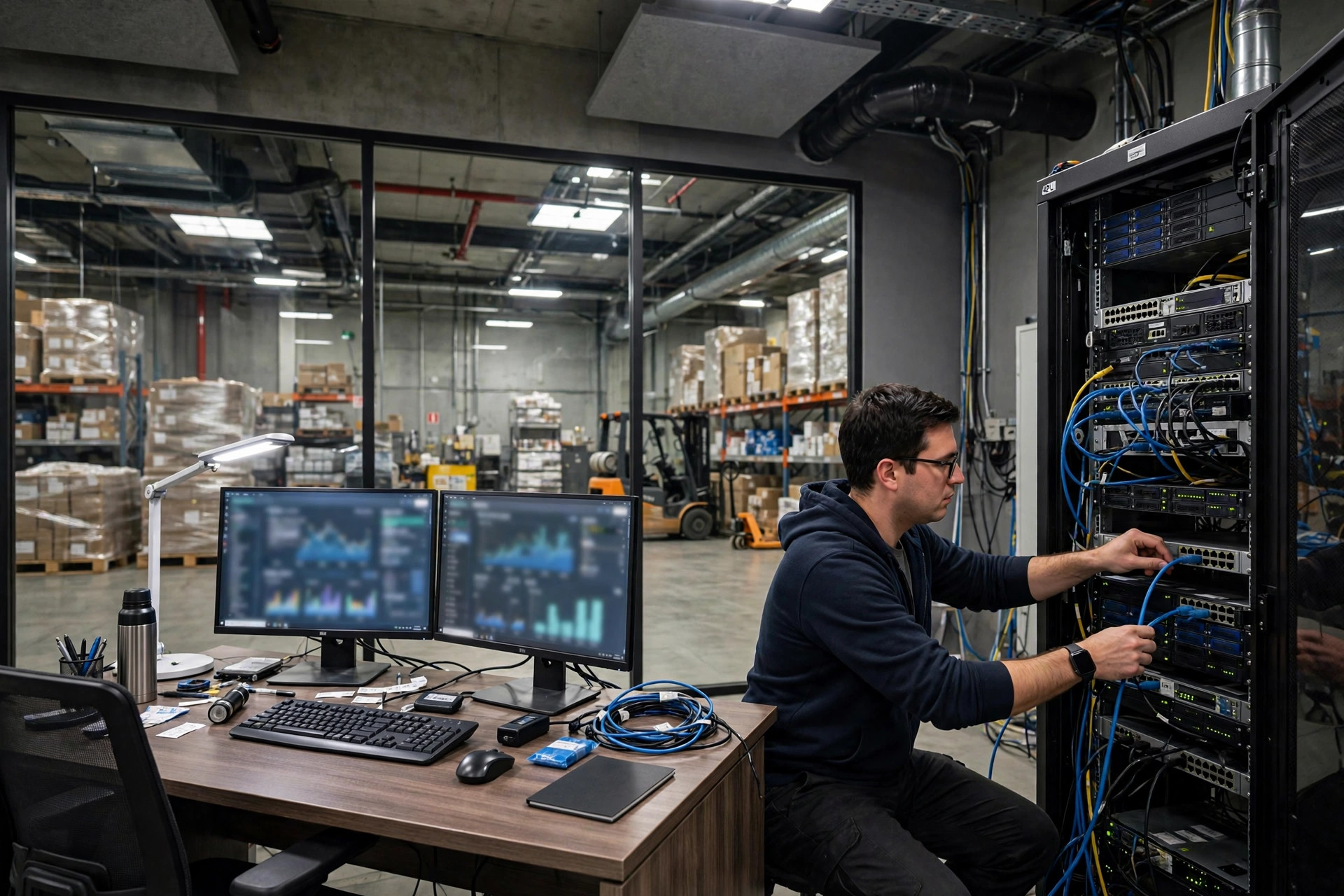
We had a client walk in last fall waving a WMS quote, convinced the WMS hidden costs were small. The license was only about $120,000 a year, he said. I laughed, because I have heard that sentence at least fifty times, and it has never once ended well. The license usually accounts for only 30% to 40% of a WMS project's first-year total cost. Implementation, integration, hardware, and training take up the other 60% to 70%, according to several 2026 industry cost analyses that land on the same split. You think you are buying software. What you are actually buying is a go-live project with a software license attached.
This client ran a 3PL outside Columbus, Ohio, two warehouses totalling about 300,000 square feet, mostly home goods for e-commerce sellers. The quote looked clean: $120,000 a year for the license, implementation "to be determined." He assumed that meant negotiable. It did, just not in his favor. Implementation came back at 1.5 times the first-year software fee, around $180,000, and that excluded integration. His eight-year-old ERP held every order, inventory record, and financial transaction; a WMS that cannot talk to it is an expensive shelf decoration. The vendor quoted integration from $60,000, with two custom endpoints priced separately. He looked at me and said, "Susan, I didn't buy a system. I adopted a dependent."
Crude, but accurate. Vendors understand quote logic better than buyers do: the license fee gets you to sign, while implementation, integration, and training fees are where the money is made. Software can be sold the same way a hundred times; implementation never can. Your workflows, your customers' requirements, your ERP version, your layout — all specific to you, and somebody has to sit in your building, map your processes, configure the system, and test it until it works. Those hours cannot be discounted the way a license can.
Implementation Fees: The WMS Hidden Costs That Grow After You Sign
We had a client in Memphis, Tennessee, a food distributor with cold storage, who signed an implementation estimate of $100,000. Three months in, the bill was $190,000. Nothing shady happened. The contract said "standard implementation scope," and three requirements fell outside it: multi-temperature zone management, FEFO picking by expiry date, and one large customer's special pick rule. Each became a change request, billed at the industry-common $150 to $250 per hour. One change can run into thousands of dollars before anyone notices.
The commonly cited range is wide for a reason: implementation services typically run 0.5 to 2 times the first-year software fee, and mid-market projects commonly cost $100,000 to $350,000. That spread is the negotiation space. My advice is blunt: before you sign, make the vendor produce an implementation scope list, item by item. What is standard, what costs extra, and at what rate — all of it in writing. A verbal "everything is included" next to a contractual "standard scope" is where every implementation argument I have ever mediated was born.
Here is the counterintuitive part: the harder you cut the implementation fee, the more expensive go-live usually becomes. I watched a buyer negotiate implementation from $200,000 down to $80,000 and celebrate. The vendor sent a junior consultant who had never run a go-live, the processes were never properly mapped, training was thin, and in the first week the mis-pick rate doubled. Claims and overtime wiped out the $120,000 he had "saved" within a month. Cheap implementation is not a bargain. It is a loan with terrible terms, repaid in errors.
Integration Fees: One Endpoint Can Eat Half a Year's Budget
Integration is the cost buyers underestimate most, because they count it wrong. Most buyers hear "WMS to ERP integration" and picture one connection. In reality it is a chain: orders down, inventory back, receipts confirmed, shipments acknowledged, billing reconciled. Every link costs money. The commonly cited range for a mid-market project is $60,000 to $250,000 for WMS-to-ERP integration, and a single custom endpoint runs $30,000 to $80,000.
We had a client in Dallas who needed three connections: his ERP, a marketplace platform, and one large customer's system. The quote listed one "standard ERP interface" at $40,000 and marked the other two "to be assessed." The assessment came back at $50,000 for the marketplace, whose order structure was unusual, and $70,000 for the customer system. He asked whether he could skip them. I said yes, if he wanted two people keying orders by hand every day. Two hundred orders a day, manual entry, mistakes included — the labor cost passes the integration fee within a year. That is the trade-off: the fee is one-time, the manual workaround bleeds every day.
When I negotiate integration, I insist on three sentences in the contract: the interface list, endpoint by endpoint, with the data fields each carries; whether each interface is fixed-price or time-and-materials, and the cap; and who owns the problem when an interface breaks, and how fast they respond. Vendors dread the third question, because the most common post-launch argument is "it's your ERP's fault" versus "it's your WMS's fault" — and while the two sides argue, your warehouse stands still.
Training Fees: The WMS Hidden Costs You Repay Double Later
The third bucket is training and go-live support, and it is the one buyers cut first, on themselves. Why pay tens of thousands for training when people can read the manual? Then go-live week arrives, the night-shift supervisor cannot clear an exception order, pickers do not know how to handle a short pick, and customer service cannot answer a single caller question. The vendor sends someone to fight the fire, billed by the hour, at a rate that makes the training quote look generous.
Training itself has no single published price range, because it depends on headcount, sessions, and on-site days. But two related numbers are well documented. Annual maintenance for an on-premise deployment typically runs 18% to 22% of the license fee, and if a SaaS contract does not cap the annual increase, 7% to 10% a year is common. Negotiate neither at signing, and at renewal the vendor sets the number. I had a client whose renewal jumped 9% in year three, more than $10,000 extra a year — over three years, enough to have paid for the training he skipped.
My approach to training is to buy outcomes, not sessions. The contract should name which roles get trained, how many people per role, the pass standard, how many days of on-site go-live support are included, and which hours it covers. And the exit standard has to be written down: not "we leave two weeks after go-live," but "we leave when the error rate stays below the agreed threshold for three consecutive days." If it is not written down, the vendor leaves on schedule and you hold the mess.
| Cost bucket | What the quote usually says | Commonly cited industry range | What to pin down before signing |
|---|---|---|---|
| Implementation | "To be determined" or "standard implementation" | 0.5–2x first-year software fee; mid-market projects $100,000–$350,000 | Scope list, change-request rate, deliverables and on-site days |
| Integration | One "standard ERP interface" price | WMS–ERP integration $60,000–$250,000; custom endpoint $30,000–$80,000 each | Full interface list, fixed vs. time-and-materials, cap, break-fix ownership |
| Training and go-live support | "Basic training included" | No single published range; priced by headcount and on-site days | Roles and headcount, pass standard, support hours, exit criteria |
| Renewal costs | Often not mentioned | On-premise maintenance 18%–22% of license; uncapped SaaS increases commonly 7%–10% a year | Increase cap, what maintenance actually covers |
Run that table against your vendor's quote, line by line. Whatever you cannot check off is what you still need to negotiate.
Here is the uncomfortable truth about WMS hidden costs: choosing a system by comparing license fees is like choosing a car by comparing the price of the steering wheel. The license is 30% to 40% of the first-year total. Win the negotiation on that 30% and you can still lose the project on the 60% to 70% you never examined.
So before your next contract conversation, ask these three questions. First, where is the implementation scope list, and what rate applies to anything not on it? Second, how many endpoints are we buying, fixed price or time-and-materials, and what is the cap? Third, who gets trained, what counts as trained, and is the annual increase capped? Ask those three, and the vendor will know you have bought a system before.
By Susan, 3PL Sales Director