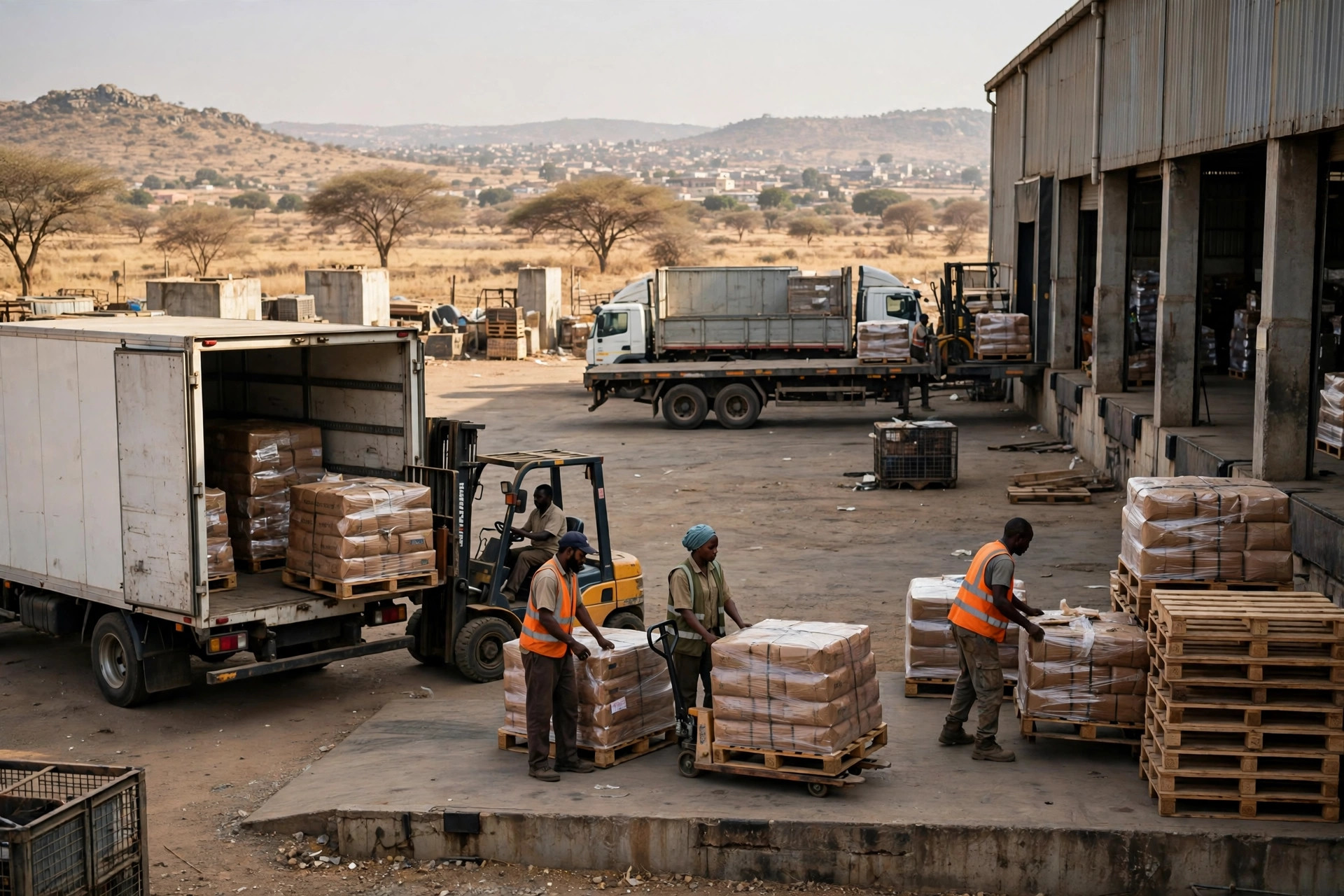
It was half past four in the morning, and the wind in Windhoek was still cold. I stood at the warehouse door and watched the last night-shift truck back into the dock. The driver tapped his horn twice. That meant he was in. The night-shift lead rubbed his eyes and told me the crew was complete, except that two new hands had started yesterday and still needed someone beside them.
To be honest, that is my first impression of the Windhoek warehouse market. The city is not huge, and the pace is not frantic, but every decision has to be worked out by hand. This is an inland capital. Nothing arrives by sea directly. Freight comes in through a port, then travels overland. That structure decides almost every warehousing trade-off here.
The Windhoek warehouse market starts with the city's position
Windhoek is the capital, and it is also an inland distribution point. Cargo lands at Walvis Bay and moves inland, while other freight comes up from the south and then heads north again. Local consumption alone is only so big. A warehouse here cannot just serve the city. The real question is whether your building serves local customers, or whether it works as a transit point.
Get that answer wrong, and everything after it goes wrong too. A local delivery warehouse can be smaller and sit close to the city and the main roads. A transit warehouse has to take big trucks, hold stock for a while, and break bulk without blocking the yard. The rosters for those two jobs do not look the same.
I have seen a colleague rent a place that looked cheap on paper. Trucks had to loop around to get in, and drivers hated the trip. When peak season arrived, trucks queued, unloading hands ran short, and the customer's phone calls never stopped. A cheap warehouse can turn out expensive in time.
A few years ago, a customer wanted a site very close to the city centre. The location looked good, but trucks could only come in through one narrow road. I walked the site and told him straight: in daytime traffic, unloading would queue, and peak season would jam it solid. He moved to a suburban site where trucks could turn around and three trucks could sit at the docks at once. The whole rhythm changed for the better.
The Windhoek warehouse market has three routes: port corridor, suburbs, and southern distribution
Start with the Walvis Bay corridor. This route is straightforward, a main line between the port and the inland capital. For people doing inland distribution, that feels reassuring. The weakness is just as real: when most freight uses one line, a busy port or a blocked road throws the whole schedule off. Customs and paperwork requirements change, so check the official sources for the latest policy rather than trusting old habits.
Then there is the suburban warehouse. Land is easier to find out there, trucks get in and out cleanly, and the building can be bigger. It suits fast-moving stock and works well as a starting point for city deliveries. The drawback is distance from city customers, so last-mile runs have to be scheduled tightly, or customers will feel the delay.
The third route is distribution into southern Africa. Freight moves south and east across borders from here. Volumes are not always large, but the chain is long. Before choosing it, ask a plain question: does this freight really need to transit here, or would a direct route from the port direction run more smoothly? Every extra transfer adds handling, and handling adds damage and error risk.
None of the three routes is good by nature. I keep a simple decision table on the office wall.
| Direction | Suits | Watch out for | Ask yourself first |
|---|---|---|---|
| Walvis Bay corridor | Imports bound for inland distribution | One busy line, schedule disruption | Can the freight wait? |
| Suburban warehouse | City delivery, fast-moving stock | Last-mile runs too thin | Are there enough runs? |
| Southern distribution | Cross-border transit, bulk break-up | A long chain, many handoffs | Must it transit here? |
The table is simple, and it works. When a new customer comes to talk, I fit their freight into the table first. If it does not fit, I do not rush to take the job.
Staffing a suburban warehouse, and keeping people
Here is a true story. Last peak season, our suburban warehouse took two jobs that landed at the same time. The night shift had a dozen or so people rostered, then two called in sick and one veteran had to step in as night lead. That night I argued with a driver. It was not a big fight. The truck's arrival time and our unloading hands just did not line up. He said he had waited too long. We said hands had only just been reshuffled. Afterward I bought him a coffee, and we worked together normally the next day.
That night changed how I roster. In peak season I never roster every person to the limit. I always keep one flexible slot open. Veterans do not mentor one newcomer each. One veteran takes two newcomers, and the pairing rotates after three days. Newcomers learn faster, and no veteran carries the whole floor alone.
Handover matters just as much. Before the morning shift arrives, the night lead writes three lines on the whiteboard: how many trucks arrived, how much was unloaded, and what is still unfinished. Ugly handwriting is fine. Correct numbers are not optional. The morning lead reads the board first, then walks the dock. What your eyes see beats what you hear on the phone.
There is one more rule I value most: people who worked the night shift do not get called back for daytime overtime the next day. It looks like fewer hours worked. In practice, it keeps people. In warehousing, when someone leaves, recruiting and retraining costs far more than those hours.
Peak season has another trick, and it is about drivers. Agree the basics before the truck moves: what time it arrives, how long unloading takes, and who to call if waiting drags on. Say those three things early, and a delayed driver knows who to call instead of arguing at the gate. Drivers are not outsiders. Half of on-time departure depends on them. Treat them as part of the team, and night shifts in peak season get much easier.
What belongs here, and what should stay away
Three kinds of freight belong here, in my view. The first is freight for Namibian consumers, where Windhoek itself is the main market, so the warehouse sits close to demand. The second is freight heading inland or into neighbouring markets, where Windhoek makes sense as a transit point. The third is freight that can live with overland rhythm and does not demand extreme speed, so the warehouse can act as a buffer.
The cases to avoid are just as clear. One is small-volume freight that still demands same-day speed everywhere, because an inland warehouse rhythm cannot support that promise. Another is freight with strict temperature control or special permits: check local compliance and supporting services before renting anything, not after. The third is freight that comes only because rent looks cheap. Rent is one line on the account. Trucks, labour, waiting time, and rework are all lines too.
One more thing customers often miss: in the warehouse, keep local stock and transit stock apart. Mixed together, pickers under pressure grab the wrong batch. Separate them, label them clearly, and remember that one rework costs more than a few extra steps.
Here is a counterintuitive judgement, and not everyone likes hearing it: in Windhoek, a bigger warehouse is not automatically an advantage. A big building with stock half full still carries heavy labour and management overhead. A small warehouse that runs smoothly, then expands, is steadier than renting big on day one. That is how we run our warehouse now: get it running right, then talk about size.
So here is my reminder to fellow operators: before you come, draw the freight flow, roster the people and trucks, and only then look at the building. Reverse that order, and even a good building becomes trouble you made for yourself.
By Chen Feng, Warehouse Operations Manager