
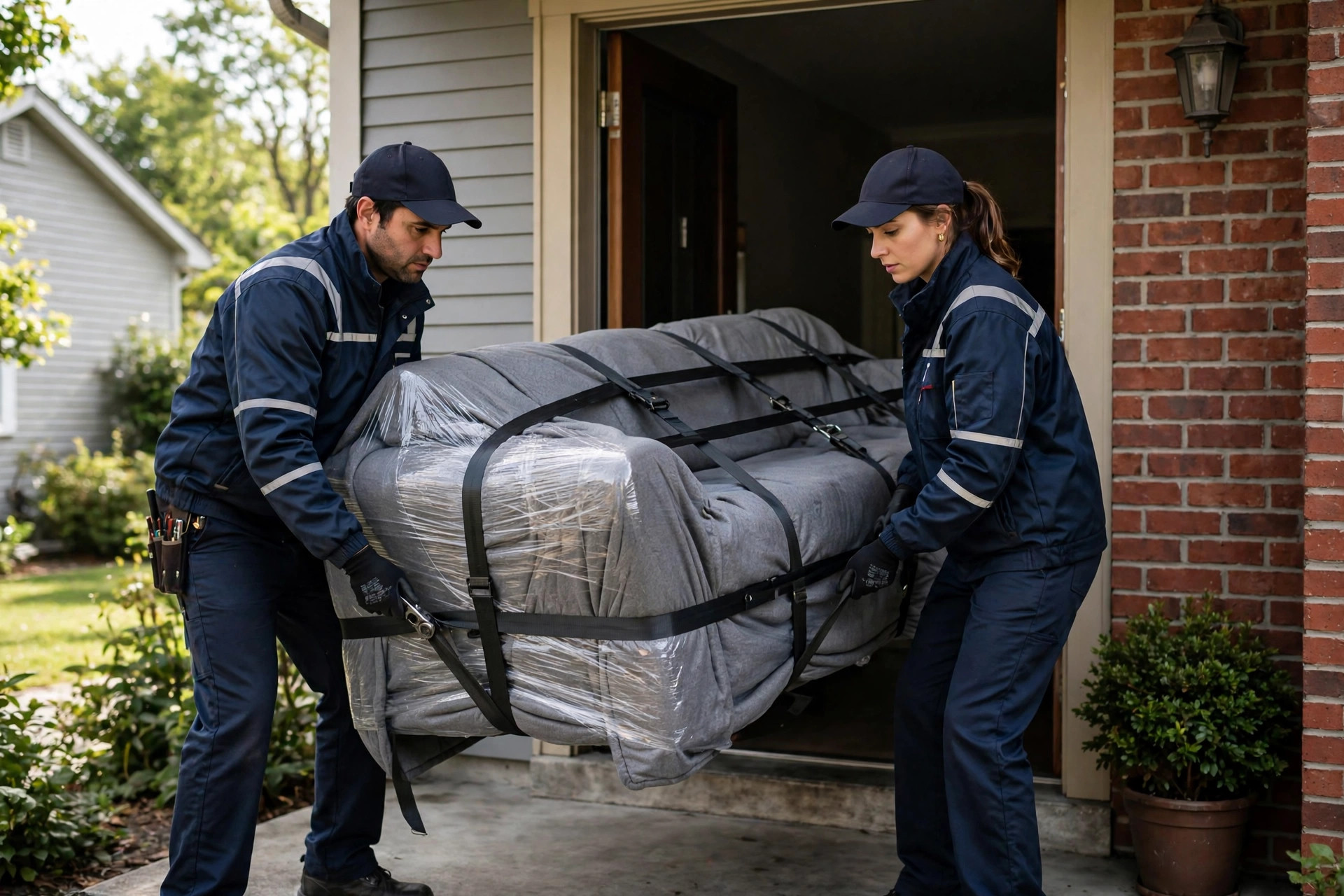
We had a client, a solid-wood furniture maker from Shenzhen, entering the US market in early 2024. First 200 orders went out via standard LTL final mile — dropped at the driveway, driver honks and leaves. One month later: 17 one-star reviews, all reading "left at my door, how is a woman supposed to carry an 80-kilo dining table upstairs alone?" Return rate hit 9%. The owner asked me: what exactly are we paying for with white glove delivery, and is it worth it?
Start with how the vendor prices it. White glove and standard final mile are two different businesses. Standard LTL sells displacement: move freight from A to B. White glove sells the delivery experience: appointment scheduling, two-person carry upstairs, unpacking, installation and room placement, packaging removal. On a $300 sofa, a $100-150 white glove fee is normal — every shipper's first reaction is sticker shock, "the freight costs more than my margin."
But that's the wrong math. I had the client run the other number: the cost of one return. An 80-kilo dining table coming back costs $60-90 in reverse freight, $20 for inbound inspection and repacking, and ~15% off on resale. One return burns $150. At a 9% return rate on 200 orders, that's 18 returns — $2,700 gone. White glove drove returns under 2%, and the savings covered the freight increase. That's the line the vendor's quote will never show you, and the math the shipper has to do alone.
Inside the White Glove Quote: Where the Money Goes
| Cost item | Share | Negotiation room |
|---|---|---|
| Linehaul + local transfer | 30-35% | Small, fixed lanes |
| Two-person carry upstairs | 25-30% | Medium — "deliver only, no install" tier |
| Installation & placement | 10-15% | Large — simple installs can go |
| Appointment & customer service | 8-10% | Small, system cost |
| Packaging removal | 5-8% | Large — optional |
| Damage reserve | 5% | None, industry standard |
Read that table and you have leverage. Three moves that actually work:
First, tier the service. Not every SKU needs the full treatment. Simple assembly (bed frames, bookshelves): negotiate "upstairs delivery + unpack and place, no installation" and cut 15-20%. Reserve the full package for complex installs (power recliners, vanities with plumbing).
Second, consolidate by zone. White glove's biggest cost is the empty return — a truck rolling for one stop. Negotiate "two fixed delivery days per week, batched routing" and cut per-order cost 10%+. The price is 1-2 days slower transit; set the expectation with buyers upfront.
Third, bet on the damage rate. Write "damage rate above 1.5%, vendor covers the excess" into the contract. If the vendor signs, they trust their operation; if they won't, you know where the padding is.
Three Ways to Buy White Glove: Carrier, Specialist, or Hybrid
Option one: sign a regional white glove carrier. Pros: stable service, insured. Cons: minimums — many require 50+ orders a month, out of reach for small sellers. Fits furniture sellers doing 200+ orders a month.
Option two: white glove as an add-on from your LTL carrier. Most big carriers offer it on the final-mile order. Pros: one vendor, systems already integrated. Cons: 20-30% more expensive, and installation is usually subcontracted to local crews, so quality varies by market. Fits sellers already on LTL who want to test the water.
Option three: linehaul yourself plus a local install crew. LTL linehaul to a local warehouse, last mile by a local furniture-installation team. Cheapest — 30%+ below specialists — but you manage two parties, and damage disputes get ugly. Fits sellers with a local warehouse and steady volume.
My Shenzhen client went with option two first: three months on the carrier's white glove add-on, returns fell from 9% to 3.5%, model validated — then signed an annual contract under option one and cut another 12% per order. The path is "validate first, lock price second." Never sign long-term on day one.
One more trap: the appointment step. Carriers typically call the buyer 1-2 days ahead; a missed appointment costs $30-50 for the second trip. Whose P&L eats that must be in the contract. Default is the seller, but push for "first miss on the carrier" — the more mature their dispatch system, the more likely they accept.

Counterintuitive: White Glove Isn't a Cost, It's a Conversion Tool
Most sellers file white glove under "logistics cost." Wrong drawer. It's a conversion cost. In furniture, putting "free white glove delivery with installation" on the listing moves conversion for real — my Shenzhen client added white glove plus the listing badge and went from 1.1% to 1.7% conversion in three months. At a $400 average order, 0.6 points means 40-plus extra orders a month, $8,000 more gross margin. The freight increase is noise next to that.
Not every category qualifies. My line: over 30 kilos per piece, or needs installation, or over $250 average order — hit one of the three and white glove is worth a conversation. Hit none, stick with standard parcel or LTL and don't burn cash.
Next contract negotiation, ask these three: (1) can we tier the service — which SKUs can drop a tier? (2) batched zone delivery — how much per order? (3) will you put the damage-rate bet in the contract? Three questions and the padding comes right out.
By Susan, 3PL Sales Director


