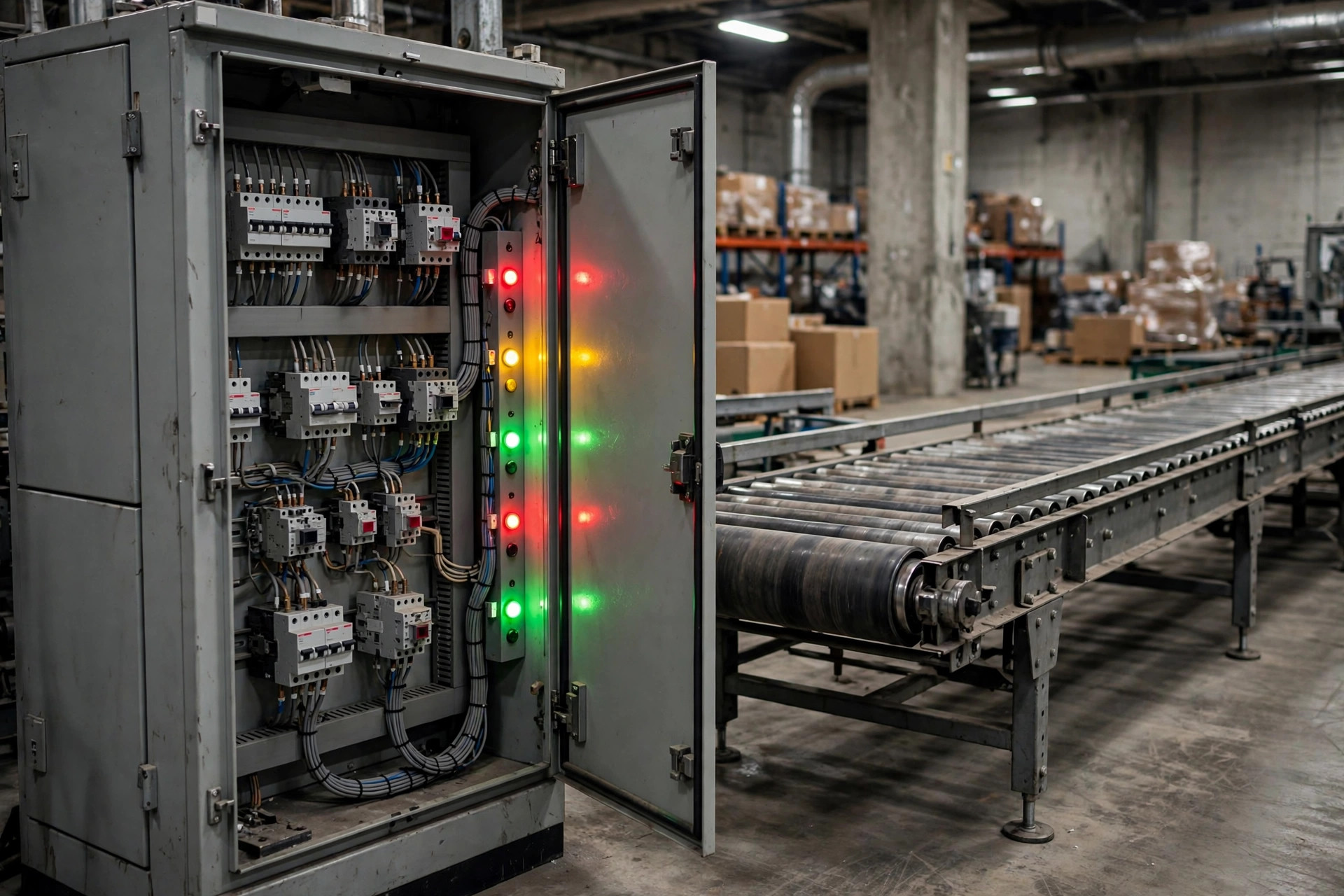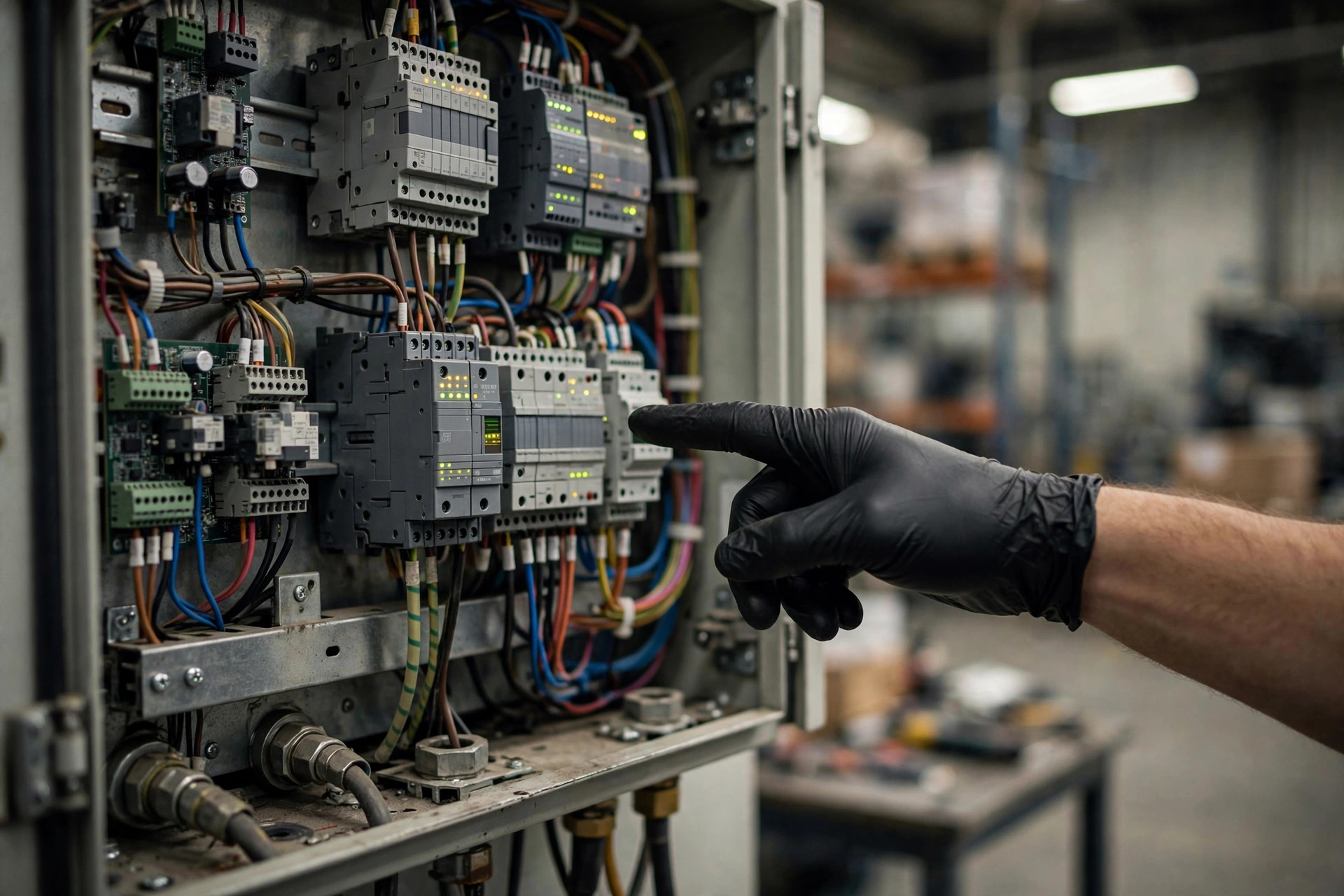
It's 3:12 in the morning. Your phone buzzes three times on the nightstand. WCS alarm: conveyor section 7 e-stop. The entire outbound line is down.
Do you get dressed and drive to the warehouse, or roll over and go back to sleep?
There is no universal answer to that question. But whether you sorted your alarms into tiers before that night ever came is what separates a rested on-call tech from one who wakes up three times a night. I've seen too many warehouses where the WCS alarm strategy for year one was "send everything, ring for everything." You know how that ends? The on-call tech's phone goes off a dozen times a night, and three months later he's blocked every unknown number — and then one night something genuinely breaks, the line sits dead for four hours, and nobody knows.
Back in 2023 I was on a project at a 3PL in Ontario, California — about 120,000 square feet, full conveyor and sortation automation. Their night shift was getting over 400 WCS alarms a month. Fewer than 10 of those actually needed someone at 3 a.m. We spent three weeks going through the alarm list line by line, three passes, and sorted everything into three tiers. Night-shift calls dropped to one or two a night. The shift supervisor told me it was the first full night of sleep he'd had in weeks.
The system isn't complicated. Every rule in it was earned the hard way.
Alarms only die three ways: the line stops, the line limps, or nobody needs to know yet
Don't build five or six tiers. Nobody can tell them apart at 3 a.m. Three is enough:
L1 — Shutdown: the line is down, get on site. Full line stoppage, outbound waves at risk, anything safety-related (e-stops, safety doors, light curtains). For these, the on-call tech is on site within 15 minutes. Note I said on site, not "returns the call." You can't fix a conveyor over the phone.
L2 — Slowdown: the line limps, handle it remotely if you can. A conveyor section running derated, a scanner's read rate dropping, a sortation chute filling up and needing manual attention. These go out as a text first. The tech remotes in, tries a restart, and only drives over if that fails. Response window stretches to an hour, and it must be closed out at shift handover.
L3 — Warning: log it, look at it in daylight. Sensor drift warnings, a motor running warm but still within limits, a one-off comms packet drop. These go into the system log. No text, no call. The day-shift equipment lead spends ten minutes each morning scanning them.
How do you decide which tier an alarm belongs in? I use three questions. If an alarm can answer all three clearly, you know where it lives:
One — when this alarm fires, is the line down? If yes, it's L1, no debate. Two — can it recover on its own? A scanner misread sometimes clears itself on the next carton. Anything self-healing is L2 at most. Three — will waiting until day shift cause real damage? If not, it's L3.
The boundaries are the hard part. My rule of thumb: when in doubt, park it at L2 and let a month of data decide. And keep the L1 list short. If a warehouse has more than 20 L1 alarms, the bar is set too loose — which is the same as having no tiers at all.
The phone always rings the person sleeping deepest
Tiers are step one. Step two is the escalation chain, and the whole philosophy fits in one sentence: the higher the tier, the harder it tries to wake someone up.
L1: phone call immediately, with a text as backup. No answer in 3 minutes, it auto-dials the second contact — the shift manager. L2: text first; no acknowledgment in 30 minutes and it escalates to an L1-style call. L3: disturbs nobody, log only.
The on-call rotation has to actually rotate — weekly, posted on the control room wall. Don't do "Dave owns the equipment so it's always Dave." Dave needs sleep too. The rotation sheet should also list the second contact and the systems integrator's 24-hour support number. I've watched people dig through their contacts for the integrator's number at 2 a.m. too many times.

Here's the big trap: never set every alarm to ring the phone. I worked with one site that took the lazy route — 200-plus WCS alarms, all tied to phone calls. The tech answered the first week. By month two the phone was on Do Not Disturb. By month three he'd changed his number. The first law of alarm strategy is trust: every single thing that rings has to deserve being woken up for, or people stop answering.
One more detail: write the text message like a human. "WCS ALM-4127 SEG-07 ESTOP" means nothing to a half-asleep brain at 3 a.m. Rewrite it as: "Section 7 conveyor e-stop, full line down, L1, please come in." A few extra words saves three rounds of "wait, which alarm was that?"
Bad tiers are worse than no tiers
Tiers aren't set-and-forget. Equipment ages, processes change — what was L2 last year might be L1 this year. My habit is a 30-minute alarm review every month, three people: the shift manager, the equipment lead, and whoever owns the project. Fixed agenda: was every L1 last month genuinely an L1? Any L2s that should move up? Any L3 that fired three times in a row — because a repeating L3 is a trend, and trends get promoted to L2.
False-alarm discipline is the other half of the job. The most common way tiers die is false alarms eating away trust in L1. Say a photoeye is misaligned and trips an e-stop on every odd-shaped carton — eight times a night, all false. Is the tech getting up the ninth time? No. So the rule: any alarm that false-fires more than 3 times in a week gets downgraded and a corrective work order. It doesn't go back to L1 until it's fixed.
And anything that can recover automatically should never reach a phone. WCS already has auto-retry logic — a scanner misread retries three times before raising the alarm. Let the machine struggle on its own first; call a human only when it gives up. That one principle kills at least a third of all nighttime pages.
One last thing, on where WCS ends and WES begins, so nobody merges the two alarm lists: WCS owns the execution layer — whether the equipment obeys. WES owns waves and task assignment — whether the work flows sensibly. A conveyor e-stop is WCS. Badly balanced sortation assignments are WES. Keep the two lists separate, and at 3 a.m. you'll know whether to call the equipment guy or the planning guy.
Something you can do tomorrow: export the last 30 days of WCS alarms tonight. Print them or throw them on a screen, sit down with the shift manager and the equipment lead for one hour, and tag every line L1, L2, or L3. Then count: more than 20 L1s means the bar is too loose — cut it. Anything you're unsure about goes to L2 and gets revisited at next month's review. One hour of work, and next month your on-call tech sleeps through the night.