Think of warehouse visual management as installing a dashboard in your facility — except this dashboard is not on a screen. It lives on the floor, the walls, and the colors. Every driver understands this: you do not read the tachometer's digits, you glance to see whether the needle is in the red zone. A warehouse works the same way. Good visual management means anyone walking in can spot "what's wrong today" within 30 seconds.
The Principle: Translating Status into Color and Position
Humans react to color and position far faster than to a line of text. Visual management exploits that physiology, translating warehouse status into a language that needs no thinking. Four dialects:
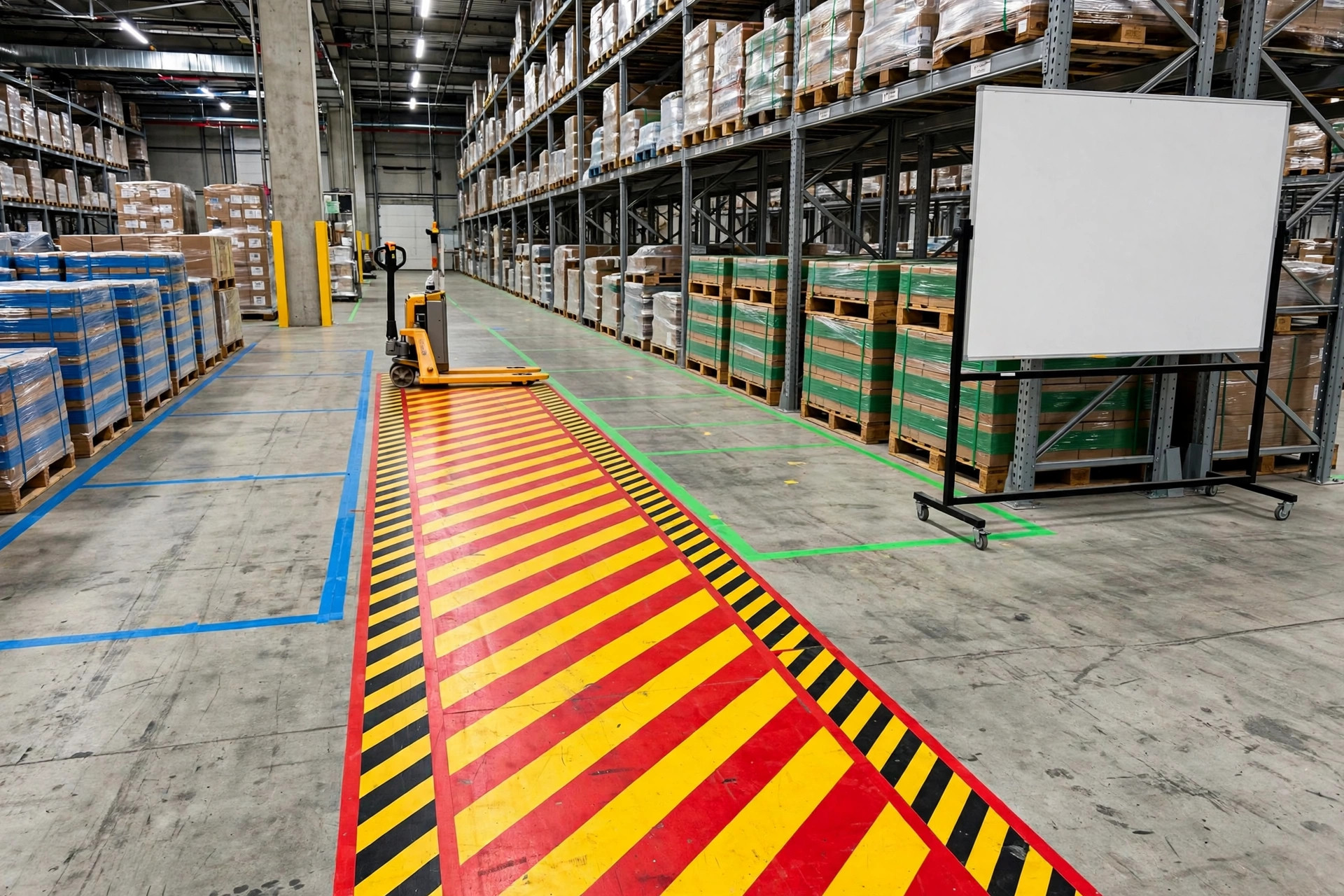
Floor marking is the language of space: where you can walk, where you can stage, where you must never block — painted once, never asked again. Boards are the language of status: today's tasks, exceptions, progress, readable from three meters away. Color is the language of priority: red stops, yellow slows, green goes — understood worldwide. Andon is the language of trouble, borrowed from Toyota's production lines: anyone who spots something wrong pulls the cord and the line stops to look.
Note that each dialect covers its own territory; they do not substitute for each other. I have seen warehouses with gorgeous boards and a disastrous floor — but you have to walk the right path before you can find the abnormality, and if the path was never painted, the clearest board in the world will not help.
Floor Marking: Get It Right Before You Get It Everywhere
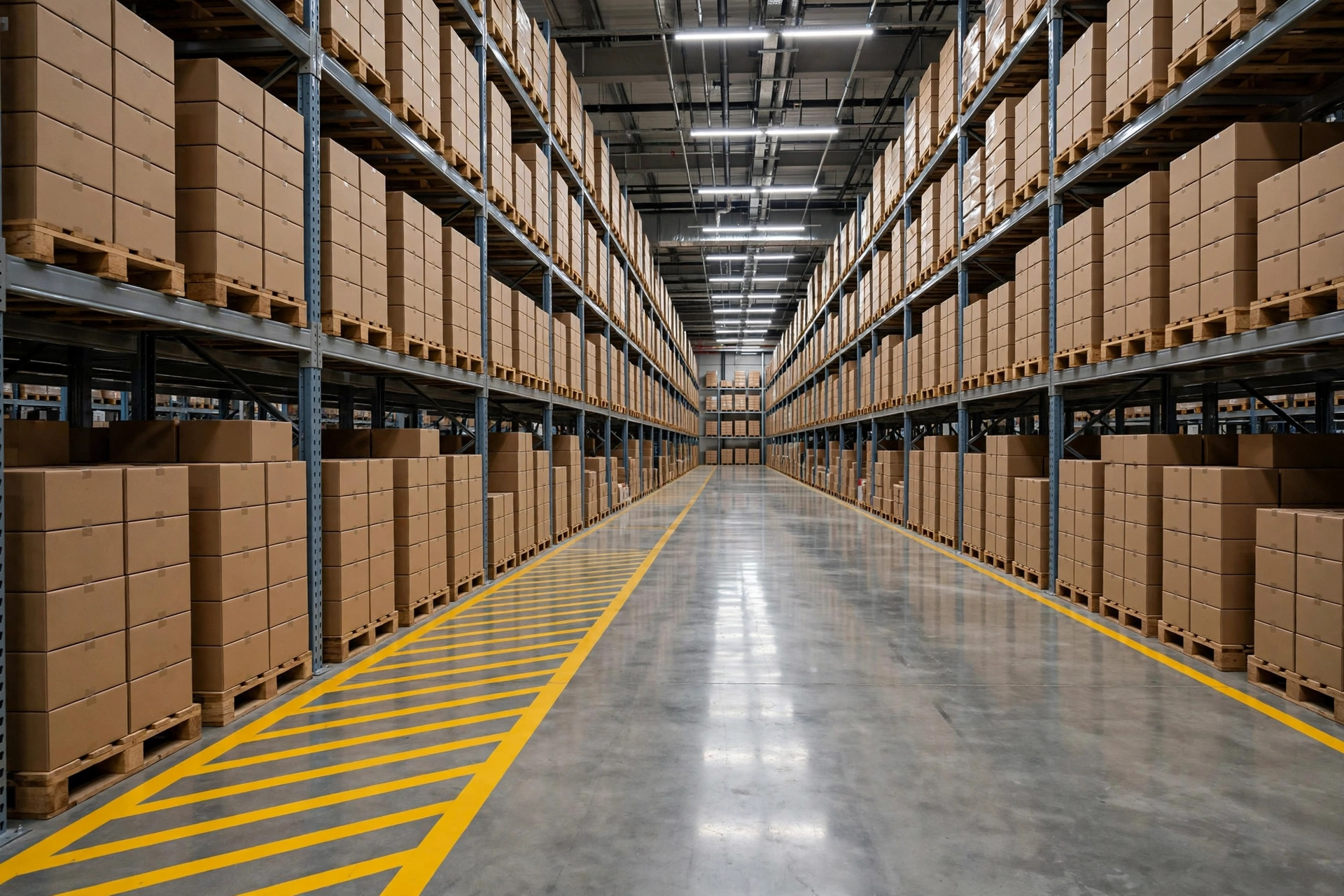
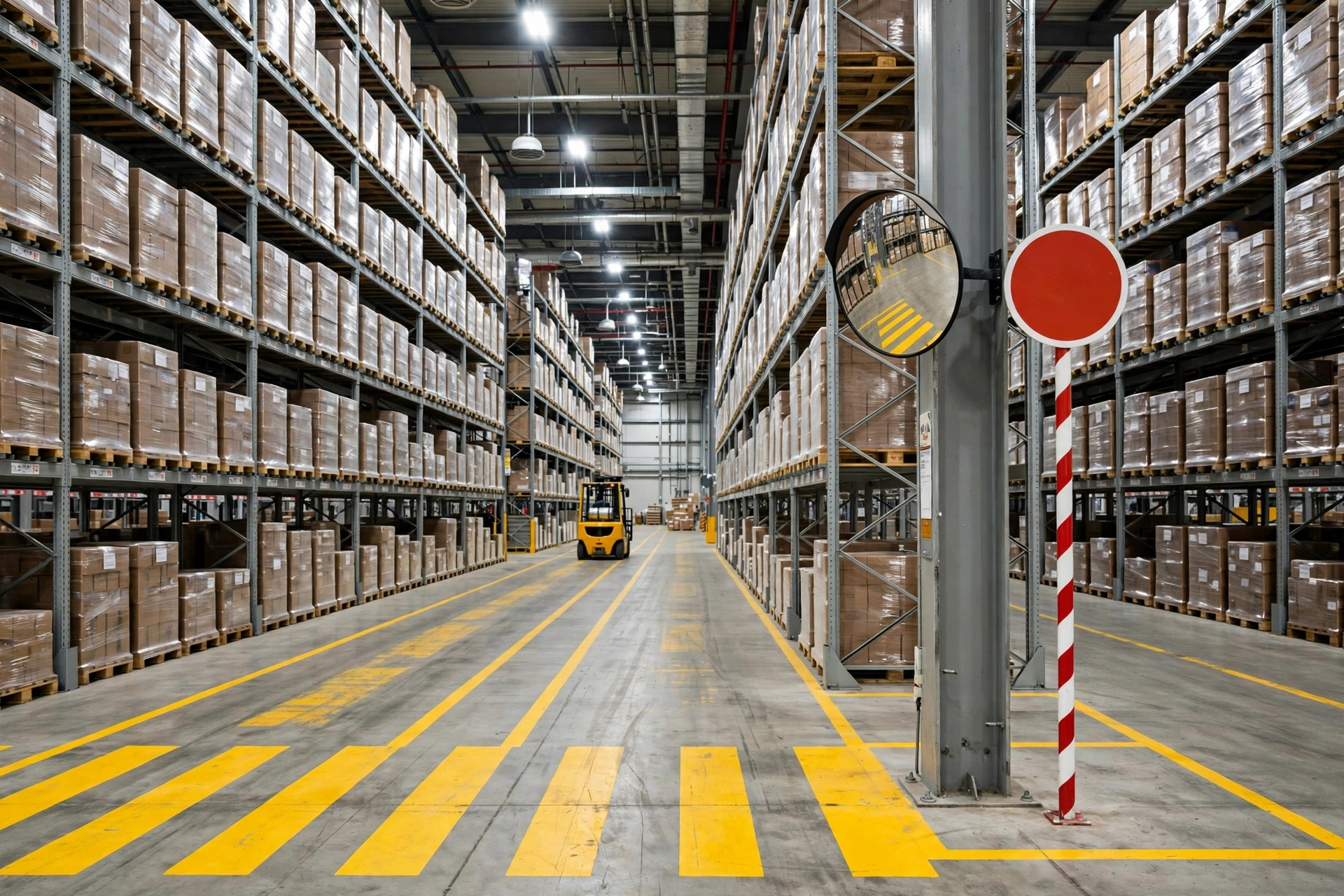
Compliance baseline first, technique second. In the US, OSHA's 29 CFR 1910.176(a) is explicit: permanent aisles and passageways must be appropriately marked. An OSHA letter of interpretation adds the working spec: the line color does not matter as long as it clearly defines the aisle, and lines may be continuous, dotted, square, or strip — with a recommended width of 2 to 6 inches, anything at or above 2 inches counting as acceptable. Separately, 1910.144 fixes the color meanings: red for fire protection equipment, yellow for caution and physical hazards. Know these two before you paint a single line — wrong colors turn compliance into anti-compliance.
In 2023 I saw the textbook negative case: an auto-parts warehouse whose main aisle lines had long been buried under staged pallets. A forklift driver, swerving to avoid the blockage, clipped a rack upright. Their own post-mortem put the damage at nearly ten thousand dollars — upright repair plus half a day of downtime. Repainting that aisle would have cost a few hundred in materials and labor. A child could do that math.
Sequencing matters too: paint aisles and pedestrian walkways first (that saves lives), then slots and staging zones (that saves efficiency), and only then 5S zones and equipment outlines (that builds habits). Warehouses that try to paint everything at once run out of money and people halfway — and the aisles that mattered most never get painted. I have watched that happen more than once.
Boards and Andon: Let Trouble Raise Its Own Hand
The floor handles "where"; boards handle "what." A usable task board needs exactly three columns: to-do, in progress, stuck. The stuck column is the point — plenty of warehouses track progress but never track exceptions, which is reporting good news only.
Andon deserves its own paragraph. Its essence is not the lamp; it is the rule behind it: anyone who spots an abnormality has the right to stop the line, and stopping the line is never punished. Without that rule, andon is decoration. I have seen warehouses install expensive electronic andon systems that nobody dared to pull — one pull meant twenty minutes of questions from the shift lead, so people simply stopped reporting. That money was wasted.
Time to shoot down a pseudo-need: electronic boards are not an "upgrade" of paper boards. Screens lose power, lag, and freeze; one big display plus wiring easily runs thousands of dollars, while a whiteboard with magnets costs tens of dollars and works fine during a blackout. For any information that updates less than once an hour, the paper board is the more reliable choice in most scenarios. Do not buy digital face at the expense of a working foundation.
The Selection Line: Paint vs Tape vs Preformed Markers
Three mainstream floor-marking options, with a clean dividing line:
| Option | Lifespan | Cost | Best for |
|---|---|---|---|
| Floor paint | 2-3 years | Lowest, priced by area | Permanent aisles and slot lines |
| Floor tape | 3-6 months | Medium, priced by length | Frequently reconfigured staging, seasonal zones |
| Preformed markers | 1-2 years | Highest, priced per piece | Heavy forklift traffic zones, fast-swap markings |
Picking wrong has concrete costs: tape in a heavy-traffic forklift zone grinds away in three months — money thrown out. Paint in a staging area that gets re-laid every year means scraping it off each time, and the labor costs more than the material. The dividing line is one sentence: the more stable the layout, the more durable the marking; the more frequent the change, the easier it should peel.
The Maintenance Trap: Markings Expire
This is visual management's biggest trap: paint it and forget it equals never painting it. Floor markings are consumables, not renovation. My recommendation is a quarterly "marking inspection" on the same sheet as your equipment checks: re-tape what's peeling, repaint what's faded, re-plan zones that pallets have permanently colonized.
There is also a silent form of expiry: the layout changed, the markings didn't. The new staging area was never painted, the old slot lines are still there, and workers stage freight by the old lines — that is exactly how chaos starts. Whenever the layout moves, update the markings before moving the freight. That order is non-negotiable.
One Counterintuitive Rule: More Colors Means No Color
I once walked a warehouse using eleven colors: red for stop, yellow for caution, green for travel, blue for material, white for slots, orange for staging, purple for hold, black for scrap… In the end the crew only registered "line or no line" — every color was wasted. Cognitive psychology has a classic finding here: the 7±2 limit on chunks the brain handles at once. Push past seven colors and reaction speed drops — the brain gives up classifying and degrades to a binary "present or absent."
So the iron rule of color management: no more than five colors facility-wide, one meaning per color, one color per meaning. Red always means "stop / danger" — never the fire extinguisher today and the hold area tomorrow. The moment a color carries two meanings, it carries none.
Whether this money was well spent comes down to one number: mean time to detect, the average time from when an abnormality occurs to when someone notices it. Before visual management, two hours. After, under fifteen minutes. If that number comes down, the paint, the boards, and the lamps were all worth it. If it doesn't, the prettiest markings in the world are just for the tour visitors — and tour visitors never cover your losses.
By Da Liu, Automation Engineer