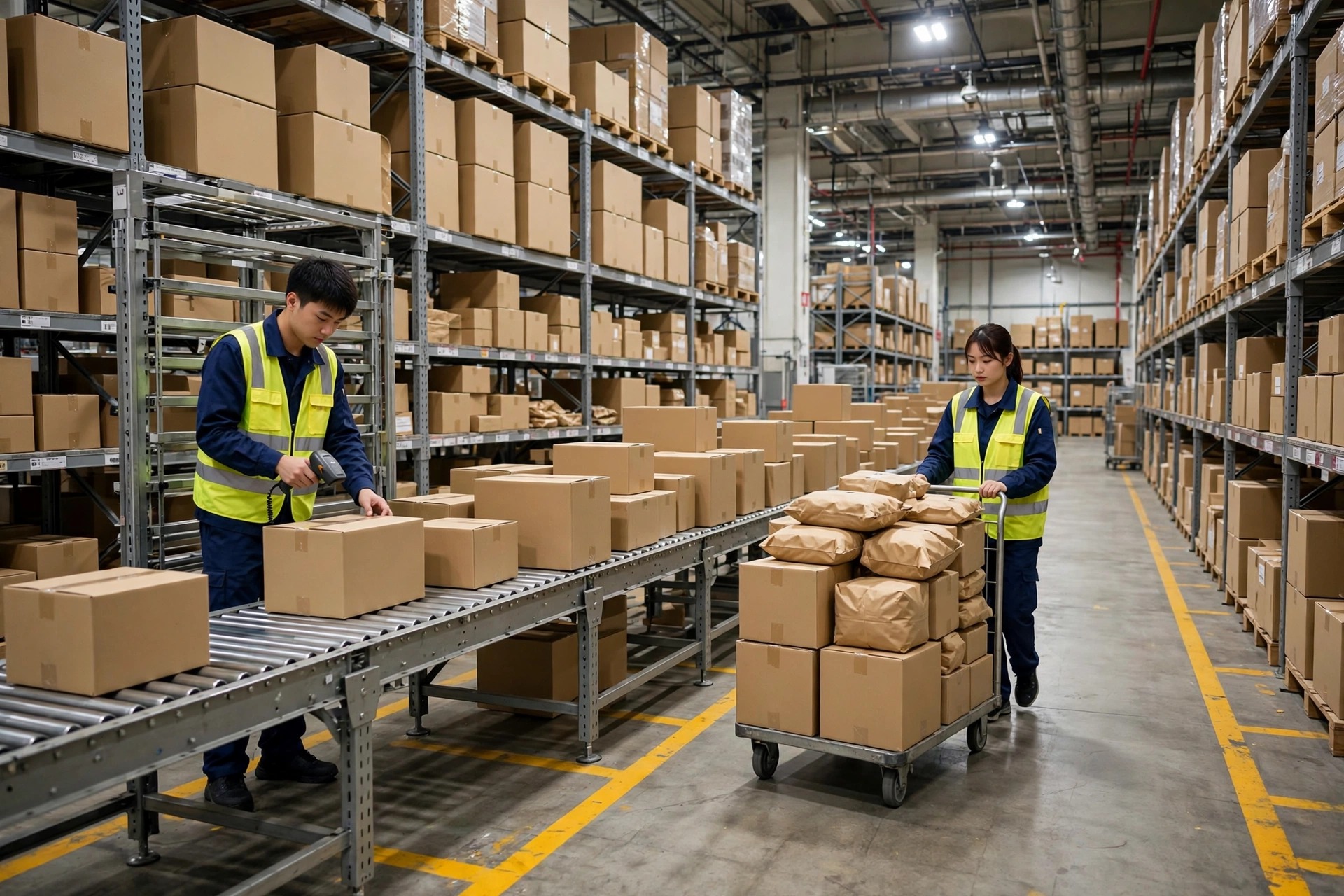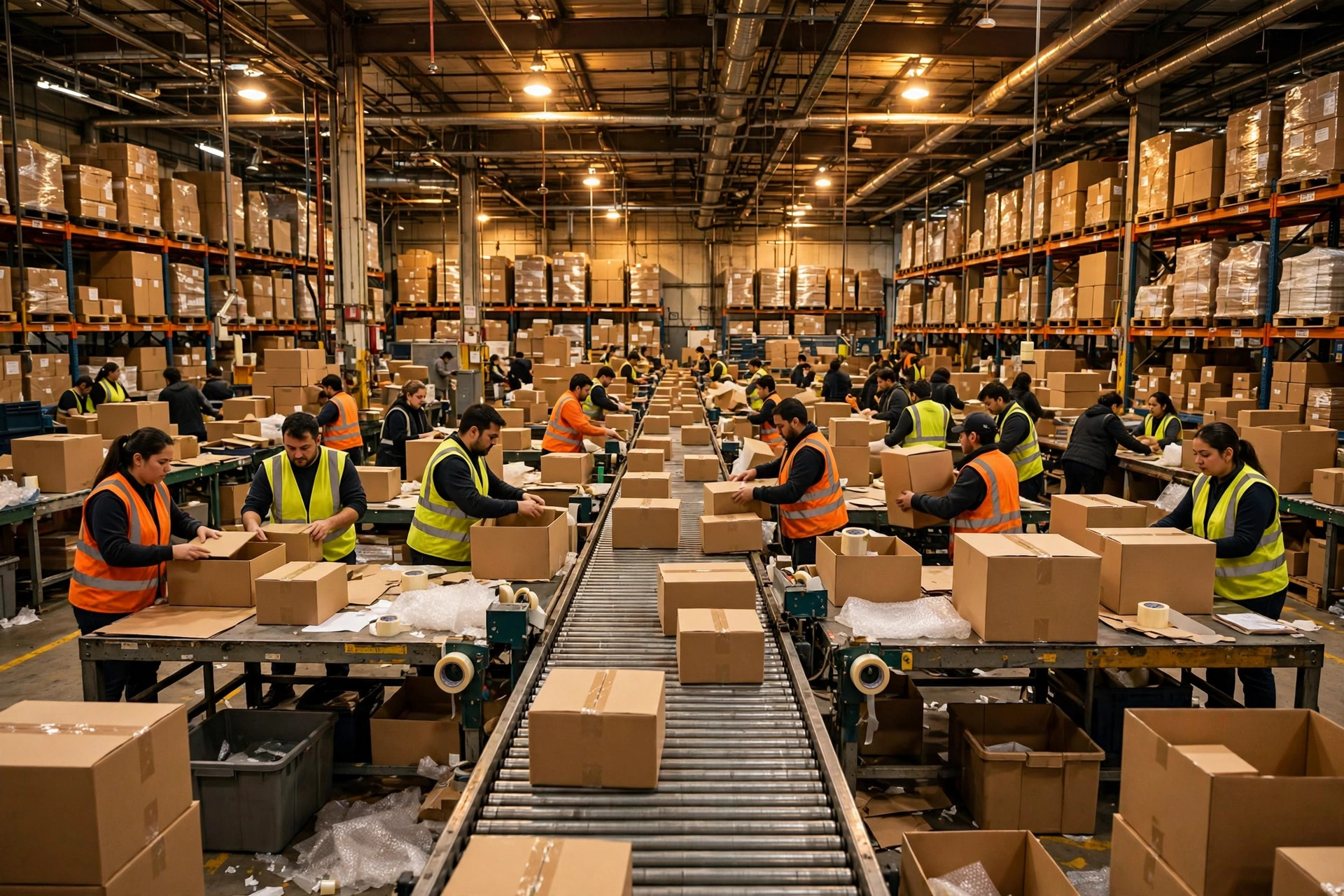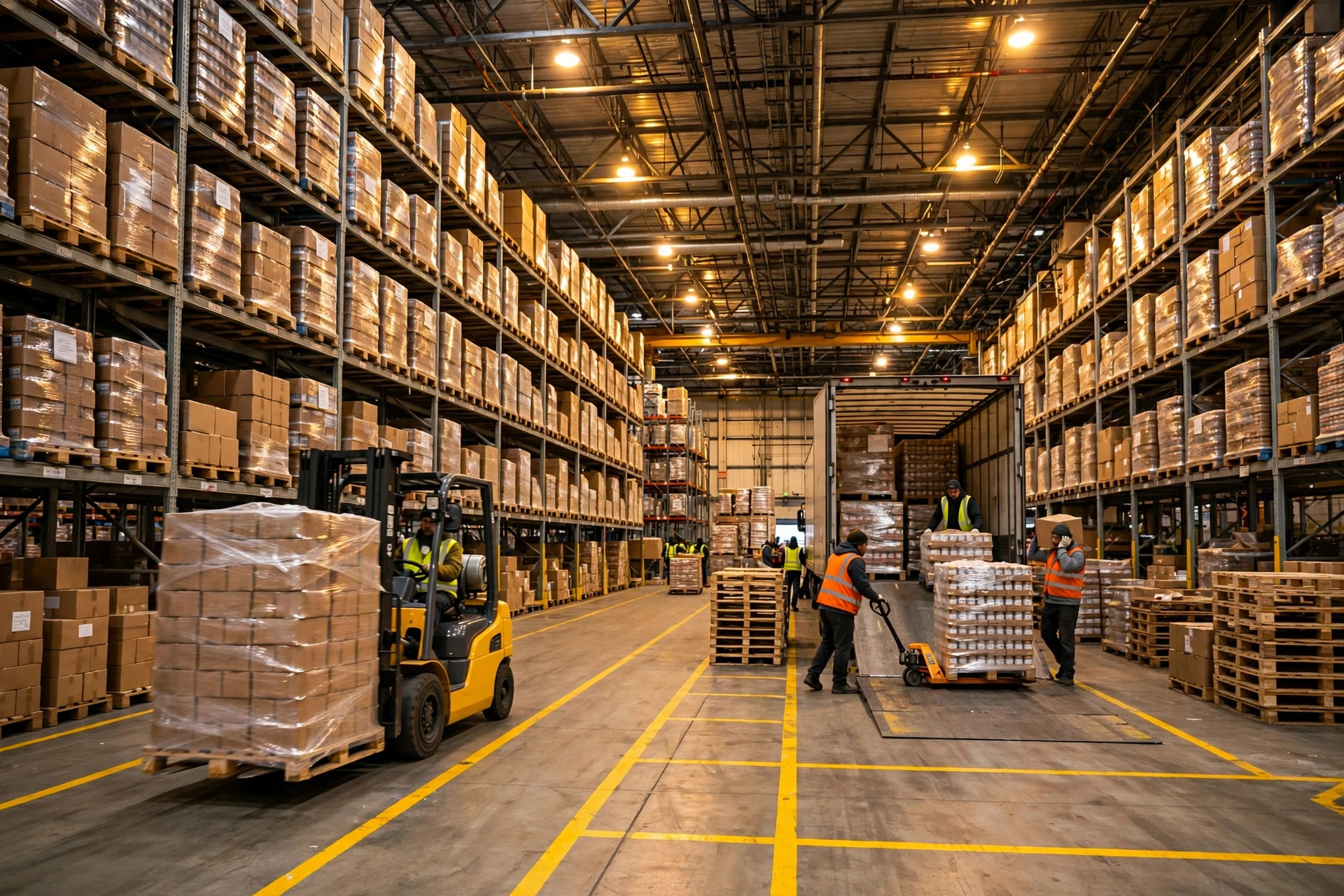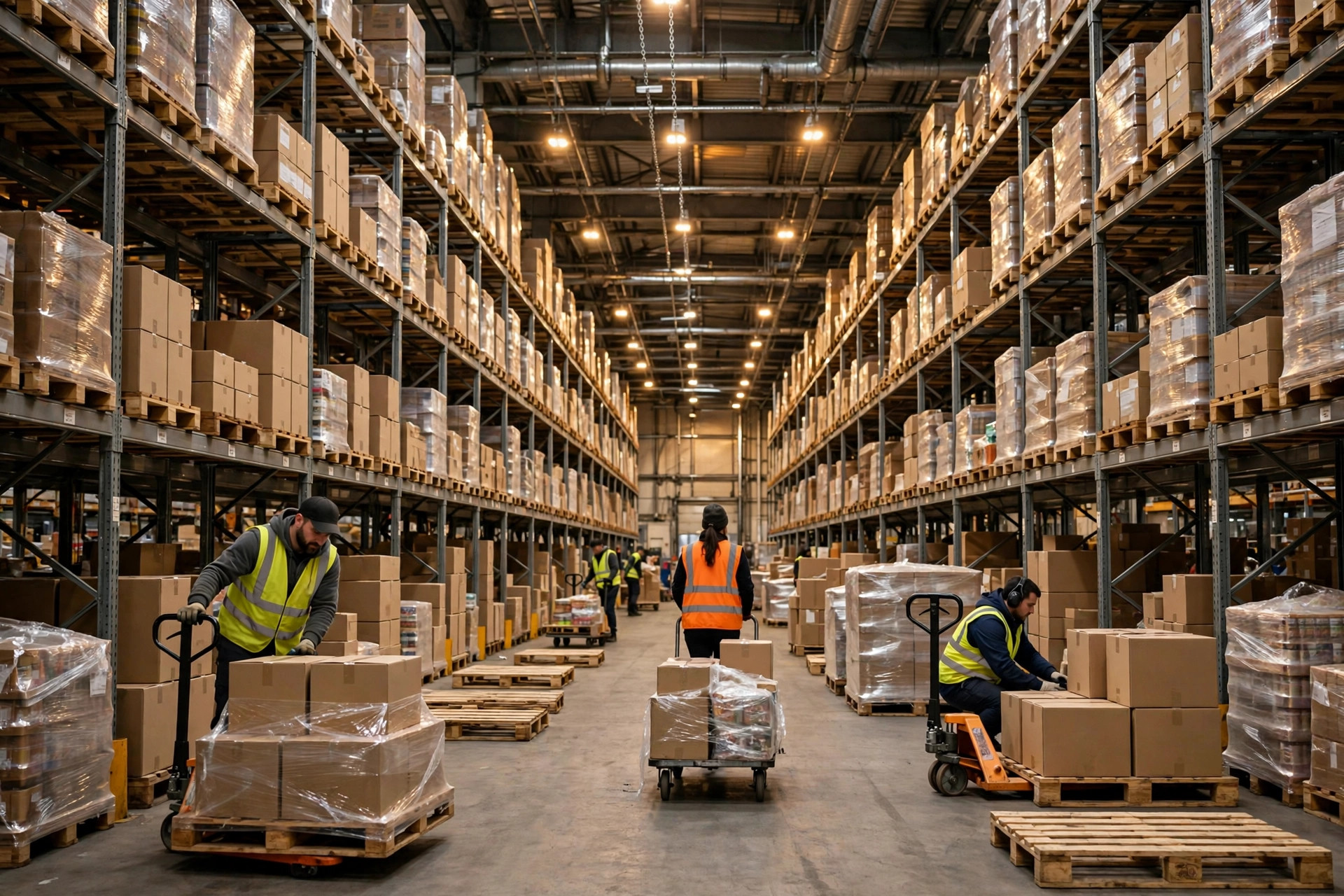
How many warehouse workers per square foot? If you're typing that question into Google, here's my verdict up front, no beating around the bush: the industry answers range from 1,000 to 7,000 square feet per employee, with the median sitting around 5,000. And honestly? That number is a junk drawer — everything gets tossed into it. What actually decides your headcount isn't square footage. It's throughput.
I've watched too many operations managers take that "5,000 square feet per worker" rule of thumb, use it to build schedules, use it to ask the boss for headcount, and end up with a mess. Let me take this thing apart properly.
How Many Square Feet per Worker? One Number, Two Warehouses, Triple the Headcount
Fall 2019. I was helping a client in Ontario, California, and two warehouses on the same street taught me a lesson I still use.
Warehouse A: 80,000 square feet, 40 people. The business? Pallet in, pallet out. Full truckloads roll in, forklifts drop one pallet per move onto the rack, and outbound ships the same way — full pallets. Two or three hundred pallets a day, 40 people handled it with room to spare. That works out to about 2,000 square feet per worker.
Warehouse B: the same 80,000 square feet, 120 people. The business? E-commerce small parcel. Thousands of packages a day — pick, verify, pack, label, load — the whole line was packed shoulder to shoulder. Under 700 square feet per worker.
Same 80,000 square feet. One runs 40 people, the other 120. Triple the headcount. The square-footage-per-worker metric dies right there on that street — and so does every answer that just hands you a number for how many warehouse workers per square foot without asking what kind of warehouse you run.
Here's the thing about this metric — it's not useless, but its fatal flaw is treating every "warehouse" as the same animal. A pallet wholesale operation and an e-commerce eaches operation have almost nothing in common except the word "warehouse." Apply one number to two different businesses, and you're asking for a wreck.
Forget Square Footage: Staff by Throughput Instead
The right method boils down to one sentence: break headcount down by function, and work backward from throughput.
Look at this comparison — one glance and the difference between the two approaches is obvious:
| Square-Footage Method | Throughput Method | |
|---|---|---|
| How it works | Total sq ft ÷ sq ft per worker | Workload per function ÷ output per worker |
| Typical number | 5,000 sq ft per worker | Picking UPH of 60–100 (measure your own) |
| Good for | Site selection budgets, rough headcount estimates | Scheduling, hiring asks, labor cost math |
| Fatal flaw | Ignores business type | Requires real data |
Here's the method I've used for over a decade.
Step one: split the warehouse into five functions — receiving, putaway, picking, packing, shipping — plus supervision and support. Staff each function on its own, then add them up. Never start with "how many people for the whole building" — that's guessing.
Step two: work picking backward from UPH. This is where most of your people live. The formula is simple:
Pickers needed = daily order lines ÷ UPH per picker ÷ shift hours
Example: 3,000 orders a day, UPH of 80 per picker (a middle-of-the-road number for small-item picking — measure your own floor), one 8-hour shift. 3,000 ÷ 80 ÷ 8 = 4.7. Round up: 5 pickers.
Packing and shipping work the same way — how many parcels can one person pack per hour? Receiving: how many trucks a day, how many pallets per truck? Say 10 trucks a day, 26 pallets each, and two people can unload 3 trucks per 8-hour shift — that's 7 people on receiving. Putaway: how many pallets replenished daily, worked backward the same way. Every function gets a number, every number ties to volume. When volume grows, headcount grows with it, and the logic is clean enough to defend in front of any boss.

Step three: supervision and support as a ratio. Operators to supervisors usually land between 8:1 and 12:1 — leaner in a small building, a bit looser in a big one.
Now the cost side, because there's always a cost: this method's only real barrier is data. You need measured UPH, and you need a volume forecast. A building with no data has to run for two weeks and measure. Worth it — scheduling by square footage means you're short-staffed in peak season and carrying dead weight in the slow months. A year of that waste costs far more than two weeks of measurement.
So is the square-footage-per-worker number completely useless? Not quite. It has two legitimate uses: rough math when you're picking a site or building a budget ("an 80,000 sq ft e-commerce building at 700 sq ft per head — call it 100-plus people"), and benchmarking how many warehouse workers per square foot against a peer building running the same business. Same type only. Comparing an e-commerce building's ratio against a pallet operation's is lying to yourself.
The Counterintuitive Truth About Square Feet per Worker: Bigger Doesn't Mean More People
One last counterintuitive call. Plenty of people argue with me the first time they hear it, then come around.
An automated high-bay warehouse can run at 20,000 square feet per worker — a team under 20 people running a 400,000-square-foot automated building. By the square-footage metric, that's the "labor efficiency champion."
But here's the truth: that's not saving people. It's converting people into electricity and maintenance bills. Shuttles, stacker cranes, conveyors running 24/7 — the meter spins faster than any human ever ran. The maintenance crew's wages plus spare parts can add up to more than the operator wages you "saved." Two sides to this coin: machines don't call in sick, don't quit, and don't negotiate overtime in peak season. But machines also won't voluntarily work two extra hours during a surge, and they won't bail you out manually when the system goes down. The money you saved on labor mostly moved into depreciation and the power bill — do the math that way, and the math finally makes sense.
So back to the original question — how many warehouse workers per square foot?
My answer: stop asking about square footage. Ask about throughput. Square footage is dead; throughput is alive. Square footage decides how big a building you lease. Throughput decides how many people you hire. Separate those two numbers, and your staffing math is finally on solid ground.
Next time someone quotes "5,000 square feet per worker" in a headcount debate, ask them one question back: are you asking about square footage — or throughput?
By Lao Mi, Supply Chain Veteran (20 yrs)