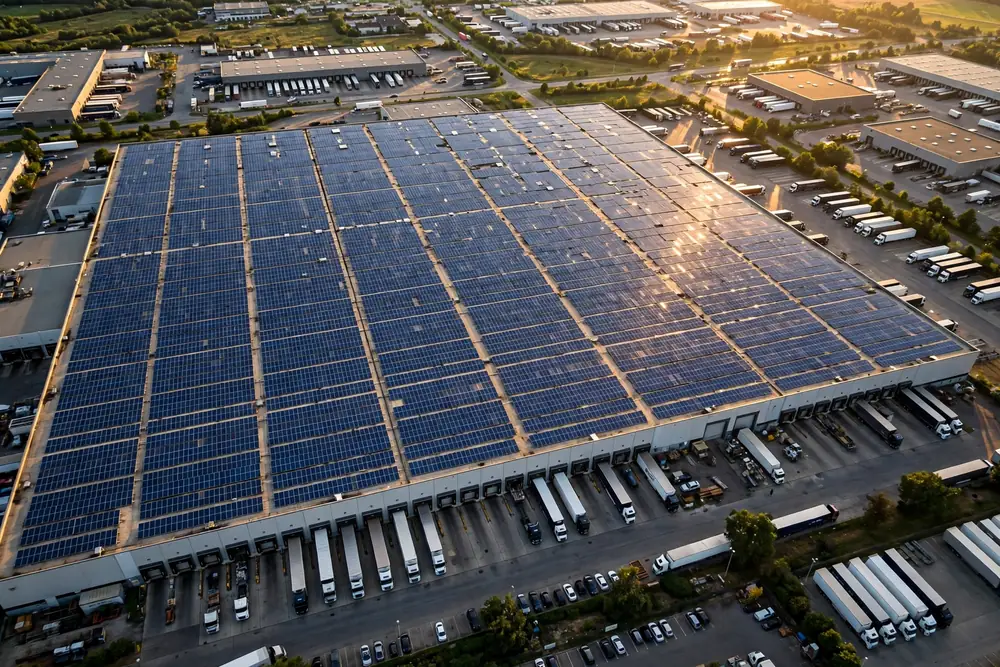
We small warehouses cannot afford to burn money like that — but I almost got that sentence backwards on warehouse rooftop solar panels. Last summer, the power bill for my 3,000-square-meter warehouse hit over $9,000 in a single month. Air conditioning, lights, forklifts charging around the clock. I stared at that bill for a long time, and one thought kept looping: that giant empty roof is just sitting there sunbathing. Why not put it to work?
Here is the conclusion up front: warehouse rooftop solar panels can make sense for a small warehouse, but the order of the questions matters. Roof first, savings second, payback last. Get the order wrong, and the money you save on electricity will not cover a single roof leak repair.
Warehouse rooftop solar panels: the savings math, roughly
The logic is straightforward: the power you generate in daylight is power you do not buy from the grid. The public benchmark for commercial solar in 2026 is about $1.77 per watt installed (Wood Mackenzie/SEIA, Q2 2026), so a 100 kW system runs about $177,000 before incentives. After incentives, most commercial systems pay back in 4–8 years. Another useful public figure: a system produces roughly 1,300 kWh per kW per year, and at 14 cents per kWh that saves about $182 per kW a year.
Now run it in small-warehouse terms. That is the honest starting point for warehouse rooftop solar panels on a small roof: size the system to what you actually use in daylight, not to what fits on the roof. Hypothetical example: my warehouse peaks between 9 a.m. and 5 p.m., which lines up nicely with the sun's working hours. A 60 kW system at $1.77 per watt costs about $106,000. It would generate roughly 78,000 kWh a year. If I use 70% of that myself at 14 cents per kWh, I save a little over $7,600 a year. Tax credits and depreciation are on top of that — check the latest official policy before counting on them. That puts payback at 8–10 years, slower than the industry average of 4–8 years. Why? Because my daytime power use is not big enough. The surplus gets exported at a much lower price than what I pay to import.
Here is the counterintuitive part: a bigger roof and more panels does not mean more money. For a small warehouse, system size should match daytime self-consumption. Every kilowatt beyond that generates power you can only sell cheap, which stretches payback instead of shortening it. Pull your last 12 months of power bills, look at daytime usage hour by hour, and size the system to that — not to whatever maximum layout the salesperson draws on your roof.
The roof-load risk matters ten times more than the savings
I nearly signed the contract right after running the savings math. Lucky for me, I had a structural engineer look at the roof first, and his first question stopped me cold: how many years does this roof have left?
The panels themselves are not heavy. Public engineering references put a modern panel at about 2.4–2.7 pounds per square foot, and the full array with racking and wiring adds roughly 3–4 pounds per square foot of dead load. That sounds small, but weight is not the real issue. Age is. Panels last 25–30 years, degrading about 0.5% a year. Hypothetical example: my warehouse roof is a membrane system laid 12 years ago, with maybe 8–10 years of life left. Once panels go on, the waterproofing underneath becomes untouchable. The day it starts leaking, you have to remove panels before you can fix anything, and the removal cost plus downtime will wipe out years of electricity savings in one shot.
So the first hard rule for a small warehouse: before you put warehouse rooftop solar panels on it, the roof must outlive the panels, with at least five years to spare. If the roof has less than ten years left, replace the roof first or skip solar entirely. And yes, the roof replacement cost belongs in the solar budget. The salesperson will not add it for you.
Leaks are the second risk. Racking has to be bolted through the roof, and every penetration is a future leak waiting to happen. The number of penetrations, the sealing method, and the inspection schedule all need to be in the contract: who owns waterproofing, who pays when it leaks, and for how many years. I know a fellow operator who installed solar in 2024 and found three leaks the next rainy season. It took two rounds of repairs to trace them to aging seals around the racking bolts. The power bill went down. The repair bill did not.
Fire access is the third risk. Panels covering the whole roof must leave fire setbacks and maintenance paths, and local fire codes set clear rules for rooftop solar placement — confirm the latest requirements with your local fire authority. Add a few pallets and cartons up there and, if anything catches fire, firefighters cannot get on the roof, and the insurer's first question will be whether the installation was compliant. Ask before you install, not after something burns.
The small-warehouse way: test small, then decide
We do not have a big company's budget, so we cannot do this in one grand step. My approach is three steps. It is unglamorous, but it works.
Step one, get the roof checked. A structural engineer, a written opinion, a few hundred dollars. It confirms load capacity, remaining waterproofing life, and the racking plan. This is the cheapest money in the whole project, and everything else rests on it.
Step two, run your own consumption numbers. Pull 12 months of hourly usage data and see how much power you actually use in daylight. If self-consumption comes in under 50%, cut the system size. Better to under-install than over-install.
Step three, read the contract line by line. Four things matter most: does the price include racking reinforcement and roof waterproofing work, is there a written generation guarantee, how long are the inverter and panel warranties, and what happens if the subsidy policy changes. Federal tax credits have firm deadlines — confirm the current official policy rather than trusting a verbal promise.
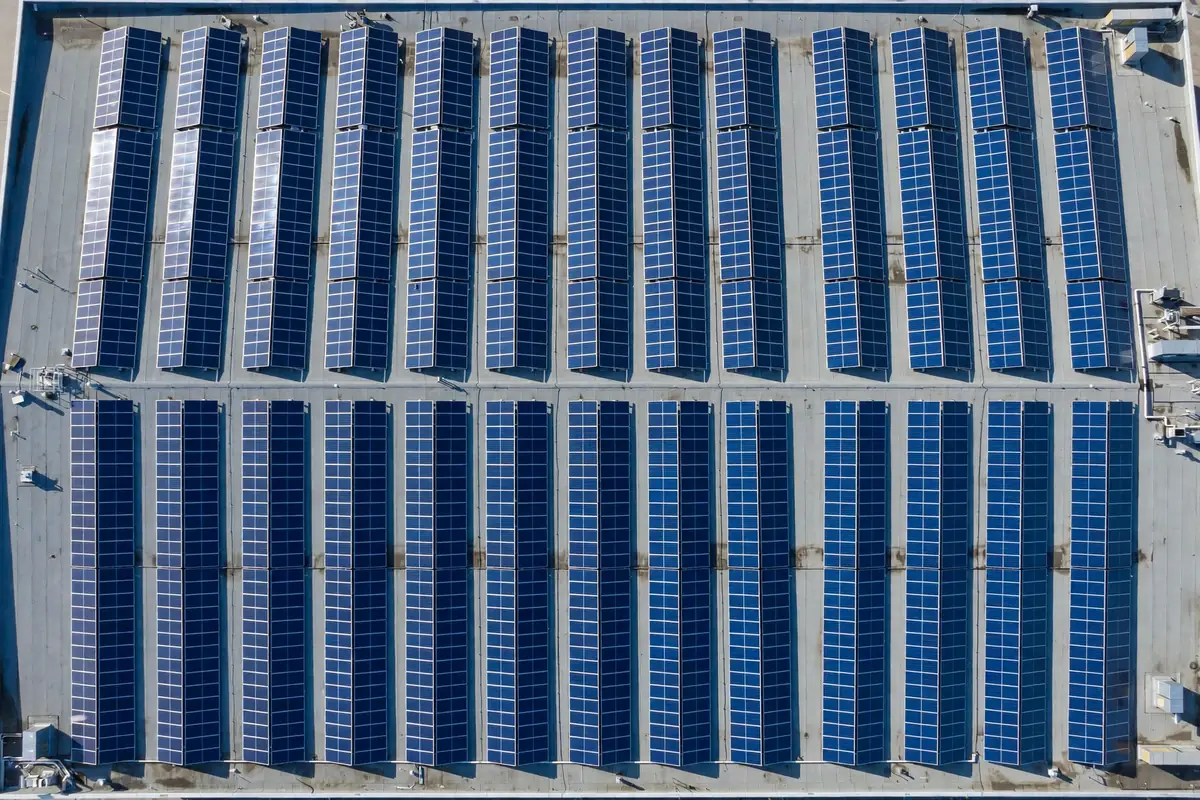
Hypothetical example: following these three steps, my final plan was not a full-roof system at all. I put 30 kW on the south-facing slope only, where self-consumption runs above 80%, and the payback came out two years shorter than the 60 kW plan. The other half of the roof waits until the membrane is replaced. Small warehouses have their own way of surviving. We do not compete with big warehouses on showmanship. We compete on making every dollar count.
One question to leave you with: how old is your warehouse roof this year? Until you know that number, treat every payback promise from a solar salesperson with a healthy dose of suspicion.
By Xiao Ma, Small Warehouse Owner