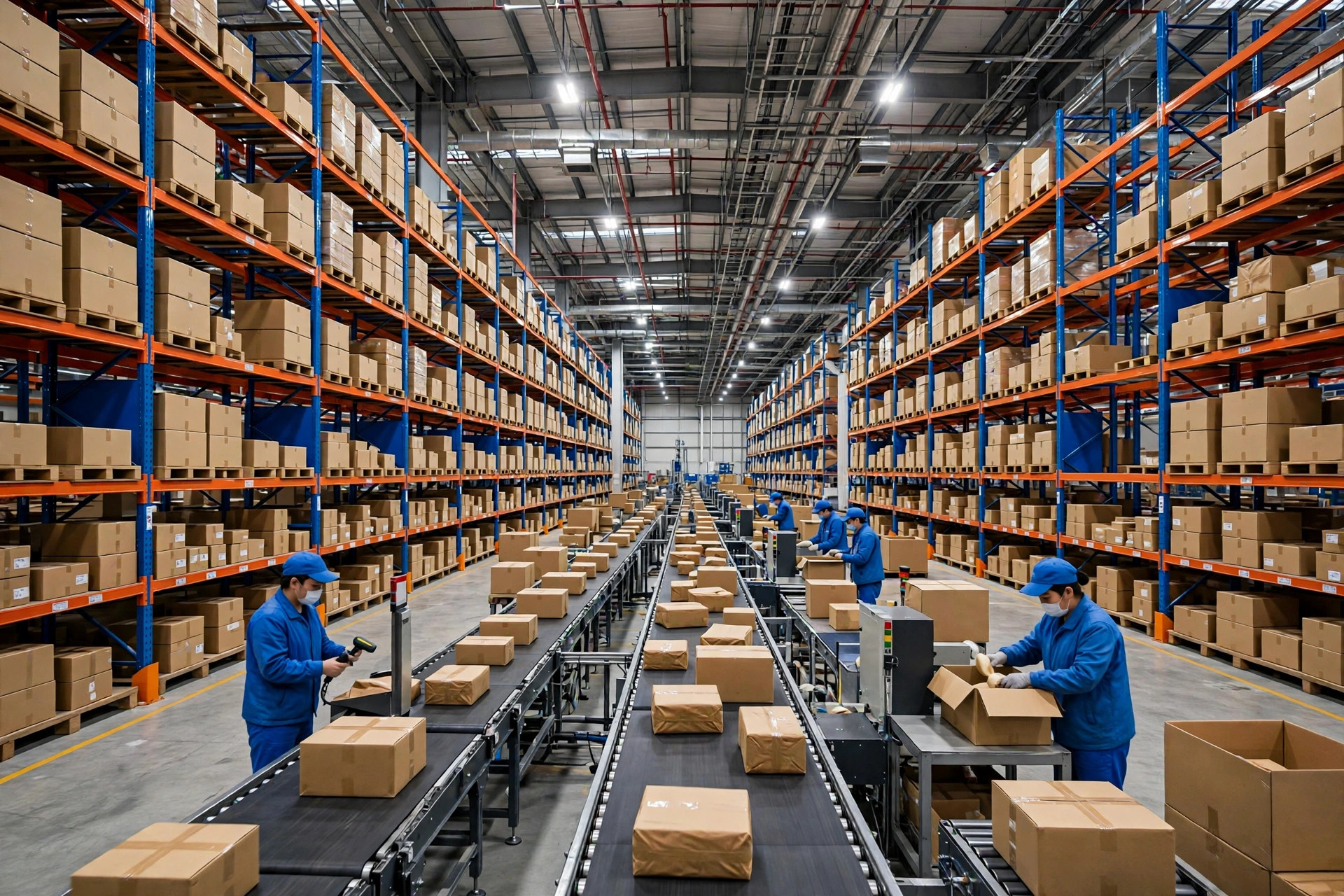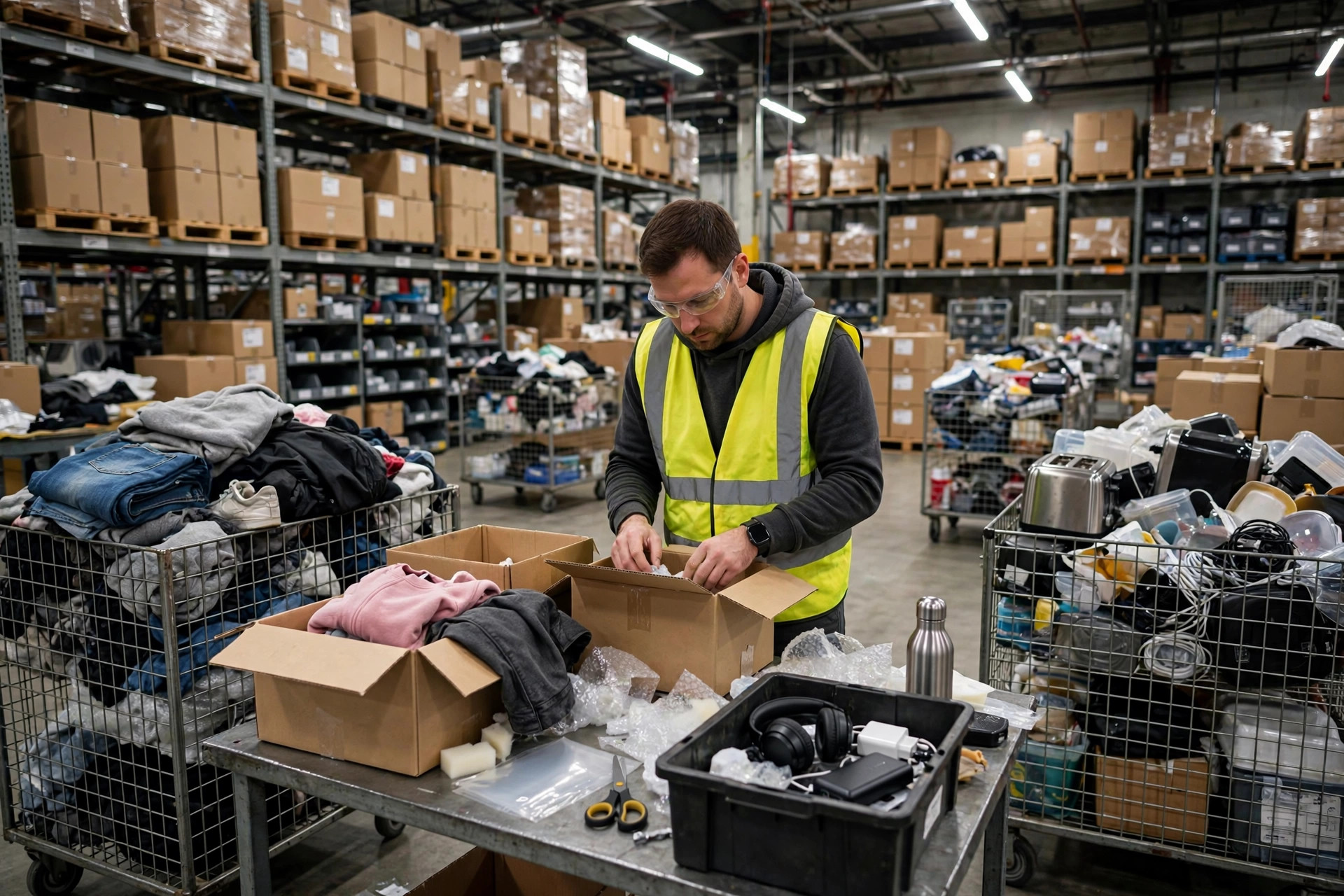
Bottom line up front: this isn't a binary choice, it's a portfolio problem. Put your stable 70% baseline on a long lease, the predictable 20% seasonal overflow on an annual 3PL contract, and the remaining 10% of volatility and promotions on on-demand warehousing. After 30-plus WMS go-lives, I can say this with confidence: everyone who treated on-demand as a "lease replacement" ended up crashing on the systems cutover. The rent math is easy. Nobody does the cutover math.
The break-even formula: the on-demand premium vs. the cost of empty space
The entire economics of on-demand warehousing fits in one sentence: you're paying a per-unit premium to buy freedom from empty space.
On-demand space is always more expensive per unit than a lease — that's the sticker price. Per-pallet or per-cubic-foot billing, monthly invoicing, 30-day notice periods: that's the standard shape on flox.is's blog, and it matches every platform I've integrated with. Exact premiums vary — get your own quotes; I won't quote numbers for you.
But a lease is only cheap on "unit price." It's expensive on "vacancy." A traditional lease runs 3 to 10 years (that's the range on cadretech's explainer page), and you pay for the square footage you signed, full or not. Four months a year it's packed; eight months it's half empty — and the empty half gets no discount.
The break-even math is simple:
On-demand wins when: your average annual space utilization < 1 ÷ (1 + flex price premium)
A worked example (illustrative numbers — plug in your own): if flex space costs 40% more per unit than your lease, then as long as your average utilization sits below 1 ÷ 1.4, roughly 71%, flex is cheaper on pure rent. Flip it: if your building runs above 85% full year-round, sign the lease and stop reading — the premium will eat you alive.
There's a counterintuitive judgment buried in that formula: the real value of on-demand isn't "cheap," it's converting fixed cost into variable cost. For fast-growing, volatile businesses, what you save isn't rent — it's the cost of being wrong. One bad five-year lease costs more than a year of flex premium.
About the "switch to on-demand and cut costs 20–40%" claim — a word of caution first. That's a vendor's page talking (cadretech's, to be specific), scoped to "seasonal demand, fast growth" customers. Vendors always compute with the sample that flatters them; don't take it to your boss as a universal conclusion. In October 2026 there was also an industry note: an analyst firm's short-term warehousing guide argued warehouse capacity should be managed as a "dynamic portfolio," not a "static real-estate commitment." I agree with the direction — but how much you actually save comes from your own utilization curve.
70-20-10: running the lease portfolio
The same platform blog had an idea I agree with: stop choosing, start portfolio-managing. Part of your capacity on stable contracts for the core, part on flex for the swings. The 70-20-10 split is my field heuristic from implementation projects — not a number from any report — tune it to your own peak-to-trough ratio:
- 70% baseline: long lease or multi-year 3PL contract. Year-round, low-volatility inventory. Three-to-five-year terms, lowest unit cost.
- 20% seasonal layer: annual 3PL contract. Covers predictable peak overflow — say, the three months before Black Friday. Re-signed yearly, priced between lease and on-demand.
- 10% flex layer: on-demand, monthly, per pallet. Promotions, surprise spikes, testing new markets. Most expensive per unit, but you can walk away anytime.
Why not 50-50, or all flex? Three reasons. First, putting baseline volume on flex space is burning money — the premium eats margin directly. Second, all-lease means swallowing 100% of your forecast risk; miss once and the vacancy rent hurts for a year. Third, the portfolio buys you an observation window: once the flex layer's volume stabilizes, convert it to an annual contract and the unit price drops immediately.

The systems bill: cutting over WMS, inventory, and the books for on-demand space
Finance does the rent math. Implementation consultants do the systems math. This is the part of the article I most want you to read: the biggest cost of switching leases is usually not the rent delta — it's the systems not keeping up.
Here's the cutover checklist from my projects. Check every box; any gap can blow up:
- Build the new site as its own warehouse in the WMS. On-demand space must be an independent warehouse entity — never a "zone" under the old building. Location coding rules, document types, user permissions: configure all of it fresh. The lazy shortcut buys a reconciliation nightmare three months later.
- Align SKU master data. Barcode rules and pack hierarchy (each/case/pallet conversions) must match across both sites. The flex operator's people work off your master data — garbage in, garbage at scale.
- Write the inventory migration plan. Which SKUs move first, how much, in how many waves, who signs off each wave, and whether the old site freezes outbound or both run in parallel. Decide before, not during.
- Configure billing. Storage rates and handling rates (receiving, putaway, pick, pack, returns) for the new site go into the billing engine up front. Flex invoices arrive monthly; misconfigured rates mean month one doesn't reconcile.
- Map external integrations. E-commerce platforms, ERP warehouse mappings, the default ship-from address on carrier accounts. Miss one integration and orders ship from the wrong building.
- Plan the exit. When peak ends: how inventory comes back, to where, owned by whom, by what date. On-demand space with no exit plan becomes a second long lease — item 6 is the one I've seen fail most, and it deserves its own section.
I've seen this pitfall three times: inventory migration disasters
Items 2 and 3 are where it blows up. Three real failures, all from adding or switching sites:
First: mismatched barcode rules. In 2023, a beauty e-commerce client opened flex space in California. The old building received on vendor barcodes; the new operator required the client's own labels. Two thousand-plus SKUs, and the scanners went red on receiving day. We printed temporary labels overnight and hand-labeled for two days. Lesson: align master data in week one after signing — not when the freight arrives.
Second: in-transit inventory with no owner. Same client. On migration day, three containers were still on the road — deducted from the old site's books, not yet on the new site's. Finance found a six-figure inventory value gap at count time. Lesson: set a hard freeze timestamp; track in-transit on its own sheet; both sites reconcile to the frozen count.
Third: ununified location coding. Another client: the old building used "A-01-02," the new site kept the platform default "R01-B02." Same SKU, two names. The joint cycle count three months later ran until 2 a.m. Lesson: lock the location coding standard on day one of multi-site, in the master data spec.
The 90-day pre-peak lock-in timeline
One usable timeline to close. First, a counterintuitive risk: flex's "flexibility" is off-peak flexibility, not peak flexibility. When everyone wants space for peak, the platform can simply have none. Before Black Friday 2024, a client of mine tried to add 3,000 pallet positions last-minute — the target market was fully booked, and they paid emergency rates to a traditional 3PL instead.
The 90-day pre-peak lock-in:
- T-90: Pull this year's sales forecast; size the 70-20-10 layers. The 70% core must be locked by now.
- T-60: Get quotes on the platform, compare three, sign the framework. Read the exit clause: 30-day notice is the standard; anything demanding more than three months' minimum commitment isn't genuinely flexible.
- T-45: Build the new warehouse in the WMS, align master data, map integrations. Systems fully ready.
- T-30: Run test orders — receive, store, pick, ship, return, at least 20 end-to-end. Skip the test run and go-live will fail.
- T-14: Pre-position inventory. Peak stock goes into the flex site early, not on launch day.
- T-7: Dual-site monitoring dashboard live. Inventory, orders, exceptions — both buildings on one screen.
And a plan B for stockouts: if T-60 quoting shows no capacity in your target market, pivot immediately — a neighboring market's site (longer linehaul, but no stockout), or negotiate temporary overflow with your existing 3PL. Never put the entire 10% flex layer on one platform in one market.
Closing line: run the lease math with the formula, run the systems work with the checklist. Get the formula wrong and you overspend; skip a checklist item and you're firefighting at 2 a.m.
By Lin Xiao, WMS Implementation Consultant