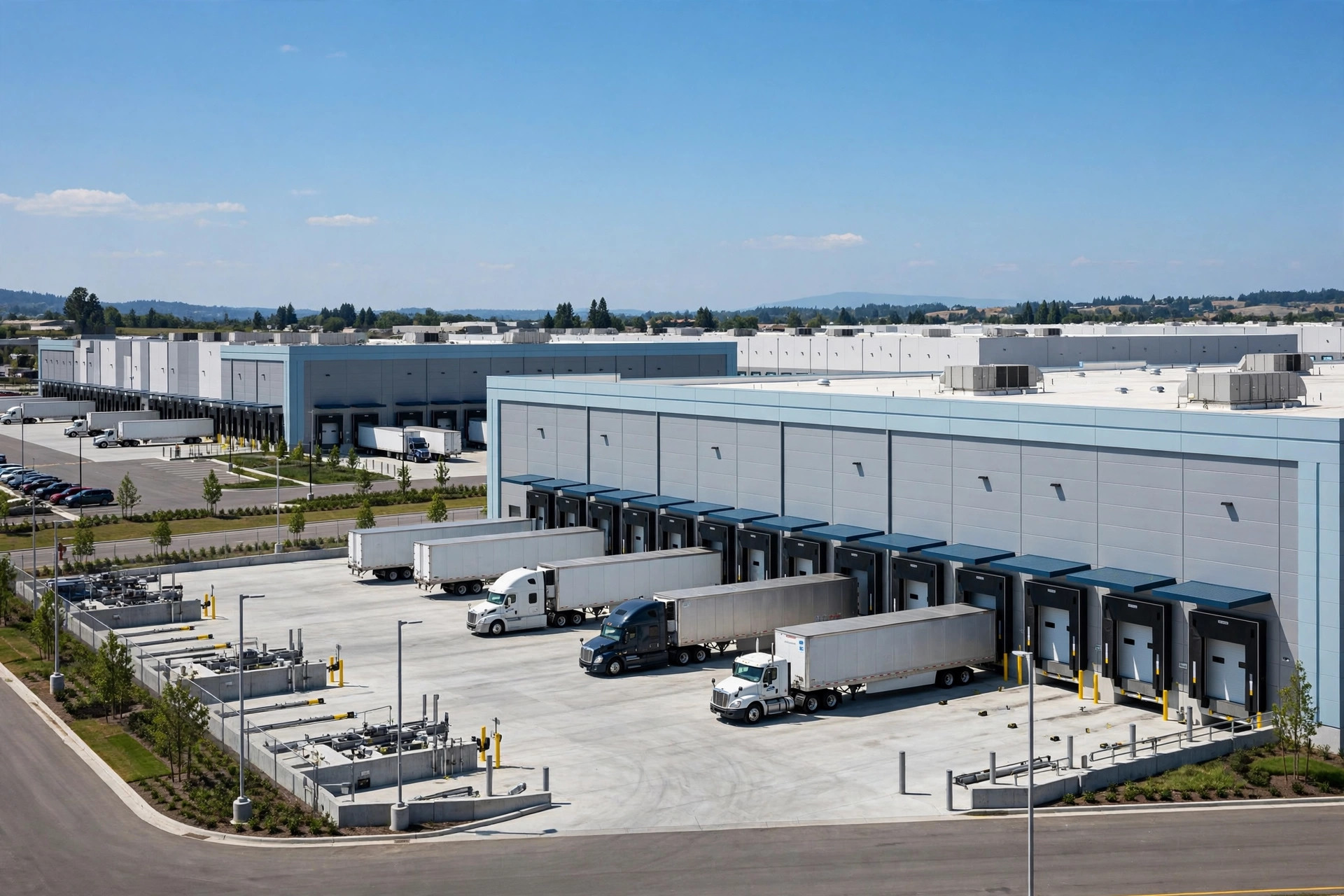
Let me start with the math, because warehouse property insurance coverage limits are one of those things people set by gut feel. Some pad the number for peace of mind. Some squeeze it to save premium. Both ways lose money. Take a 90,000 sq ft warehouse with a replacement cost of $9 million. Insure it for $12 million and the extra $3 million of limit costs you five figures in premium every year. The carrier will only ever pay your actual loss - not one extra dollar comes back for the inflated limit. That is money down the drain.
Here is the counterintuitive call up front: a higher coverage limit is not safer. Insurance pays actual loss, not the number on your declarations page. Every dollar of limit above rebuild cost converts to premium at a 100% loss rate.
Your coverage limit has exactly one anchor: rebuild cost
Mis-anchoring the limit is the most common way to overpay. I have seen three anchors. Two are wrong.
Market value is wrong. It includes the land. Land does not burn and does not flood, so you are paying premium to insure dirt that cannot be destroyed. Book value is wrong too. A ten-year-old building carried at depreciated book value might sit at half its rebuild cost. After a loss, you rebuild at today's lumber and labor prices - half the money means you fund the gap yourself.
The only correct anchor is replacement cost: demolition and debris removal plus materials plus labor, priced the day the loss happens. That is the number the carrier actually pays against.
Replacement cost breaks into three buckets: first, demolition and debris removal - including hazardous waste disposal after a fire, a line item most buyers never think about at placement; second, the rebuild itself - steel or tilt-up structure, roof, sprinklers, electrical, all at today's material and labor prices; third, soft costs like design and permitting. Note that lost rent and lost profit during downtime are not in the property policy - that is business interruption coverage, a separate buy. Do not expect one policy to do both jobs.
One more mis-anchor: the loan balance. The lender only cares about recovering its money, so it asks for coverage of the outstanding loan. You owe $4 million, you carry $4 million - but the rebuild costs $9 million. After a loss the bank takes its $4 million first and the remaining $5 million gap is yours. The loan balance is the bank's anchor, not yours.
In 2023, a 90,000 sq ft 3PL warehouse in Ontario, California carried an $11 million limit because the lease required coverage "not less than market valuation." I had them run a replacement-cost appraisal. It came back around $7.8 million. The extra $3.2 million of limit was costing five figures in premium every year - and in a real loss the carrier caps payment at actual rebuild cost, about $7.8 million. They paid three years of wasted premium before anyone checked. A landlord's minimum is a floor, not a target.
Set the limit too low and coinsurance discounts your payout
Overinsuring bleeds you slowly. Underinsuring hits fast. Most US commercial property policies carry a coinsurance clause: you must insure to at least 80%, 90%, or 100% of replacement cost, depending on the policy. Miss that line and every claim gets discounted proportionally. The formula is public:
Payout = (limit carried / limit required) x loss - deductible
Two things people miss. First, the penalty applies to small claims too, not just total losses. Second, the denominator is replacement cost on the day of the loss, not the day you bought the policy.
New policies commonly default to 90% coinsurance. Choosing 100% means your limit must track replacement cost to the dollar, and premium runs highest; 80% costs less but a run-up in construction costs can push you under the line fast. There is no universally right pick - only whether you keep your valuations current.
In 2022, a 60,000 sq ft distribution warehouse in Dallas, Texas sat on a $4.2 million limit untouched for five years. Construction costs had climbed hard in that window, pushing replacement cost to roughly $7 million. With a 90% coinsurance requirement, the required limit was $6.3 million; they carried $4.2 million. An electrical fire caused about $900,000 in damage, and the owner assumed a $4.2 million limit would obviously cover a $900,000 loss. Run the formula: 4.2 / 6.3 x $900,000 = $600,000, minus the deductible. He wrote a check for over $300,000 out of pocket. Not a denial - a proportional discount. That is the painful part.

Three coverage limits, one table: what "cheap" really costs
Talk is cheap, so here is the model. A 90,000 sq ft warehouse; all parameters below are stated assumptions for illustrating magnitudes, not quotes - use your carrier's rates and your own appraisal:
- Replacement cost R = $9.0 million (assumed)
- Coinsurance 90%, so required limit = $8.1 million
- Annual rate assumed at 0.35% of limit (actual rates per your carrier's quote)
- One moderate fire, $2.0 million direct loss (assumed scenario), $50,000 deductible (assumed)
| Limit tier | Annual premium | Coinsurance met? | Payout on $2M fire | Out-of-pocket gap |
|---|---|---|---|---|
| Full $9.0M (100%) | $31,500 | Yes | $1.95M | $50K (deductible only) |
| $7.2M (80%) | $25,200 | No | $1.7278M | $272.2K |
| $5.4M (60%) | $18,900 | No | $1.2833M | $716.7K |
Check the 60% row: 5.4 / 8.1 x $2.0M = $1.3333M, minus the $50K deductible = $1.2833M paid, $716.7K out of pocket.
Dropping from full coverage to 60% saves $12,600 a year in premium and adds $666,700 to your out-of-pocket on one moderate fire. $666,700 / $12,600 is roughly 53 - you need 53 consecutive loss-free years for that "saving" to break even. Small savings, big gamble. Bad trade.
The lever: get a replacement-cost appraisal before you renew
The money-saving lever is not the limit number. It is the sequence of actions.
First, get a replacement-cost appraisal before setting the limit. A few thousand dollars, good for two to three years. Limit errors run in the millions; the appraisal is the highest-ROI spend in the whole process. In years when construction costs spike, refresh it annually - the Dallas warehouse would never have tripped coinsurance if it had appraised once in five years.
Second, ask your broker about an agreed value endorsement. It suspends the coinsurance clause outright. Or add inflation guard, which floats your limit with a construction cost index so you stop adjusting it by hand every year. Both are standard endorsements; any broker knows them.
Third, if you want cheaper premium, move the deductible, not the limit. Raising the deductible from $10K to $50K cuts premium directly and never triggers a coinsurance penalty. The logic is simple: sub-$50K losses were never worth claiming anyway - they eat time and push up renewal rates, so you might as well retain them formally. Moving your retention from $10K to $50K just assigns to yourself the small claims you would never file, in exchange for real premium savings. Cutting the limit saves small money against big risk; raising the deductible saves clean money.
At every renewal, three moves, ten minutes: first, ask your broker for this year's construction cost index movement; second, check whether limit divided by current replacement cost has slipped under your coinsurance line; third, in any year materials jumped materially, get the appraiser on site. Do those three and your limit never drifts far wrong.
Fourth, a landlord's or lender's minimum in the lease is a floor, not a target. Set the limit from the appraisal report, always.
The conclusion fits in one formula: optimal limit = your most recent replacement-cost appraisal (valid within two years) - not a dollar more, not a dollar less. Saving $12,600 a year in premium costs you $666,700 extra on one moderate fire, and it takes 53 loss-free years to break even. Are you willing to bet on 53 years?
By Lao Zhou, Logistics Cost Analyst