Every winter, warehouse managers receive the same reminder about warehouse pipe freeze protection winter planning. The reminder itself is sound. Its timing is the problem. By the time a cold snap is already on the forecast, the window for installing insulation, testing heat trace, and verifying alarms has shrunk to days. The real question is never which material to buy. It is what a given pipe will actually experience in cold weather, which protections will fail together when the power goes out, and which moment of refilling will turn a small crack into a flood.
The pattern in publicly documented freeze incidents is consistent. Frozen pipes rarely burst in areas where people walk during the day. They burst where airflow, disuse, and absence of supervision overlap. Consider one warehouse in the American Midwest, roughly twenty thousand square meters, operated by a third-party logistics provider. During a weekend in December 2024, a dock door in the loading area was left slightly ajar after frequent trailer movements, and a supply pipe above the door froze in the direct draft. When water service was restored on Monday morning, a joint failed, and water ran across part of the racking area for much of the morning before anyone noticed. The pipe itself was the cheapest part of that loss. The larger costs were damaged goods, disrupted operations, cleanup, and the insurance discussion that followed. A second example comes from a distribution warehouse in northern China, where the fire riser room sat against an exterior wall without its own heating. Staff rarely opened the door in winter, and during the Spring Festival period the room stayed colder than the rest of the building until an inspection found frost on a valve handwheel. Neither case involved exotic equipment. Both involved a pipe that nobody was watching.
Where Warehouse Pipe Freeze Protection Fails First
The sensible way to survey a building is by risk, not by drawing order. The first category is pipework along exterior walls and near dock doors, where cold air reaches it directly and temperatures swing every time a door opens. The second is riser rooms, stairwells, roof tank rooms, and any space without its own heating, where low temperatures go unnoticed precisely because nobody enters the room. The third is loading-dock and outdoor runs, including pipes feeding outdoor taps, wash points, and fire department connections, where a single break in outdoor insulation lets cold air travel along the pipe. The fourth is seasonal pipework that sits idle in winter, such as washdown lines and standby branches. Idleness is not protection. Water left inside an idle pipe is the risk.
A pre-winter walk-through should focus less on whether insulation exists and more on whether it is complete. Joints, bends, valves, and points where brackets penetrate the lagging are where gaps appear, and one gap can undermine a whole run. For each run, record three facts: whether it holds water in winter, whether anyone passes it regularly, and whether it has its own heat source. Those three facts, rather than habit, should decide which protection method applies.
Insulation, Heat Trace, or Drain-Down: Choosing by Pipe
Insulation, heat trace, and drain-down are three different kinds of spending, and adding them together as one budget line produces the wrong answer. Insulation is a one-time cost with almost no running expense. It slows cooling; it does not prevent it, and in sustained cold with the heating off, it only buys time. Heat trace is a continuing cost: it uses electricity to hold pipe temperature, works directly, and ties pipe safety to the power supply, so a power cut can disable both the heating and the alarm at once. Drain-down is the opposite. It costs little in materials but demands management: someone must decide which runs can be drained, confirm how far they are drained, and own the spring restoration, or a drained run will simply be forgotten.
| Method | Upfront cost | Running cost | How it fails | Best for |
|---|---|---|---|---|
| Insulation | Moderate | Very low | Slow cooling, hard to notice | Indoor runs that hold water year-round |
| Electric heat trace | Higher | Continuous electricity | Fails on power loss, needs alarms | Exterior walls and draft-exposed dock runs |
| Drain-down | Low | Management time | Restoration easily overlooked | Seasonal runs idle in winter |
A short decision framework keeps the spending honest. Ask whether the run must hold water in winter. If it need not, drain it rather than insulating it. If it must hold water and sits in a draft or an unsupervised space, combine insulation with heat trace, and pair the heat trace with a power-loss alarm. If it is an ordinary indoor run, intact insulation is enough, and fitting heat trace to every pipe in the building wastes money that should have gone to the riskiest runs. Applied this way, a warehouse concentrates its winter spending on a small number of genuinely dangerous runs instead of spreading it evenly across the building.
Fire System Pipe Freeze Protection Needs Its Own Winter Check
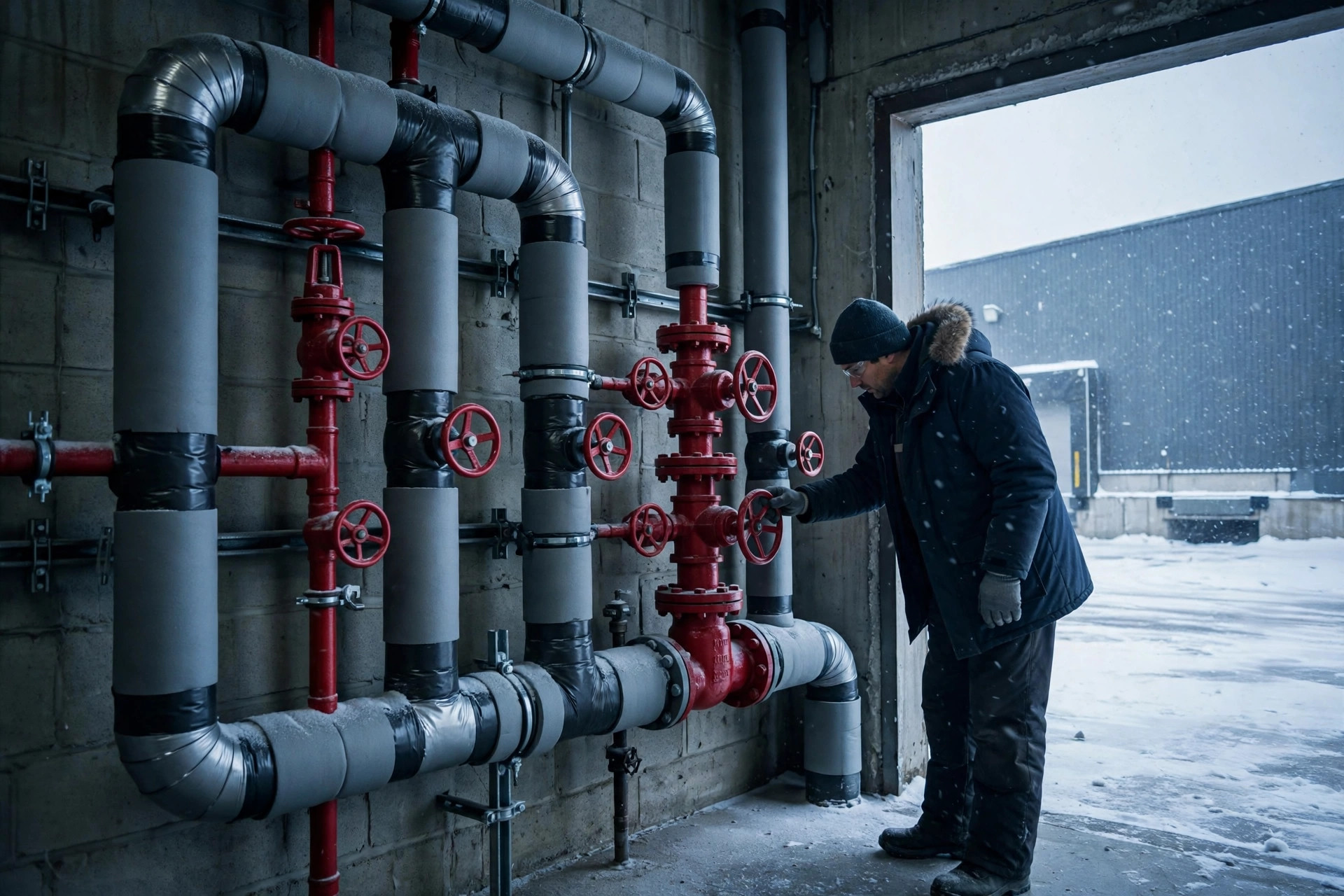
Fire protection pipework deserves separate attention because its failure mode differs from ordinary supply pipes. When a domestic pipe freezes, the consequence is loss of water. When a fire pipe freezes, the consequence is a system that cannot deliver water when it is needed, and that failure stays hidden until the moment it matters. Riser rooms, valve assemblies, alarm valves, and outdoor fire department connections all belong on a separate winter checklist. The check should confirm not only the insulation but also that valves still turn, pressure gauges read normally, and that heat trace and alarms are actually tested by someone.
Here the counterintuitive point matters: the thicker the insulation, the more disciplined the inspection must be. Lagging hides leaks and heat trace faults, so a pipe can freeze or seep slowly inside its jacket while the outside looks unchanged for weeks. Treating the completion of insulation as the completion of freeze protection is one of the most common winter management errors in warehouses. The remedy is to write inspection dates into the same record as the installation, revisit priority runs at least monthly, and add one more check before each cold snap. Any modification or repair to a fire system should follow the latest requirements of the local fire authority and the equipment supplier; where the requirement is unclear, confirm it rather than improvising. For fire code specifics, check the official source in your jurisdiction, since requirements vary and change.
A Pre-Winter Checklist You Can Actually Finish
The work above compresses into a list that a warehouse can realistically complete before winter, and it is the practical core of warehouse pipe freeze protection. First, walk every exterior run, riser room, and loading-dock pipe, and record insulation gaps and valve condition. Second, fit heat trace with power-loss alarms to the runs that must hold water in direct drafts. Third, drain seasonal runs, tag them, and name the person responsible for restoring them. Fourth, inspect the fire riser room and valve assemblies separately, and confirm that alarms are tested. Fifth, write down inspection frequency for cold snaps in advance, rather than improvising staffing when the forecast turns.
The broader trend is worth noting. Freeze protection is shifting from a once-a-year emergency project to a routine part of winter operations. The reason is structural rather than climatic: warehouses keep getting larger, unsupervised areas keep growing, and the time between a pipe failing and anyone noticing keeps lengthening. The protection itself is rarely expensive. Late discovery is expensive. A warehouse that surveys its pipes before winter, spends on the riskiest runs first, and keeps inspecting through the cold season has done most of the work. Which runs will trigger the first alarm in the next cold snap, and whether the checklist survives contact with a real winter, is something only the season itself will answer.
By Dr. Chen, Supply Chain Researcher