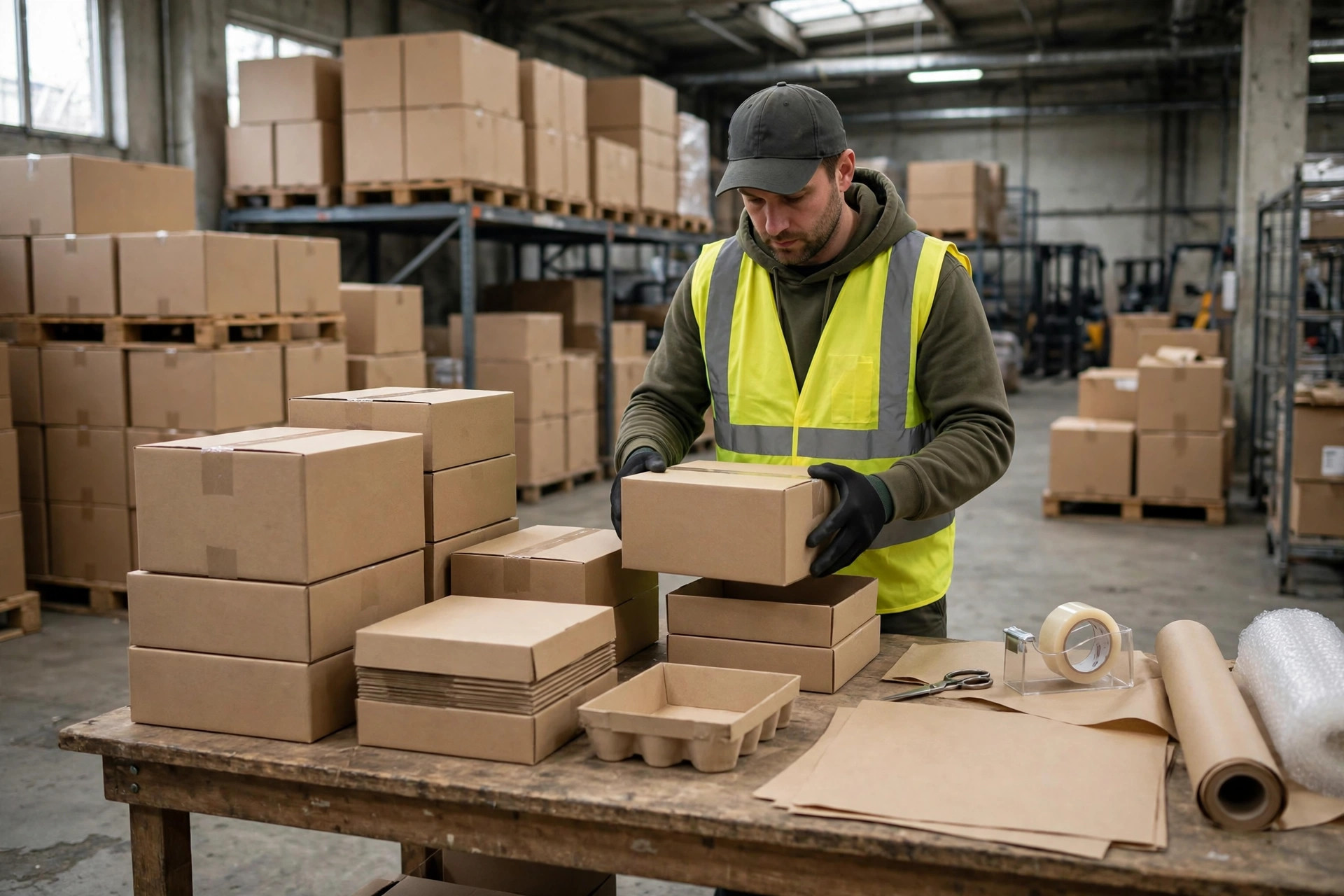
We small warehouses cannot afford to burn money like that. That is the first thought in my head every time I look at the pile of returned cartons stacked beside our packing benches. On paper, the warehouse packaging reuse cost question looks like free money: the box is already there, a strip of tape later it ships another order, and whatever you did not spend on a new carton is pure profit. After a few years running a small warehouse, I have learned to be suspicious of anything that looks free, because damage claims never arrive politely. A carton is a carton the first time, a maybe-box the second time, and a small gamble the third time. This is not a story about big-company systems. It is about how a small warehouse draws a line it can actually afford, between saving money and paying it straight back.
How we grade reused cartons for packaging reuse: use as-is, downgrade, or scrap
Here is our awkward starting point. Our warehouse is only a few thousand square feet, with a handful of packing benches, and in peak season the cartons left over from returns and unpacking pile up until they block the walkway. Throwing them away hurts, keeping them eats space, and workers grabbing whichever box was nearest is how we used to work, purely by feel. That ended one autumn when a batch of returned cartons that looked perfectly firm went out with light household goods, and a few orders arrived with split corners and scuffed contents. The payout was not huge, but the back-and-forth with customers dragged on for days. From that day on, every carton headed for a second life has to pass three homegrown checks: hand, eye, and weight.
The hand check is simple: squeeze the walls and corners, and if the board feels soft or damp, it is scrap. The eye check looks for water marks, oil stains, torn tape edges, crushed creases, and any stain you cannot identify; a box that touched something unknown does not ship, no matter how new it looks. The weight check asks whether the carton deserves this particular order at all, because heavy goods never go in a reused box, only light ones do. These checks sound crude, but they work precisely because they turn a judgment call into an action, and any worker on any shift performs the same three moves.
We grade every candidate into three tiers, and the tiers are posted on the wall above the packing benches so nobody has to ask. Tier one, use as-is, means the board is firm, dry, and undamaged, and the carton ships light, sturdy goods, exactly once more. Tier two, downgrade, means the board is slightly soft or carries old creases, so it only holds even lighter goods, or it stops being an outer carton altogether and becomes an inner divider or padding. Tier three, scrap, means damp, deformed, crushed-cornered, or smelly cartons never enter the packing flow at all. The beauty of this system is that it tests follow-through, not judgment. A small warehouse has no dedicated quality inspector, so the simpler the rule, the longer it survives.
One detail is easy to overlook, and it once cost us more than the cartons we saved. Old shipping labels on a reused carton must be completely removed before it reaches a bench. Once, in a rush, we left an old label half-torn on a box, the carrier scanned the wrong label, and the parcel went to the wrong place. The return freight alone cost several times what the carton had saved. Ever since, every reused carton gets a clean-face pass first: old labels off, old writing covered, unrecognizable before it counts as qualified.
Where packaging reuse savings go, and how damage takes them back
Saving money on cartons only means something if you count the damage in the same breath, because counting one side is just lying to yourself. Here is the homegrown formula we use now. It does not need to be precise to the cent; it needs to point in the right direction. Take the new cartons you did not buy, subtract the extra labor and tape that reuse costs you, and then subtract the extra damage payouts and customer-service hours that reuse creates. This is where the warehouse packaging reuse cost math gets honest, because the moment that last item starts climbing, everything you saved at the front quietly walks out the back.
Let me give you a second story. For a while we served a light-goods client whose products were light and hard to break, so we pushed the reuse rate high and watched packing costs slide downward. Everyone was pleased. Then the problem changed shape. Reused cartons come in mixed sizes, so a few boxes always stuck out on pallets and rubbed at the edges during loading, and some old tape gave way in transit. Looked at one order at a time, no single claim was large. Added up at month end, though, the service hours, reshipment freight, and quiet impression that our packing was sloppy were all real costs. A big company can absorb that impression with its brand. A small warehouse cannot, because losing one client hurts far more than saving a few pallets of cartons ever helps.
So here is the counterintuitive judgment that makes some people shake their heads: a higher reuse rate does not always mean more savings. Reuse has a sweet spot, and past that point, each extra reused carton saves pennies on board while gambling on damage, mis-shipments, and customer trust, which are the big-ticket items. Our current approach is to reuse only where we feel genuinely safe: light goods, short routes, and sturdy products get reused cartons gladly, while heavy, valuable, fragile, or long-haul multi-transfer shipments always get a new carton. That is not timidity. That is a small warehouse survival formula: saving small money is fine, gambling big money is not.
| Tier | What it can hold | How many second lives | Risk to watch |
|---|---|---|---|
| Use as-is | Light, sturdy goods | One only | Corner stress, old tape peeling |
| Downgrade | Lighter goods, or inner divider and padding | Never as an outer carton | Mixed sizes, pallet edge rubbing |
| Scrap | Nothing | Zero | Dampness, deformation, odor contamination |
Posting that table on the wall has another benefit: a new worker does not need to ask the old hands, because the table answers for them. A rule that lives only in a veteran worker's head leaves when that person leaves; written down and posted, it becomes the warehouse's actual system.
Three homegrown rules for warehouses like ours
Rule one: give reused cartons their own zone, never mixed with new cartons. Mixed together, busy workers cannot tell them apart, and the rule dies on contact with reality. Beside our benches we marked a reuse zone, and only cartons that passed all three checks may enter it. Everything else goes straight to scrap. Once the zones were separated, the cost of following the rule dropped immediately.
Rule two: write a no-go list that says exactly which shipments never take a reused carton: heavy goods, valuable goods, crush- or moisture-sensitive goods, and anything traveling a long, multi-transfer route all get new cartons, no exceptions. That list beats a vague instruction like try to use new cartons, because at the moment a worker hesitates, the list decides for them.
Rule three: spend half an hour each month reviewing three numbers on a sheet of paper, no fancy report needed: how many cartons we reused, how many damage cases were carton-related, and how much service time those cases consumed. If the damage column starts creeping up, we tighten reuse next month. If it stays flat, we can loosen slightly. A small warehouse has no data team, but that one habit beats gut feeling every time.
That is the warehouse packaging reuse cost lesson in one line: reuse is worth doing only when damage is counted beside savings, not after it. Big-company reuse systems are not something we can copy, and frankly we do not need to. They have dedicated staff, testing equipment, and a brand that absorbs mistakes. We have a few workers and one small warehouse. But that does not mean we have to save blindly. Grade the cartons, draw the no-go lines, and count damage together with savings, and a small warehouse can run reuse honestly. Every cent genuinely saved is real profit, and every claim avoided is a customer kept.
Small warehouses have their own way of surviving. We do not compete with big companies on show, only on who lasts longer and stays steadier.
By Xiao Ma, Small Warehouse Owner