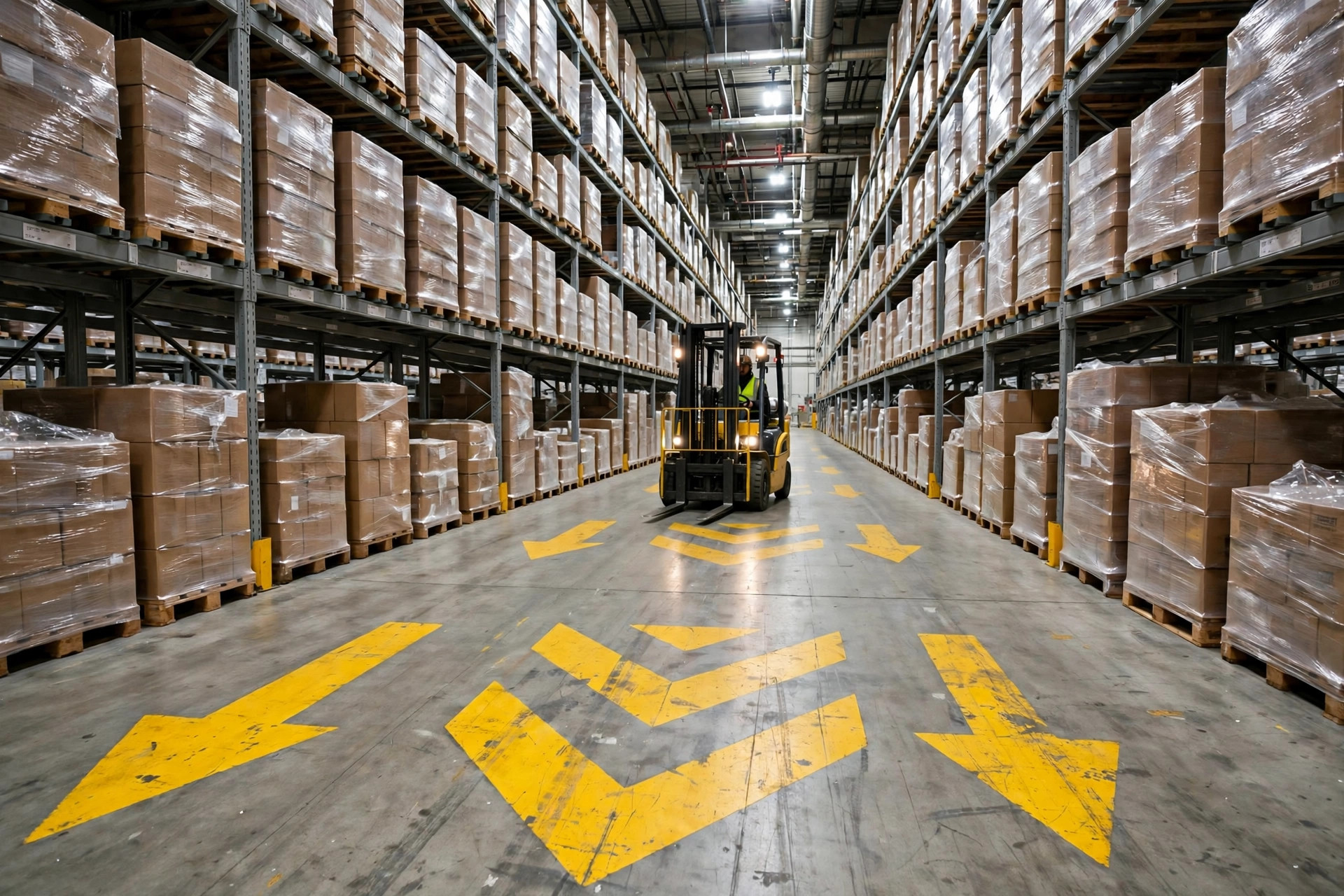
Here's my verdict up front: converting an old warehouse's two-way aisles into a one-way traffic loop is money well spent — but not every warehouse deserves it. I've seen too many operations hear that a one-way traffic flow retrofit cuts accidents and boosts efficiency, then rush to paint arrows across the whole building, only to discover their forklifts now drive extra laps every day and the fuel bill eats whatever the safety gains saved. This one cuts both ways, so let's lay both sides on the table.
The Three Real Pains of Two-Way Chaos
First, what's actually wrong with two-way aisles. A lot of older warehouses were built for convenience — aisles run both directions, forklifts meet head-on, and people walk right down the middle. Three real pains, all measured in money and safety.
One: head-on meets. Two forklifts coming at each other in a two-way aisle — one of them has to back up or yield. Half a minute lost per encounter, dozens of encounters a day, and the time just bleeds away. Worse is the blind spot: a forklift carrying a load can't see a thing ahead, so it meets oncoming traffic on horn and prayer.
Two: pedestrians and forklifts sharing space. Plenty of old buildings never got dedicated walkways — pickers push carts and carry cartons down the same aisle as the forklifts. A forklift-pedestrian incident isn't a fender bender; it's the serious kind. A warehouse I know had a forklift clip a walking employee back in 2018 — minor injuries, but two weeks of shutdown and a jump in insurance. That owner now says: money spent separating people from machines is never spent too late.
Three: pure disorder. Two-way aisles with no direction rules mean every driver improvises, and at peak hours the aisle intersections jam up. It looks like "flexibility," but really it pushes all the traffic-management cost into every driver's head — everyone judging, everyone yielding, minimum efficiency.
Bottom line: the problem with two-way chaos isn't that it's slow. It's that it's unpredictable. Slow you can plan around. Unpredictable, you can't plan at all.
A Pit I Walked Into Myself: The Retrofit That Made Trips Longer
Here's a pit I walked into personally. In 2020, a 3PL warehouse in the Inland Empire — 80,000 square feet, two-way aisles for over a decade, two forklift scrapes a year — decided to go one-way. A consulting firm drew the plan: a full-building one-way loop, clockwise main aisle, one-way feeders. Floor marking, signage, some rack relocation — a few tens of thousands of dollars and two and a half days of downtime.
The results? The good first: zero head-on forklift incidents in the first year, pedestrian conflict complaints gone. The owner was pleased and told the meeting the money was well spent.
But the price? A full-building one-way loop means some slots are "easy out, long way back." A forklift heading to the farthest slot from receiving can't come straight back — it has to circle around. Measured over weeks, forklifts averaged about 8% more travel per trip — hundreds of trips a day, and fuel and labor quietly crept up. Drivers grumbled: three minutes a trip became three minutes twenty.
This cuts both ways: big win on the safety ledger, small loss on the efficiency ledger. Net, that warehouse still came out ahead — because the repair and downtime cost of two scrapes a year dwarfed the extra travel. But that conclusion isn't universal. Put the same retrofit in a warehouse that barely had incidents to begin with, and the math can flip. So before you retrofit, run your own numbers — don't copy someone else's conclusion.
Laying Out the One-Way Loop: Width, Turns, Markings
If you do go ahead, three details deserve real attention.
First, aisle width. Two-way forklift aisles typically need 12 to 13 feet; one-way can squeeze down to 10 or 11. Two or three feet saved per aisle adds up to real slot capacity across a building. But that's a general range — how far you can squeeze depends on your trucks' turning radius, so use the manufacturer's spec sheets, not gut feel. Counterbalance and reach trucks turn very differently; in a mixed fleet, design for the clumsiest truck.
Second, turns and intersections. The killer failure of a one-way loop is the dead end: beautiful arrows on the floor, forklift drives in, discovers it can't turn around, and has to back out — reversing on a one-way aisle is more dangerous than two-way ever was. Before painting, walk the plan with an actual forklift. Leave generous turning radius at intersections, and put convex mirrors on blind corners. Don't cheap out on mirrors.
Third, markings. Floor arrows need to be big and frequent — small arrows disappear at forklift eye height. Put up one-way signs at key intersections, and use different colors for vehicle lanes versus pedestrian walkways. Do the marking once and do it right; painting arrows this year, adding signs next year, and filling in walkways the year after costs more in rework than doing it properly the first time.
The Retrofit Cost, Split Four Ways
People always ask what a warehouse one-way traffic flow retrofit actually costs. I split it four ways — order-of-magnitude references, since labor and contractor rates vary by market. Use them as a yardstick when you get quotes.
| Cost block | What it covers | Rough magnitude |
|---|---|---|
| Floor marking | Arrows, lane lines, walkways; grinding old paint + new coating | A few thousand USD (by area and complexity) |
| Signage | One-way signs, speed signs, convex mirrors, bollards | A few thousand USD |
| Rack relocation | Moving racks to free aisle width, re-labeling slots | A few thousand to low tens of thousands USD |
| Downtime | Lost throughput while marking and moving racks | Often the biggest line — price it by daily output |
See it? The biggest cost of a one-way traffic flow retrofit usually isn't the few thousand for paint — it's the downtime. A warehouse shipping 5,000 orders a day that shuts down for two and a half days loses far more in volume and customer trust than the paint job costs. So schedule the work in the slow season, break it into small phases, and don't do a "big bang" full shutdown to save on contractor fees — that's saving pennies and losing dollars.
And don't skip training. The first week after go-live, take fifteen minutes at the morning shift: walk the new loop, and drill the two or three intersections where people will get it wrong. A driver getting lost once is an accident; three times means the marking failed, not the driver — go fix the marking instead of yelling at people.
Which Warehouses Shouldn't Bother
Now the other side: which warehouses shouldn't do this at all.
First, small buildings moving under 30 pallets a day. Few trucks, few people, aisles never really congested — the incident probability you're buying down can't cover the retrofit cost. For a small warehouse, marked pedestrian lanes plus speed limits solve most of it. Don't do surgery where a bandage works. I saw a 20,000-square-foot building a couple of years ago, moving barely 20-odd pallets a day, whose owner insisted on going one-way. Over twenty thousand dollars in marking and rack moves, plus a day of downtime. Result? Incident rate was zero before, still zero after. Twenty grand bought peace of mind — money that would have gone a lot further on blue forklift spotlights and proper safety training.
Second, warehouses with a year or two left on the lease. A retrofit is a fixed-asset investment; if the landlord jacks the rent at renewal and you have to move, the paint money evaporates. With a short lease, spend on movable safety instead: training, removable signage, tighter procedures.
Third, slow-turn storage-heavy warehouses. Forklifts barely move a few times a day, head-on probability was low to begin with, and the time a one-way loop saves is negligible. That warehouse's real pain is slot utilization and cycle counts, not traffic flow.
A one-way traffic flow retrofit is good medicine with a clear effect — but the wrong diagnosis makes it a waste. I've seen too many warehouses take the medicine before diagnosing the illness. Before the first arrow hits the floor, answer three questions: how many traffic-related incidents a year? How long do forklifts sit jammed in aisles each day? How much extra travel will the loop add? Get those three numbers straight, then decide whether to do it and how far to go.
One line to close: a one-way loop cures disorder, not slowness. If your warehouse is chaotic, spend the money. If it's just slow, find the real cause first — paint isn't a cure-all.
By Lao Mi, Supply Chain Veteran (20 yrs)