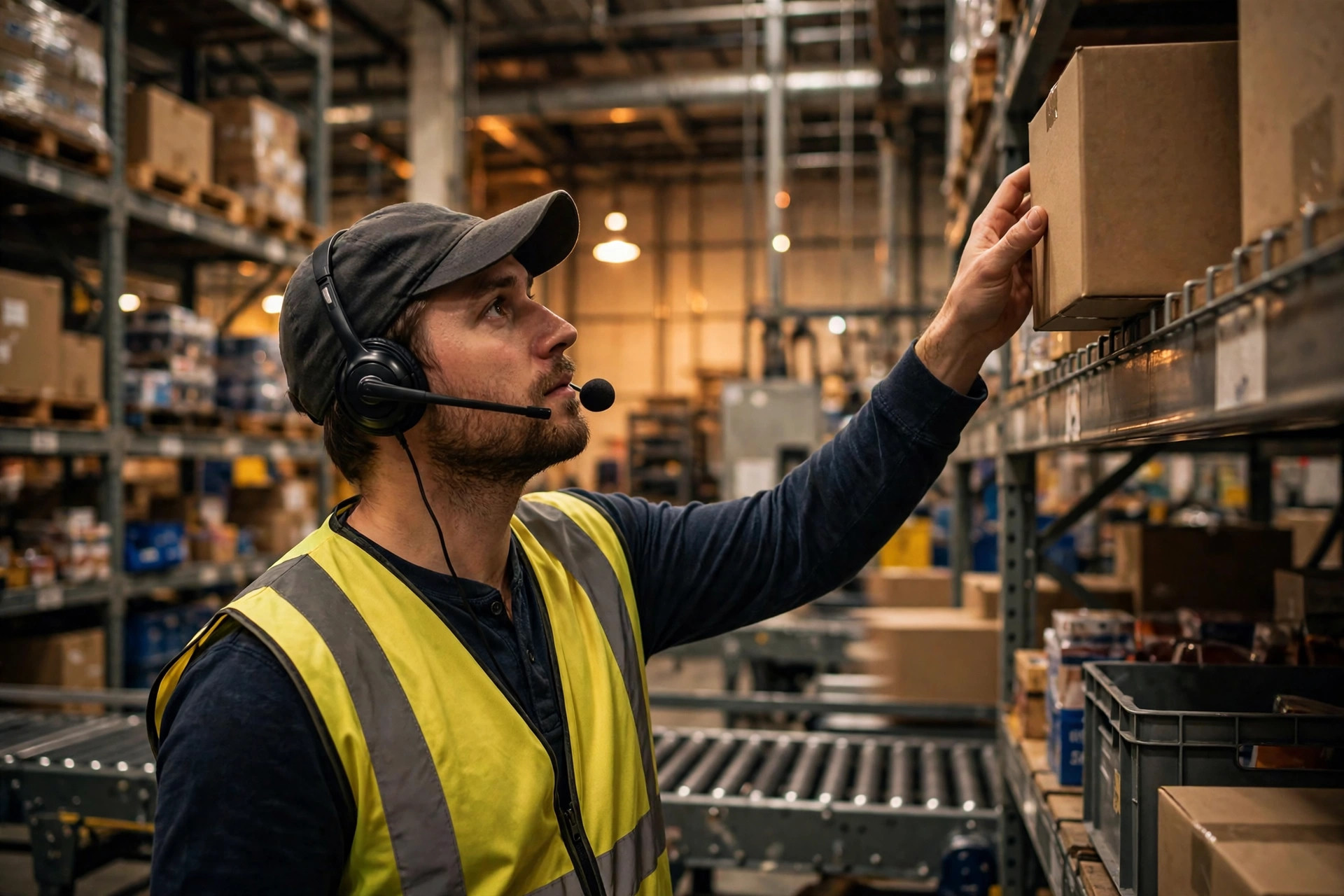
Let me be honest with you: about a year ago, I stood in my little 3,000-square-meter warehouse watching a sales rep's demo video of voice-directed picking, and I was drooling. The picker wore a headset, muttered a few words, and the system called out the next location — fast, accurate, beautiful. I thought: if I brought this into my warehouse, my guys who run around with paper pick lists all day would be flying.
Then the rep quoted a price, and I landed back on earth. Per-user monthly subscription, plus headsets from their approved list — one headset cost as much as three secondhand barcode scanners. Yeah, no. A small warehouse like ours can't burn money like that. But I couldn't let it go. The tech isn't magic — I use it on my phone every day. So why does it have to cost a fortune the moment it enters a warehouse? I decided to hack together my own scrappy version. This post is an honest report of the pitfalls we hit and the money we saved over the past year.
Speech Recognition Face-Planted on Day One in Our Warehouse
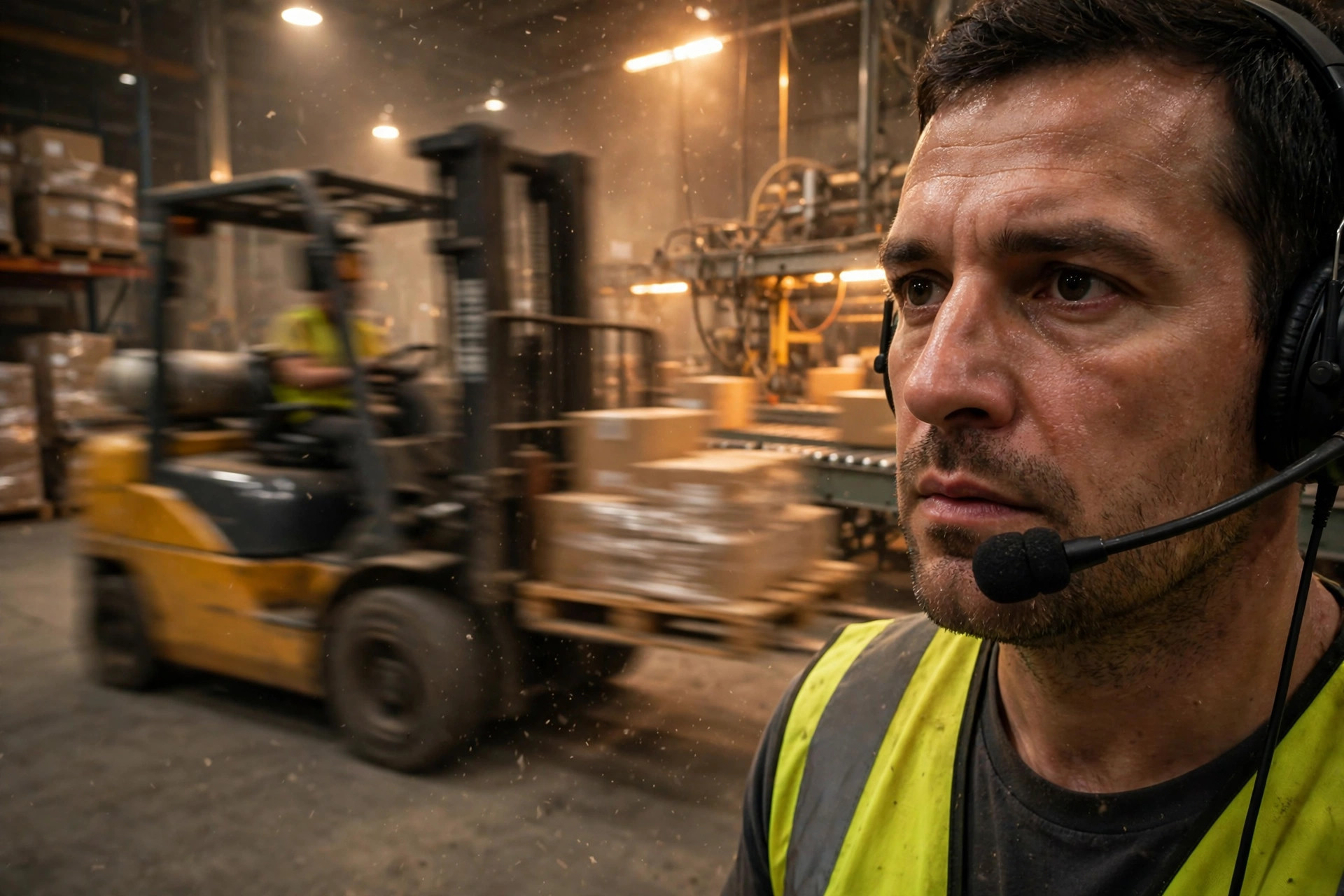
First, our noise baseline, so you have a reference point. Grab any decibel-meter app on your phone: next to our conveyor line, it hovers in the mid-80s all day. When a forklift backs up, the beeping spikes toward 90. In summer, with all the exhaust fans running, the whole place sounds like a giant beehive. That whisper-quiet warehouse in the demo video? Doesn't exist here.
My first scrappy setup was cheap Bluetooth earbuds plus a phone app — under thirty bucks a headset. On day one, our picker Xiao Zhang said "confirm" into the earbud, and the system replied "please repeat." He said "next order," and it jumped to "cancel." That morning, four out of ten commands went wrong. Zhang ripped the earbud out: "Boss, this thing is worse than me just yelling." That day I learned the real lesson: in an 80-plus-decibel warehouse, the biggest enemy of speech recognition isn't the algorithm — it's the environment. Why do the big-company demos look so smooth? Either their warehouses are big enough to zone off quiet areas, or they turned the conveyor off for the demo.
Can Speech Recognition Actually Hear Anything at 85 Decibels?
Cold water first, with a counterintuitive bit of math: 95% recognition accuracy sounds great, right? In a picking workflow, it means 1 mistake in every 20 commands. Pick 300 orders a day, and that's 15 interruptions for corrections. So don't get hypnotized by "95% accuracy" — in picking, you need something closer to 98% before it stops being annoying. Each correction — stop, repeat, confirm — eats half a minute. Over a day, you're losing the better part of fifteen minutes just to corrections, not counting the cost of a wrong pick that ships out.
Noise doesn't hurt accuracy evenly, either. We ran our own crude tests — same people, same command list, a hundred tries per shift, counting the misses. First thing in the morning, before the warehouse is at full speed, recognition is decent. Come the afternoon shipping rush, with forklifts, conveyors, and pack stations all running, the error rate more than doubles. The worst is sudden noise: a forklift backup beeper, a pallet slamming down with a bang. Those drown out the keyword entirely, and the system either mishears or just gives up.
Then there's the accent problem. Zhang is from the northeast, Lao Li is from Henan, I'm from Sichuan. Our "confirm" command came out of Lao Li's mouth sounding like something else entirely, and the system refused to learn it. We eventually switched from single-syllable commands to fixed two-syllable words — "got it," "repeat," "next" — and had everyone record a few dozen samples for adaptation. Things improved. Hard-won lesson: before you buy any system, have the guy with the thickest accent in your warehouse test it first.
The Scrappy Trio: Mic, Command Words, and Knowing When to Quit
The enterprise playbook says "full acoustic retrofit plus a custom voice model." We can't afford that. Our scrappy approach has three moves, and none of them cost much.
Move one: don't cheap out on the mic. Regular Bluetooth earbuds are toys in our warehouse — one gust of wind, one passing forklift, and it's all static. We switched to noise-canceling boom headsets, with the mic sitting close to the mouth and directional pickup. Night and day. They cost two or three times what earbuds cost, but still a fraction of the vendor-approved models. Rule of thumb: spend most of your budget on the mic, not the software — a bad mic kills any algorithm.
Move two: design your own command words. Don't use the system defaults like "confirm/cancel" — they collide with background noise too easily. Our final command set: "start" to begin, "got it" to confirm, "say again" to repeat, "next" to skip. All distinct-sounding, all short, all hard to confuse even with an accent. Fewer is better — we ended up with six commands total, and the pickers memorized them in half a day. The vendor's deluxe package with thirty commands? We don't need it. Six is plenty.
Move three: retreat on schedule. This is the scrappiest and most effective move. Our rule: during the two-hour afternoon shipping rush, when noise peaks, the voice system automatically switches back to barcode scanning. Pickers don't have to think about it — the system just announces "too noisy, switching to scan mode." Sounds cowardly, right? But the math is brutal: forcing voice during peak hours wastes more time on corrections than scanning ever would. Scrappy, but it works.
Running the Numbers: Is Voice Picking Worth It?
Lao Zhou — the numbers guy among our circle of small-warehouse owners — made me do the math. Here's the table, judge for yourself:
| Voice picking (scrappy version) | Pure barcode scanning | |
|---|---|---|
| Hardware per person | Noise-canceling boom headset, a few hundred bucks | Barcode scanner, a few hundred bucks |
| Software cost | Phone app, annual fee or one-time purchase, a few hundred per person per year | Free (comes with the WMS) |
| Training | Half a day (six commands) | One hour |
| Pick speed | Hands-free, roughly 20% faster on bulky-item lines | Hands tied up, awkward with big items |
| Error cost | On the order of 1 miss per 20 commands when noisy | Mis-scan caught on the spot, quick to fix |
| Best fit | Big items, full cases, jobs where both hands are busy | Small items, high SKU variety, quiet areas |
The honest conclusion: if your warehouse handles a lot of bulky or full-case picks, voice is worth it. Hands-free picking is genuinely great — on our bulky line, the speed gain was visible to the naked eye. If you're all small items and high SKU counts, stick with scanning — the correction overhead will drive you insane. We ended up with a hybrid: voice on the bulky line, scanners on the small-items line.
The payback math is simple: 8 pickers, 3 of them on the bulky line got voice. Hardware plus software for year one came in under ten grand. The bulky line picks about 20% more per person per day, and at our labor cost, the investment paid for itself in under four months. For a small warehouse doing voice: never go all-in on day one. Pilot one line. If it works, expand. If it doesn't, your loss is contained.
The Enterprise Playbook Doesn't Fit Us: A Scrappy Checklist
For fellow small-warehouse owners, here's the checklist we earned with real money:
- Measure your noise before you talk solutions. Walk the floor with a phone decibel app. If the mid-80s are your normal, don't expect voice to work out of the box — fix the mic problem first.
- Let the thickest accent test first. If he passes, the whole warehouse passes. If he can't, walk away early.
- Design your own commands, and keep them few. Six or fewer, distinct-sounding, two syllables if you can.
- Surrender to the noise at peak hours and switch to scanning. Don't fight physics — the efficiency math will teach you humility.
- Pilot one line first. Never roll out warehouse-wide. Expand when it works.
- Spend on the mic, save on the software. A noise-canceling boom headset is non-negotiable; start with cheap software and upgrade once it's running smoothly.
To a big company, speech recognition is a "digital transformation lever." To a small warehouse like ours, it's just a practical tool that lets the crew make two fewer trips and free up their hands once in a while. No need to envy the enterprise full-suite package. Small warehouses have their own way of surviving: spend little, solve small problems, bank small wins. Add them up over a year, and the savings cover an extra month's bonus for the crew.
By Xiao Ma, Small Warehouse Owner