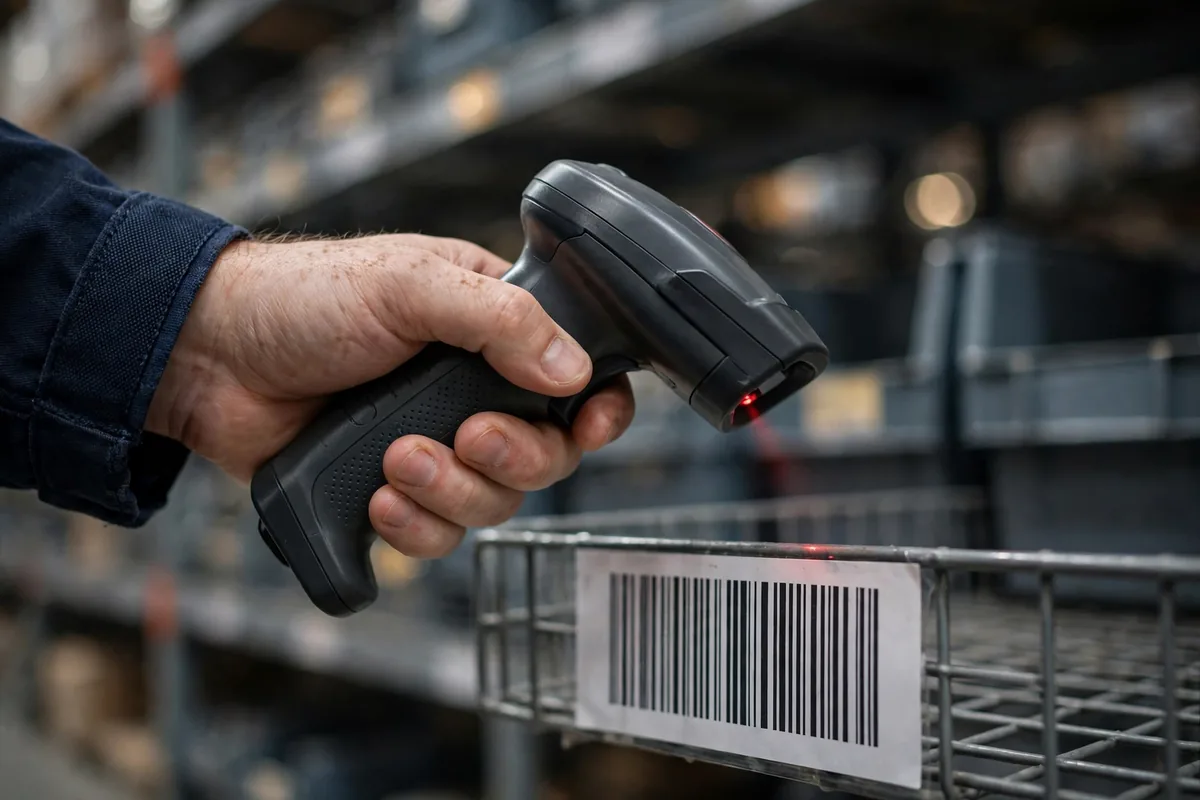
Excerpt: A warehouse location code check digit is not decoration. It is the last checkpoint that catches a wrong location code at the moment of scanning, before the goods go to the wrong place. This article explains what it protects against, how it works, and when it is not worth adding.
Let me give you the verdict first: a location code check digit is worth adding, but not for every warehouse. To put it bluntly, it does not protect you against typos in the abstract. It protects you against the much worse situation where a wrong code is scanned, accepted without complaint, and only discovered days later when the inventory no longer matches reality. A location code travels through labels, handhelds, spreadsheets, and the warehouse system. One wrong character is enough to send goods to the wrong slot, pick the wrong product, and throw the whole count out of balance.
I learned this the hard way in a third-party warehouse in Ontario, California. It was the autumn of 2023, just before peak season, and the site had replaced a batch of location labels. A picker scanned A-12-34-2 for putaway, the system showed no error, and the goods went in. Two weeks later, during a cycle count, location A-12-34-2 showed 400 cases on the books but only 60 cases on the shelf. The rest were sitting next door in A-12-34-7. When the labels were printed, the 2 and the 7 came out blurred, and someone had copied the wrong digit during manual entry. With no check digit, the system had no way to know that the code was wrong. It accepted it happily. In the end, 12 people spent two nights opening cartons and reconciling stock, and the site nearly lost a major client over it.
A second case was quieter, and therefore harder to catch. In a Dallas e-commerce warehouse in early 2024, the team moved from a three-segment location code to a four-segment code. Experienced staff typed locations from memory, and B-08-15 became B-08-51. The digits were simply transposed. Nothing was lost and the books still balanced, because both locations genuinely existed and the system recognized both. The result was pickers walking extra distance every day for three weeks while the supervisor investigated the process, the layout, and the staffing plan, before anyone thought to question the code itself. That is the worst kind of error: one that is perfectly legal as far as the system is concerned.
What a Location Code Check Digit Actually Protects Against
A warehouse location code check digit is a self-check character appended to the end of a code. It is calculated from the rest of the code by a fixed rule. When the code is scanned or typed, the system recalculates it. If the result does not match, the scan is rejected on the spot, before anything is put away or picked incorrectly.
It mainly catches three kinds of mistakes:
- A single-character error: one digit misread, misprinted, or mistyped, such as 2 read as 7.
- A transposition error: two adjacent digits swapped, such as 15 typed as 51.
- A mixed-code error: one location's code copied onto another location, or an old coding scheme carried into a new system.
It does not catch the case where the location code is correct but the wrong goods are placed there. A check digit validates the code, not the goods. That distinction has to be clear before go-live, or people will treat it as a cure-all and blame the system when a different kind of error still happens.
How a Location Code Check Digit Works: A Worked Example
There are many algorithms. The idea below is a simplified illustration of the most common approach, so you can see the logic. Before you implement anything, fix one rule for your whole operation and write it into your standard operating procedure.
| Step | What you do | Example |
|---|---|---|
| 1. Take the base code | Remove the check digit, keep the rest | A-12-34 |
| 2. Weight each digit | Multiply digits alternately by 3 and 1 from left to right | Each digit gets a weight |
| 3. Sum and take the remainder | Add the products and take the remainder when divided by 10 | Suppose the sum is 47, remainder 7 |
| 4. Generate the check digit | Subtract the remainder from 10 | 10 minus 7 equals 3, so the full code is A-12-34-3 |
This is an illustrative example, not a claim about any particular official standard. The strength of the method is not in how clever the math is. It is in using exactly one algorithm everywhere: scanners, handhelds, and manual entry all run the same check. Changing algorithms halfway through is worse than having none at all.
Now run the numbers as a worked example. Suppose a warehouse scans 8,000 times a day for putaway and picking combined. If the wrong-code rate is just 5 per 1,000 scans, that is 40 wrong-code events a day, or roughly 1,200 a month before anyone improves the process. If each event costs two people an hour each to find the goods, correct the record, and re-verify, that is 2,400 labor hours a month tied up in rework. A check digit costs a one-time effort in development and relabeling, and then it keeps saving that time every day. On the other hand, if your site scans fewer than 500 times a day and has fewer than 300 locations, manual double-checking may already keep up. In that case, fixing label clarity and the review process first is more useful than adding a check digit.
A Check Digit Rollout in Four Steps
First, freeze the coding rules. How many segments, how many characters per segment, letters or numbers: decide once, and put it on a single page that everyone can see. Adding a check digit before the rules are frozen is like building on sand.
Second, enforce the check at every entry point: the scanner, the handheld device, and the manual entry screen. Covering only one entry point is the same as covering none. The error message should speak plainly, for example: "Location code failed validation. Please check the label and scan again." A bare error code helps nobody on the floor.
Third, relabel in batches. Start with the high-frequency picking zones and the areas where characters are easily confused, such as the digit 2 versus 7, or the letter O versus the digit 0. Never relabel the entire warehouse in one go right before peak season.
Fourth, keep an authorized exception path. Damaged labels and temporary locations will happen. They need a supervisor-approved exception that leaves a trace. Without an exception path, people under time pressure will bypass the system and the check digit becomes decoration. Without a trace, the exception becomes an unmonitored back door.
A Counter-Intuitive Judgment
Most people assume a more complex check digit is safer. In practice, the opposite is often true. I have seen a warehouse use a two-character check with mixed letters, and pickers could not remember the rule. When they typed a code by hand, they copied it, guessed, and then asked a supervisor for an exception when the system rejected it. Exceptions eventually outnumbered normal scans. A check digit only works if the people on the floor are willing to use it. A simple rule that everyone can follow beats a theoretically perfect rule that nobody follows.
There is also a trade-off worth naming: a check digit makes the code longer. One extra character means reworked labels, a field length that may be too short in an older system, and a higher memory load for experienced staff. Before go-live, confirm that the system field, the label size, and the print template can all hold that extra character. Discovering a truncated field on launch day is an avoidable embarrassment.
In the end, a check digit buys you one thing: knowing immediately when a code is wrong, instead of finding out during a cycle count. The bigger the warehouse, the longer the codes, and the more people handling them, the better that purchase looks. For a small, simple operation, get the basics right first, and add the check digit when the scale justifies it.
By Lao Mi, Supply Chain Veteran (20 yrs)