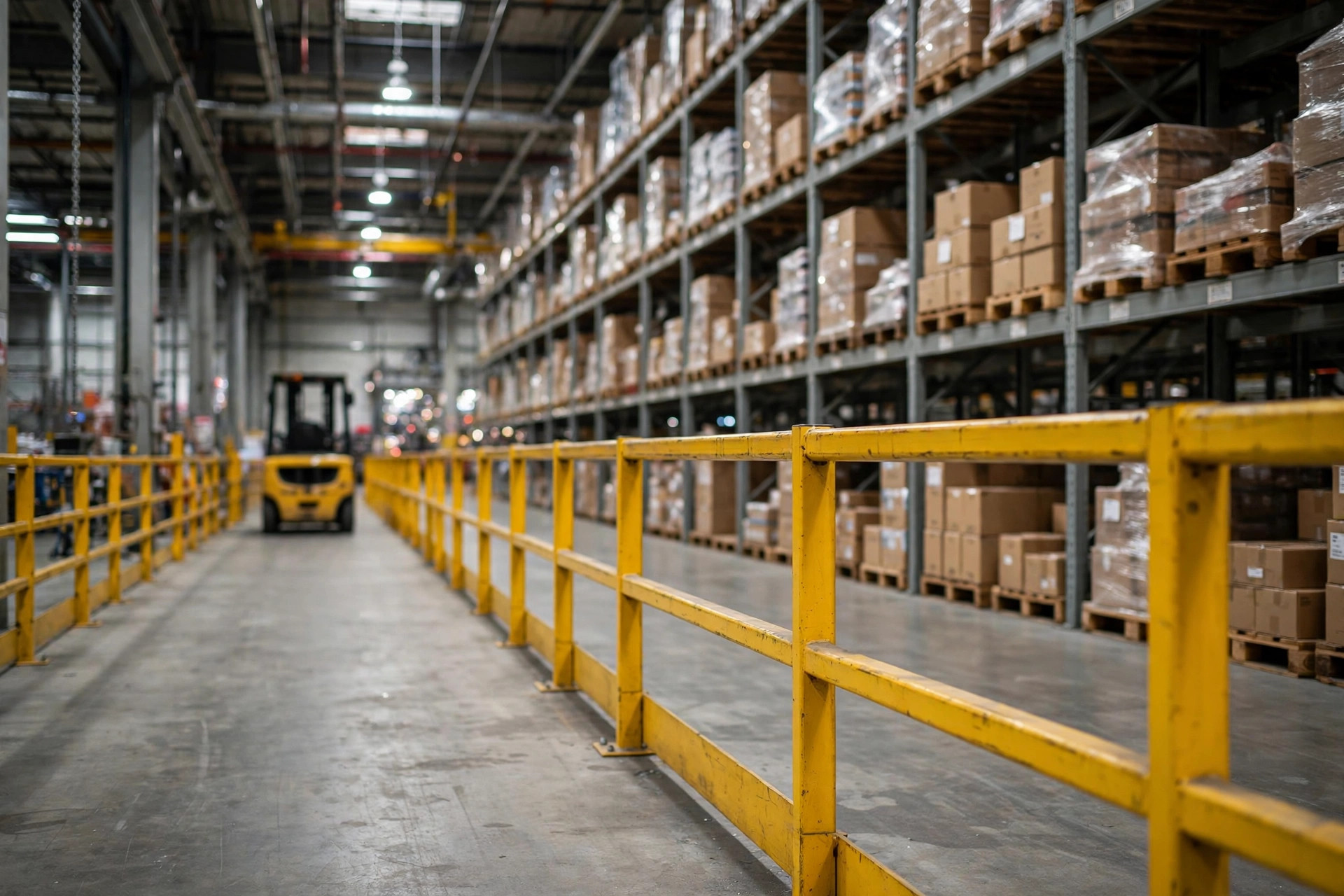
A Fontana facilities manager asked me for the warehouse guard rail cost per foot — one number, no hedging. This was November 2025: an 80,000-square-foot 3PL warehouse, three quotes on his desk ranging nearly 2x from low to high.
I didn't answer. I asked him three questions back: single-rail or double-rail? How many linear feet? And what post spacing? He went quiet — because the entire difference between those quotes was hiding inside those three questions.
Here are the three calculations I walked him through. Run them yourself before you request a single quote.
Calculation 1: Warehouse Guard Rail Cost Per Foot Starts at $35/$60 — Then the Fine Print Starts
Start with the manufacturer's published numbers. Handle It's official FAQ lists roughly $35 per foot for single-rail guard rail and roughly $60 per foot for double-rail. Those are manufacturer list prices; actual pricing varies with steel gauge, wall thickness, and finish — check the vendor's current published pricing.
| Type | Reference price (USD/ft) | Where it belongs | | Single-rail steel | about 35 | Pedestrian-only walkways, rack-end protection against light contact | | Double-rail steel | about 60 | Forklift aisles, dock areas, anywhere real impact is possible | | Polymer (HDPE) | Quoted per section/kit; typically above steel single-rail per foot | Food/pharma where chipped paint and rust are unacceptable |
Polymer guard rail is usually quoted per section or kit, and its per-foot cost typically lands above steel single-rail — confirm against the manufacturer's current quote. You're not paying for cheap; you're paying for rails that flex back after impact and never shed paint or rust. In a food facility, one paint chip in the product line costs more than the entire guard rail run.
The single-to-double price gap is about 1.7x. What you buy is the second rail and meaningfully higher impact resistance. Don't economize in the wrong place: where forklifts and pedestrians share space, one sideswipe repair will cost you more than the upgrade spread. I've run this math for three clients. Same answer all three times.
Calculation 2: Post Spacing Decides the Real Cost Per Foot
The easiest place to hide margin on a guard rail quote isn't the per-foot price — it's the post spacing.
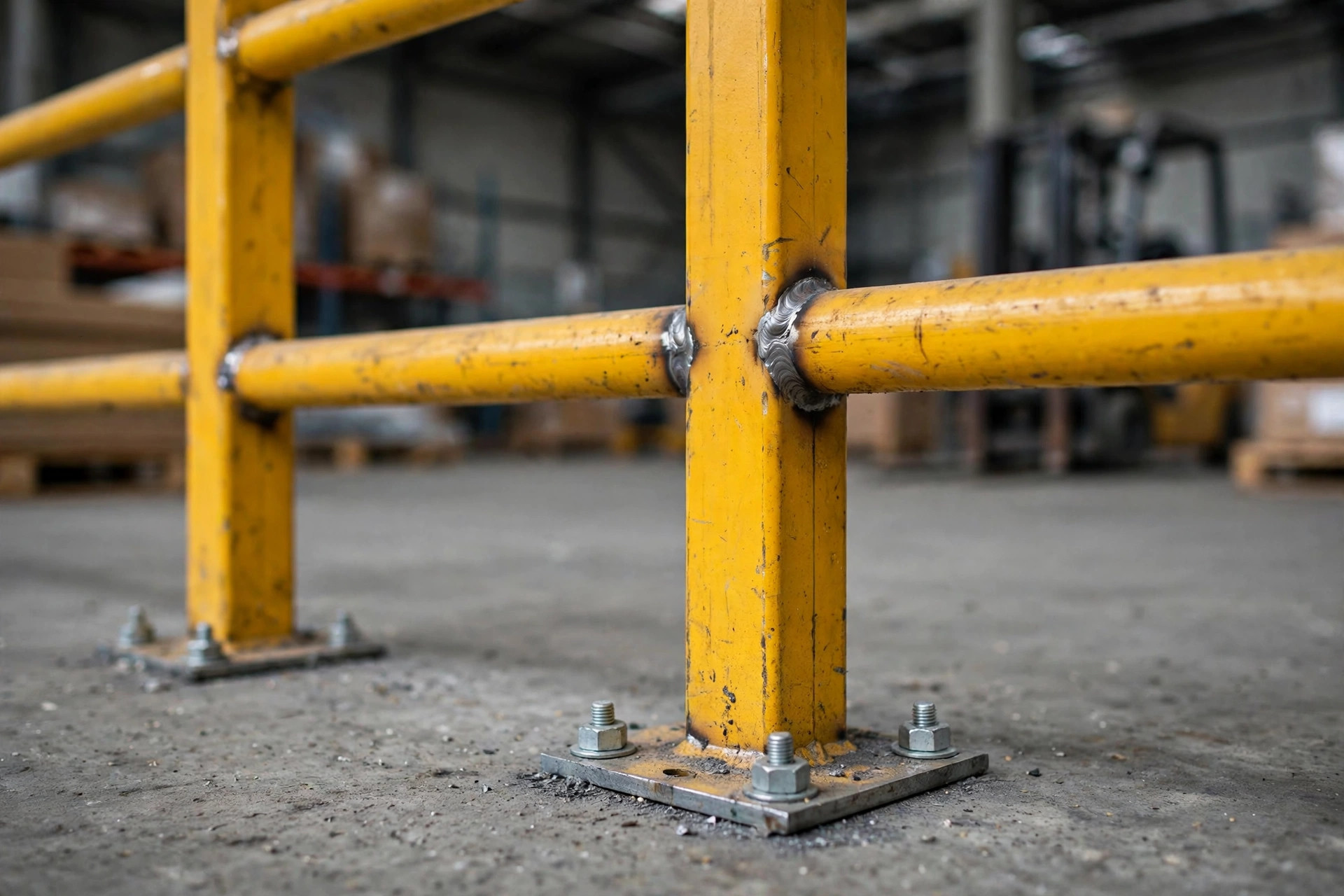
Guard rail is sold as rails plus posts. On a 120-foot run, 8-foot post spacing means 16 posts; 4-foot spacing means 31. Posts, base plates, anchor bolts, and install labor all roughly double — total cost per foot swings 30%-50%. That's a rule-of-thumb range; read the line items on the actual quote.
In February 2026 I reviewed quotes for a 50,000-square-foot facility near Dallas: same 200-foot forklift aisle, Vendor A at 8-foot spacing, Vendor B at 4-foot spacing. Vendor B was 42% more expensive overall. B's rep said "ours is stronger." Strength is proven by test data, not post density — thin-wall tube at 4-foot spacing still loses to heavy tube at 8-foot spacing. Make the vendor put the impact rating in writing: the common benchmark is 10,000 lbs at 4 mph, a manufacturer test standard, not an OSHA mandate. Any quote without that line gets compared as bare steel.
Two costs quotes routinely omit:
- Installation labor: if you have an in-house maintenance team, cost it at internal hours; outsourced install is usually quoted per project or per foot — get local contractor pricing. A 120-foot run is roughly a day's work for a two-person crew.
- Floor condition: cracked slabs or utilities below mean the anchor-bolt plan changes after someone actually looks at the floor. That surcharge never appears in the first quote. It specializes in ambushing first-time buyers.
So never ask only "what's the price per foot." Ask four questions: single or double rail? Post spacing? Impact rating in writing? Is install and floor prep included? Four answers, and the warehouse guard rail cost per foot has nowhere left to hide.
The OSHA Red Lines: 42 Inches and 200 Pounds — Get Them Wrong and the Rail Is Decoration
Whether OSHA inspects you this year or not, one failed inspection costs more in remediation than the original install. Two numbers to memorize:
- Height: top rail 42 inches above the walking surface (±3 inches tolerance), midrail around 21 inches. That's the guardrail system spec in OSHA 1910.29 — verify against the current version on OSHA's website.
- Strength: the top rail must withstand a 200-pound concentrated load, applied downward or outward. Same clause; ask the vendor for the test report at acceptance.
One common misunderstanding to correct: OSHA 1910.29 is a fall-protection rule. There is no OSHA clause that says, word for word, "thou shalt install forklift impact guard rail in warehouses." But the 42-inch/200-pound parameters have become the industry's default acceptance line — insurers check it, fire marshals check it, customer audits check it. Install to that standard and inspections stop being scary. Install below it and you've spent the money without reducing the risk.
The Counterintuitive Part: The Most Expensive Guard Rail Is the One in the Wrong Place
In April 2026, a 60,000-square-foot warehouse in Riverside installed 150 feet of double-rail guard rail to protect a pedestrian walkway. Two weeks later the annual fire inspection concluded the rail encroached on the fire egress path's required clear width. Removal, relocation, re-drilling anchors, floor patching — the rework cost nearly half the original installation.
The rail itself was never the expensive part. The location was. Before installation, measure three things with a tape: the fire egress minimum clear width, forklift turning radius, and dock door swing. If any one conflicts, revise the drawing first — not after the anchors are in the concrete.
A Five-Year View: Where the Real Money Goes
Material cost is a one-time number; the five-year number is what your CFO actually pays. Roughly:
| | Single-rail (pedestrian zone) | Double-rail (forklift zone) | Polymer | | 120-ft material | about $4,200 | about $7,200 | Per-section quote, above single-rail | | 5-yr repair exposure | Low (no vehicle contact) | Low-moderate | Minimal (flexes back, no repaint) | | Wrong application penalty | High — one forklift hit can total it | Low | Low |
The pattern: the cheapest rail in the right place beats the most expensive rail in the wrong place, every time. A $4,200 single-rail run protecting a true pedestrian walkway is money well spent. A $7,200 double-rail run installed six inches into the egress path is $7,200 plus a rework bill.
The Calculable Conclusion
For a 120-foot pedestrian run: single-rail at $35/ft is $4,200 in materials; double-rail at $60/ft is $7,200 — a $3,000 spread. Anywhere forklifts mix with people, that $3,000 is the cheapest insurance you'll buy in the next three years. When quoting, pin down post spacing, the impact rating, and whether install is included in one pass — warehouse guard rail cost per foot is calculated per foot, but it is decided at the posts and the location.
By Lao Zhou, Logistics Cost Analyst