Let me start with the money, because that is where this story ends anyway. Take an industrial control board at $65 a unit (hypothetical example) — the kind of stock warehouse esd protection electronics storage is meant to protect. One pallet holds 200 boards, $13,000 of stock. Static discharge kills 40 of them: $2,600 gone. The customer sends the whole batch back, and rework, retest, and rush replacement freight add another $4,000 or so. The expensive part is the customer: that account moved more than $400,000 a year through this warehouse, and at renewal it moved most of that volume to another 3PL. I worked out those numbers in the winter of 2024, reviewing an electronics warehouse's books after exactly this kind of incident. Nobody in a warehouse thinks static protection matters — until one incident costs half a year's profit.
That is the real question behind warehouse esd protection electronics storage: static is invisible and silent, the dead boards show no mark at all, and the losses are entirely real money.
How Static Actually Kills a Board
Start with a number most people do not know: a person only feels a static shock at around 3,000 volts, while many metal-oxide semiconductors fail at just 80 to 100 volts. The static that kills a board is far below what you can feel. The most sensitive parts can fail at around 20 volts. By the time you feel the zap, the board has already died a dozen times over.
The core standard is ANSI/ESD S20.20-2021, current edition published in 2021. It covers parts sensitive to discharges of 100 volts human body model (HBM) and above, and 200 volts charged device model (CDM) and above, and it limits the voltage on isolated conductors to below 35 volts. The European counterpart is IEC 61340-5-1, broadly aligned. These are the two standard numbers to start from; everything else is opinion. Exact limits should be checked against the standard text itself.
Where does the charge come from? People walking are the biggest source. Published data makes the point: at 20 percent relative humidity, a person walking across a vinyl floor can build up 12,000 volts; at 80 percent, the same walk generates 250 volts. A 60-point swing in humidity changes the charge by a factor of dozens. In winter, when heating dries the air and warehouse humidity drops into the 20s, static risk roughly doubles — which is why electronics warehouses see incidents cluster in winter.
There is a nastier failure mode: latent damage. A board takes a static hit, passes every test at receiving, and fails three months later in the customer's hands. The internal damage from the discharge degrades slowly until the board stops working. Receiving inspection cannot catch it, outgoing sampling cannot catch it. You only find out when the customer sends it back. In 2023 I worked a case for a consumer electronics contract manufacturer: the return rate crept up for three straight months. We checked incoming material, we checked process, and the cause turned out to be the warehouse. That winter it had switched to ordinary plastic totes. Boards rubbed against the plastic, picked up charge, and handlers moved them bare-handed. A whole batch was hit. The totes went back, and the return rate dropped the same month.
The Warehouse ESD Protection Electronics Storage Ledger: Four Investments Against One Incident
What does protection cost? Break down the structure. The table below is a hypothetical example: a 2,000-square-meter electronics zone with 20 operators. The figures are a scenario illustration; actual quotes should come from vendor documentation:
| Investment | One-time cost (hypothetical) | Annual upkeep (hypothetical) | What it controls | | ESD flooring | about $25,000 | about $700/year testing | The discharge path for charge from walking | | Rack grounding and conductive totes | about $8,000 | about $1,100/year replacement | Charge on stock sitting on racks and in totes | | Personnel protection (wrist straps, smocks, shoes) | about $2,000 | about $1,400/year replacement | The moment a hand touches a board | | Humidity monitoring and humidification | about $5,500 | about $1,700/year energy | Keeping humidity above the 30% floor | | Total | about $40,500 | about $4,900/year | — |
Now the loss side, same hypothetical scale — double the opening pallet: direct goods loss about $5,200, retest, rework, and rush replacement about $8,000, and customer claims plus lost business above $40,000 a year. Put plainly: one decent incident costs enough to pay for the whole zone's protection twice over. Whether that money was wasted is not a matter of opinion. The ledger is right there.
Here is the counterintuitive part: the most expensive item is often not the most effective one. The flooring is the big ticket at $25,000 — but if operators handle boards bare-handed, the best floor in the world does nothing, because the discharge goes straight from hand to board and never touches the floor. The $2,000 of wrist straps, smocks, and shoes, plus one hard rule — boards never leave their bags, hands never touch a board without a wrist strap — prevents more incidents than the floor does. Spend first where the money is closest to the board.
The flooring itself needs care too. ESD floors come in conductive and static-dissipative types, and dissipative floors generally measure between 10 to the 6th and 10 to the 9th ohms of surface resistance — a range that recurs across published material. When buying, do not just compare quotes; ask for the resistance figures on the test report, and check the grounding is actually connected. I have seen beautiful flooring with a ground wire that went nowhere. Acceptance is one test: measure it. Resistance in range and grounding continuous, or it does not count.
Humidity money is not optional either. ANSI/ESD S20.20 recommends relative humidity above 30 percent and below 70 percent, and an industry handbook calls 40 to 60 percent desirable inside a protected area. The warehouse approach: hold the floor at 30 percent, humidify below it, and do not overthink the ceiling — below 60 percent is generally fine for electronics storage. Put the hygrometer in the work zone, not by the office door, log the reading daily, and check it twice a day in winter.
Warehouse ESD Protection Electronics Storage: Spend Where It Counts
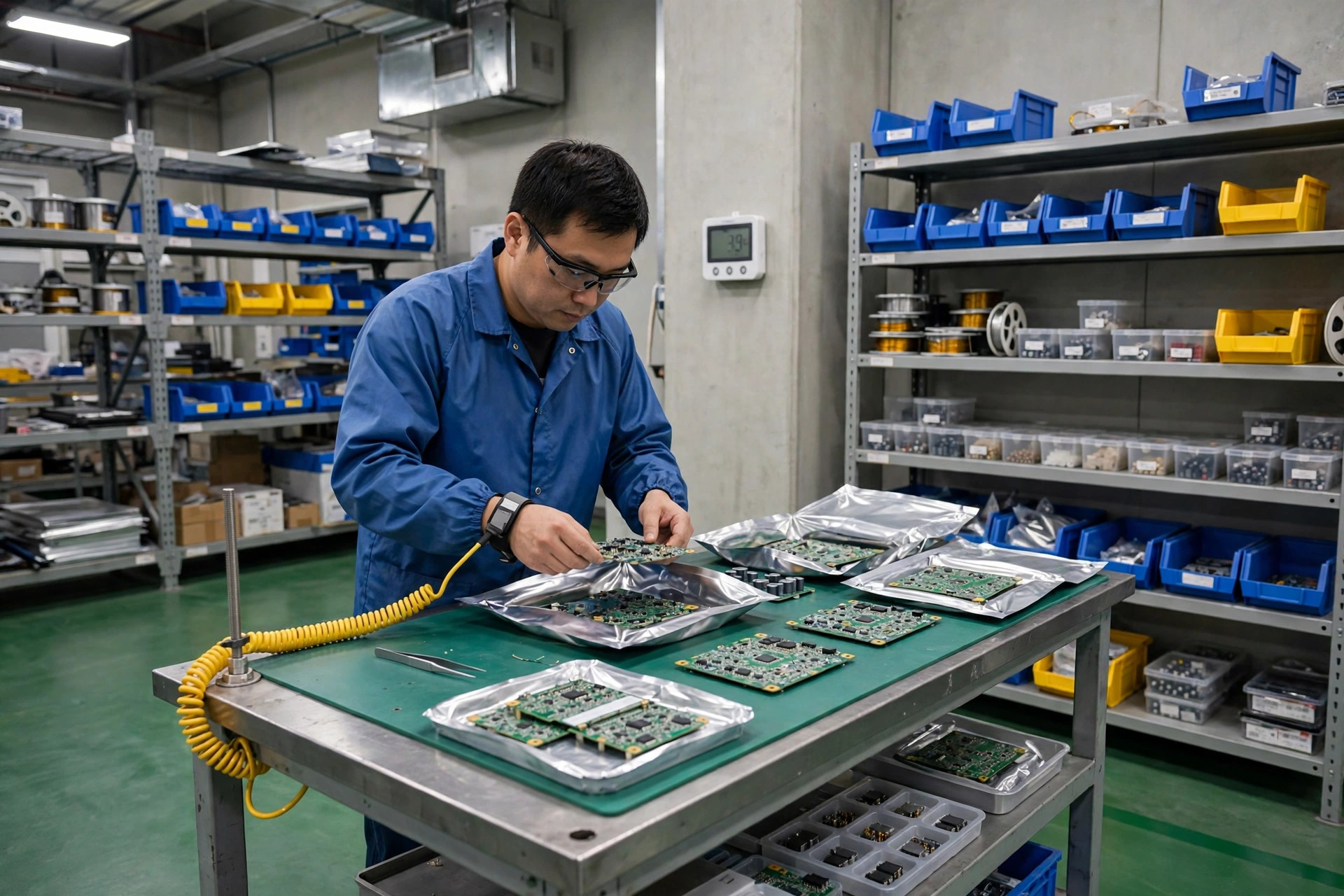
The first lever is zoning before spending. The whole warehouse does not need to meet the static standard. Sensitive goods — boards, modules, chips — get one marked ESD protected area, and the protection money goes only there. Cartons, cables, and structural parts that are not sensitive stay exactly as they are. The tighter the zone, the better the money works. Mark the boundary on the floor, put up a sign, and make the rules visible at the door: change shoes, strap on, then enter.
The second lever is people before things. In static incidents, people are the main charge source and also the cheapest control point. Test wrist straps every morning; a failed strap means no entry. Replace smocks and shoes on schedule. And the one rule that matters most: sensitive parts are never handled bare-handed, and boards always travel in a dissipative tray or a shielding bag. That rule costs nothing to write, but it takes effort to enforce — mention it in the morning briefing, check it on walkarounds, penalize violations. Three months and it becomes habit.
The third lever is packaging, the last line of defense and the easiest place to cut corners. Shielding bags, dissipative bags, conductive totes — buy them against the standard, not against the price. Shielding bags carry a defined energy limit in the standard; check the standard text itself for the exact figure. Ordinary plastic bags, ordinary foam, ordinary tape are not allowed inside the protected area, full stop.
One more trap: protection is not a one-time job. Floor resistance drifts with use and humidity, wrist straps age, and a forklift can shear a ground wire in an afternoon. Put testing on the monthly plan: floor resistance, wrist straps, ground continuity, once a month, results written down. A reading out of range gets fixed the same day, not next month. Static does not wait for your schedule.
Here is the conclusion, and it is a calculable one: the break-even point is simple — one-time investment plus three years of upkeep, divided by the average cost of one incident, equals how many incidents you need to prevent to break even. Using the hypothetical figures above: ($40,500 + $4,900 × 3) ÷ $55,000 ≈ 1. If the system prevents a single decent incident in three years, it has paid for itself. Three years without a single incident? Anyone who runs an electronics warehouse knows that is not going to happen. Once the math is on the table, there is nothing left to argue about.
By Lao Zhou, Logistics Cost Analyst