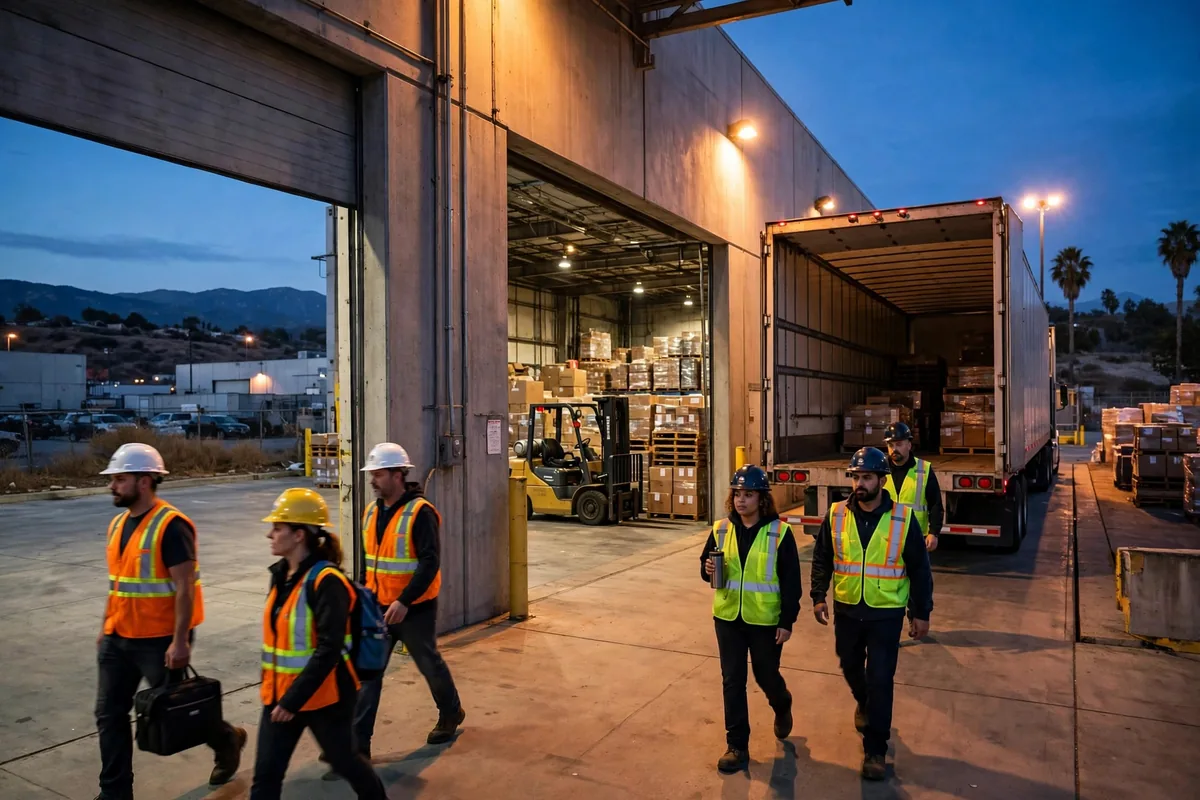
Warehouse employee turnover retention is the whole story of a building I sat outside last fall, around three in the morning, waiting to get unloaded in Fontana. A hiring sign was taped to the light box by the gate — night shift pickers wanted, decent hourly pay printed right on it. The guard told me that sign had basically never come down in almost a year. People come in, last less than three months, and walk out. The warehouse is always hiring and always short-handed. I sat there for four hours waiting on a dock door, thinking the same thing I always think at places like that. The building isn't short of people. It's leaking people, like a tire with a slow puncture. You can keep pumping air in, but until you patch the hole, it never stays full.
I've been running freight for fifteen years, and I spend half my working life dealing with warehouses. Shippers, warehouse managers, forklift drivers, night shift leads — I've met them all. Let me tell you something: I've seen dozens of warehouses that can't keep people, and the reasons are the same ones over and over. And most of them have nothing to do with money.
Warehouse Employee Turnover Retention Is Rarely About the Paycheck
Here's a real story. There's a small e-commerce warehouse in Riverside, night shift picking and packing, about forty people total. I used to haul out of there all last summer, and I got friendly with the night lead. He told me they'd lost seventeen people in three months and hired more than twenty in the same stretch — net gain of almost nothing. I asked him what the people who quit actually said. He counted them off on his fingers. One said the night schedule only came out on Friday evening, so he never knew until the last minute whether he was working Saturday, and he couldn't plan his kids' rides. One said he'd been there two months and still had to pay for his own forklift certification out of pocket. And one young guy, a good worker, quit with a single sentence: the lead had chewed him out in front of the whole crew for mis-packing one carton, and he couldn't show his face after that.
Which one of those three is about money? Schedules posted too late, nobody backing a certification, getting humiliated in front of the crew. Add those three together and an extra hundred or two a month won't hold anybody. Fifteen years on the road taught me this: drivers, warehouse people, all of us — what we can't stand isn't hard work. It's not knowing where we stand. Not knowing tomorrow's shift, not knowing if next month looks the same, having your whole day depend on one supervisor's mood. Once people feel that uncertainty, their feet start moving toward the door.
Now take a 3PL warehouse in Ontario that does the exact opposite. Their night lead posts next week's schedule every Wednesday. Need a swap? Say so in the group chat two days ahead and the lead finds a replacement — nobody has to go begging coworkers. I ran loads there all last winter, and the same familiar faces were at the dock every time. The hiring sign was long gone. Their night pay sits mid-pack for the area, not the top, but people just don't leave. Pay is the floor. Once you're above it, people stay or go based on whether the days feel livable.
Warehouse Employee Turnover Retention Math: What One Quitting Worker Really Costs
A lot of folks think hiring is cheap — somebody quits, you hire another one. Let me walk you through the bill, using rough figures from that small Riverside warehouse. Plug in your own numbers and the shape holds. A night picker at a little over twenty dollars an hour walks out. First, a few hundred dollars goes out on job ads and agency fees. Then the new hire spends two weeks learning the job, mis-picks climb, and every returned order costs a few dozen dollars in freight and rework. Meanwhile a veteran is pulled off their own line to train the rookie, so for two weeks two people do the work of one and a half. And the worst of it hits in peak season: one experienced hand is worth two new ones, and the moment you're short, the whole line slows down.
I added it up with that night lead and he nodded along: losing one person costs the warehouse roughly a month of that person's pay, all in, and more during peak. Now look at what keeping people costs. Posting the schedule early costs nothing. Pairing a new hire with a veteran mentor for two weeks and paying the mentor a hundred or two a month in a training stipend — that's money spent in the open, and you can see what it buys. Getting a lead to stop yelling at people in front of the crew costs nothing at all. Keeping people versus replacing people — the math isn't close.
| Where the money goes | What losing one person costs | What keeping one person costs |
|---|---|---|
| Hiring | Ads and agency fees, hundreds of dollars out the door | Nothing |
| Getting up to speed | Two weeks of mistakes, wrong picks, rework | A mentor for two weeks, a small training stipend |
| Line speed | The whole line slows when an experienced hand leaves | Post the schedule early, zero cost |
| Morale | Veterans watch rookies cycle through and start wondering too | A lead who treats people with respect, costs nothing |
Stick that table on the office wall. It beats any motivational speech. That table is warehouse employee turnover retention in one picture: every dollar spent keeping someone is a dollar not spent replacing them. High warehouse employee turnover usually doesn't mean people are hard to find. It means the building is leaking, and no amount of hiring patches a leak.
Night Shift, Mentors, and Leads Beat a Raise
Here's the counterintuitive part: no night shift differential, however generous, makes up for a chaotic schedule. I've seen a warehouse pay three dollars an hour more for nights than days, and people still walked. Why? The schedule came out Friday night, so the night crew couldn't commit to anything on a weekend — no kid's ball game, no birthday dinner reservation. Three dollars an hour doesn't buy a predictable weekend. Flip it around: post the schedule a week ahead, make shift swaps orderly, and people will stay for a dollar less, because they can plan a life around the job. Predictability is invisible, but it's the hard currency of retention.
Mentoring works the same way. Too many warehouses throw a new hire straight onto the line on day one, and the first mistake earns a scolding. The first week is when people are most likely to quit. The old-school fix is simple: every new hire spends the first two weeks with one fixed mentor who gets a monthly stipend, and the mentor's name goes on the new hire's badge. The mentor earns the stipend, the rookie has somebody to lean on, and the warehouse loses one fewer person. That money is worth ten times what a job ad costs.
And then there's the lead. More than half the quitting I've heard about at warehouse gates comes down to the direct supervisor — that's what people tell me at dock doors across Southern California. A good lead hands out work fairly, corrects mistakes in private, and gives credit in public. Recognizing people costs nothing and works faster than a raise. I talked once with a forklift driver who'd been at the same warehouse six years after quitting two others. His pay there wasn't the highest. The lead remembered his kid's name and switched him to a day shift on his birthday. That was it. A small thing, and the man stayed six years.
One word for shippers, too. When you're picking a 3PL, don't just look at the per-order price on the quote. Walk the warehouse. Check whether there's a hiring sign taped to the gate year-round, and watch the crew's faces at shift change. A building that never takes its hiring sign down will let you down in peak season — your freight will sit, and whatever you saved on the unit price will come right back out of your pocket.
When a machine breaks, you swap the part. When a person walks out, they take the feel and the know-how with them. An experienced hand knows which pick location always goes wrong, which cartons can't be stacked, which line jams at what hour. None of that is written in any manual. It's all in people's heads. Lose the people, and your warehouse stays a rookie camp forever.
By Shifu Zhao, Trucking Veteran (15 yrs)