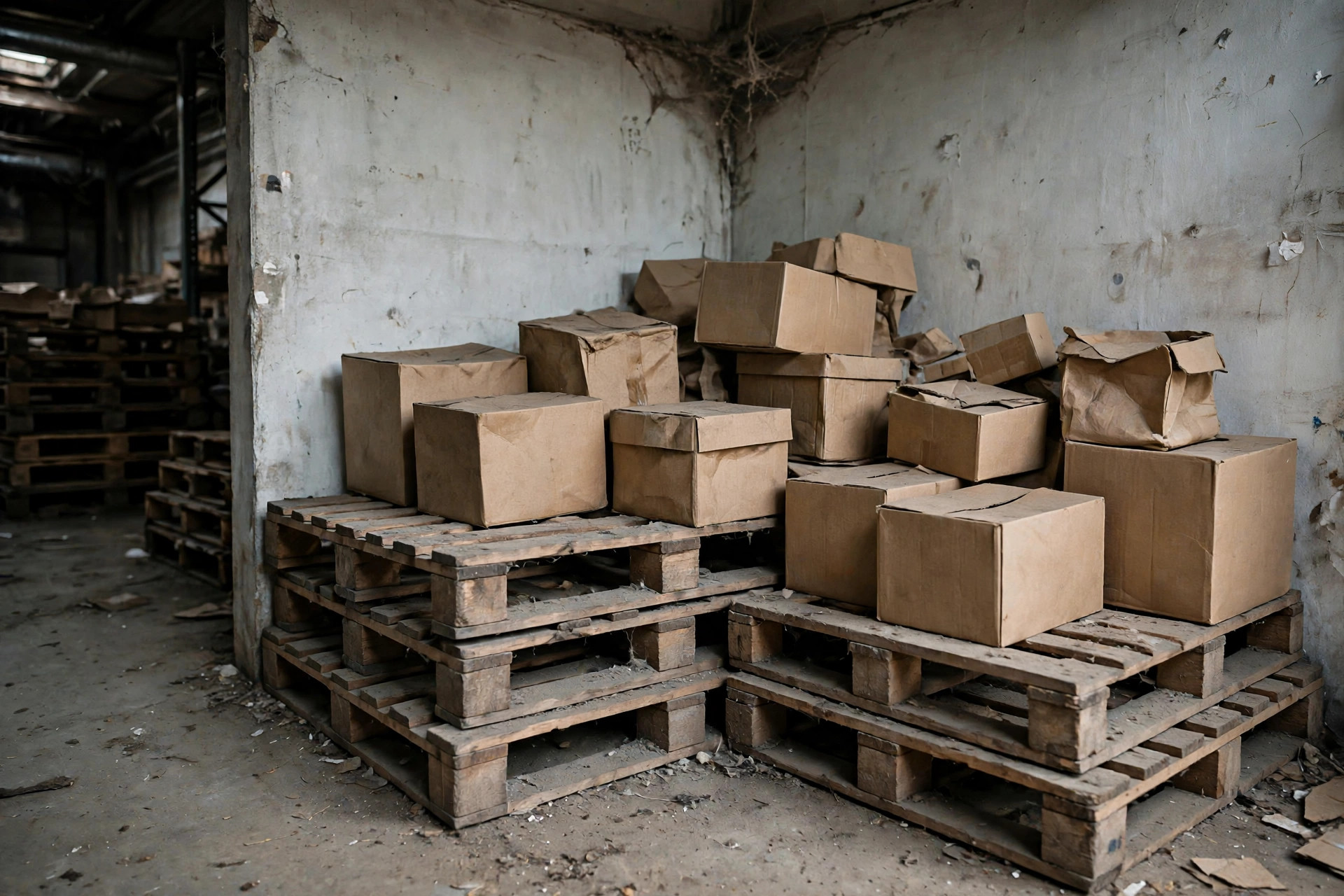
Excerpt: Warehouse dead stock management is not a year-end clearance event; it is a daily interest charge on inventory nobody will buy. This article prices the three ways dead stock kills margin and lays out the one process that actually moves it.
Let me start with the number that matters. In warehouse dead stock management, the most expensive decision is usually no decision at all. Stock sitting on a shelf does not look like a loss. The system still shows it at full value, nobody has written it down, and nobody has admitted anything went wrong. But every month it sits there, it consumes space, labor, counting time, and working capital. The loss is real; it is just spread out so thinly that no single report makes anyone feel responsible for it.
Warehouse Dead Stock Management Death No. 1: The Slow Bleed
In the fall of 2023, a small-appliance exporter running a warehouse outside Ningbo found more than four thousand older-model humidifiers still in stock during a routine count. The manager's call was to wait for next spring, on the theory that the old model would still sell. By the following spring, a new model had launched, distributors would not take the old one, and the remaining units went out at scrap value. The mistake was not a bad sales forecast. It was treating time as free.
Here is a worked example, using illustrative assumptions for an ordinary warehouse rather than any published rate: take ten thousand dollars of dead stock and assume combined storage and capital costs of about one percent of value per month. Twelve months of waiting costs roughly twelve hundred dollars, before counting recounts, relocations, damage, or the opportunity cost of the locations that stock is blocking. That is the arithmetic of the slow bleed. Nobody steals twelve hundred dollars from you. You hand it over one quiet month at a time.
Warehouse Dead Stock Management Death No. 2: The Clearance That Breaks Your Price
In June 2024, a household-goods warehouse near Dongguan tried to clear slow-moving storage boxes with a blanket half-price sale. It moved the boxes. It also taught every regular customer that the real price was negotiable, and the next season's normal orders came back with the clearance price attached as the opening bid. The clearance itself was not the error. The error was failing to isolate it.
This is the counter-intuitive judgment at the heart of warehouse dead stock management: clearance done slowly and cleanly often protects more margin than clearance done fast and loudly. Separate the channel, label the batch clearly, and keep clearance prices out of the normal price list. A sloppy clearance can cost more in damaged price integrity than the dead stock itself was ever worth. That is money spent for no good reason, and it is entirely avoidable.
Warehouse Dead Stock Management Death No. 3: The Stock Nobody Will Sign Off
The third way inventory dies is bureaucratic. At the end of 2024, an e-commerce warehouse in Hangzhou carried more than three hundred slow SKUs, about forty percent of them over a year old. Every meeting agreed something should be done. Every month the decision slipped because ownership of the write-down had not been settled. The stock did not move. The count team, however, kept moving around it, recounting it, and working around locations it blocked.
Nobody can see this cost on a single line of a profit-and-loss statement, because it is scattered across labor hours, location utilization, and error rates. But it disappears the moment you write two things down: who is authorized to price a disposal, and the deadline by which that price must be set. Warehouse dead stock management is less about courage than about deadlines. A list without a deadline only grows.
The One Way Out: Grade It, Price It, Give It a Deadline
The surviving process has three steps, and all three have to happen together. Skip one and you drift back into one of the three deaths above.
First, grade the stock. Sort by age and movement into three buckets: stock that can still sell through normal channels, stock that can only move through clearance, and stock fit only for scrapping or dismantling. The grading rules must be written down. Judgment calls made case by case always end with "let's wait one more month," and one more month is how the list got this long in the first place.
Second, price every bucket before you need the price. Set a normal-channel price, a clearance floor, a bundle price, and a scrap value, with storage, capital, and channel costs included in the math. Do not price on the day you are desperate to move something; desperate pricing is how clearance breaks your price list. Some clearances will still lose money after holding costs, and that is fine, provided the loss is smaller than the cost of holding on. The point is to know which loss you are choosing, not to pretend there is a choice with no loss at all.
Third, set a deadline for every bucket, with an automatic escalation: unsold normal-channel stock drops to clearance at its deadline, and unsold clearance stock goes to scrap evaluation. The deadline is not a threat. It replaces "let's wait" with a default action, and defaults are what actually move inventory.
A Decision Table for Warehouse Dead Stock Management
| Option | When it fits | Worked example on $10,000 of stock | The trap to avoid |
|---|---|---|---|
| Sell through normal channels | Demand exists, just slow | Near full price, minus continued monthly holding cost | Drifting into a second year of dead stock |
| Isolated clearance | Weak demand, sound product | Illustrative recovery of sixty to seventy percent, priced separately from normal stock | Clearance prices leaking into normal negotiations |
| Bundle with a fast seller | Single item will not move alone | Illustrative recovery above solo clearance when bundled sensibly | Letting bundles drag down your best sellers |
| Scrap or dismantle | No demand, minimal residual value | Illustrative residual around five percent, plus freed locations | Delaying so long that holding costs exceed the residual |
Read the last column first. Every disposal option has a characteristic trap, and choosing well means choosing with the trap in mind, not after falling into it. That discipline is the whole game in warehouse dead stock management.
A Monthly Habit That Keeps the List Short
One more operating detail is worth stating plainly: review the dead-stock list every month, and look at only three numbers each time — how much new dead stock appeared, how much of the old list was disposed of, and whether anything crossed its deadline. Many warehouses produce long, impressive reports that never answer those three questions, so every meeting debates individual items while the total quietly grows. A one-page monthly review, same day, same people, same definitions, is enough. If new dead stock exceeds disposals for three straight months, the problem is upstream in buying or sales, and no amount of downstream clearance will fix it. Turn the tap off at the source, and treat warehouse dead stock management as a monthly routine rather than an annual panic. When grading, pricing, and deadlines are all in place, dead stock stops being a mystery and becomes what it always was: a number, a date, and a decision.
By Lao Zhou, Logistics Cost Analyst