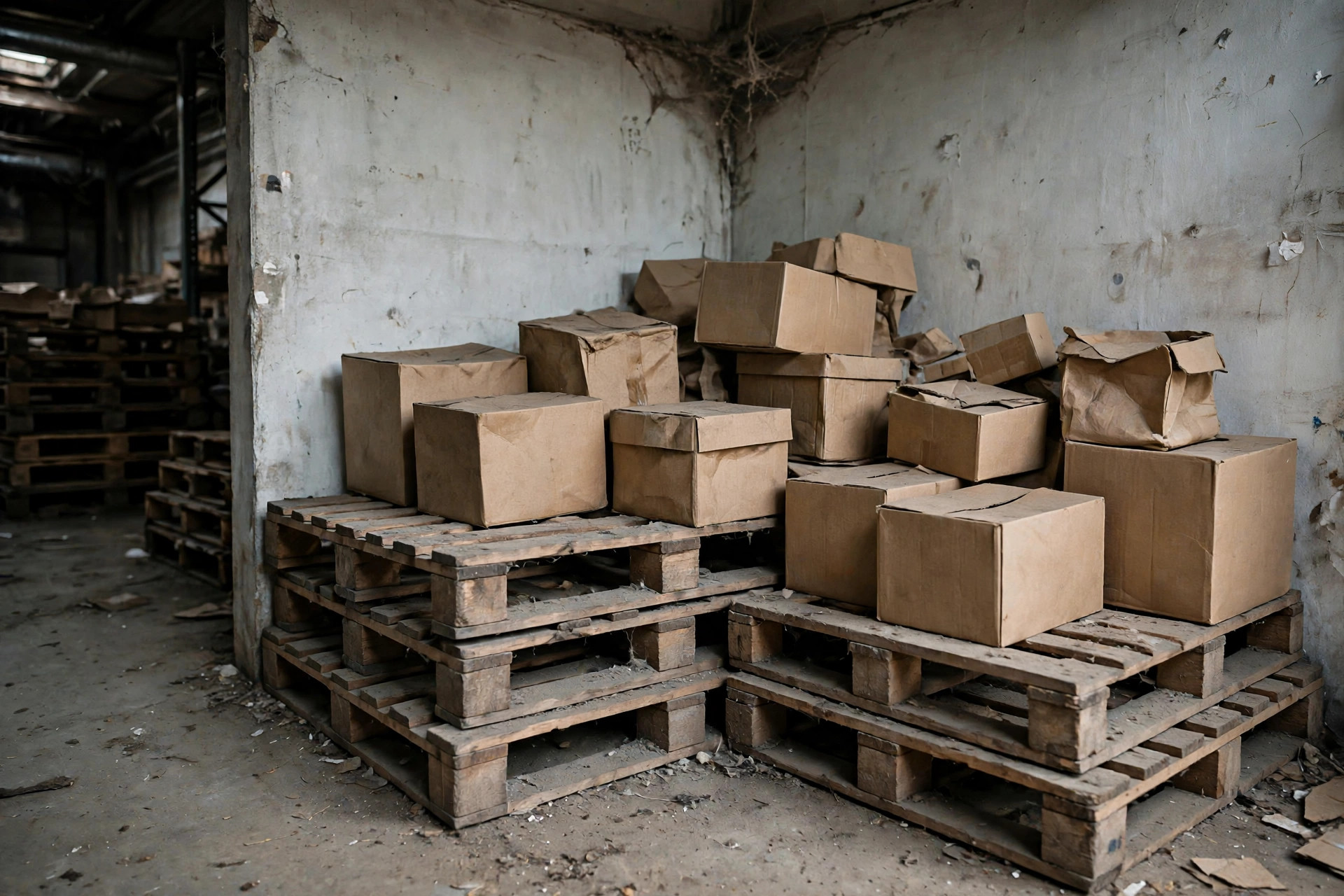
Here is the conclusion up front: dead stock inventory warehouse trouble does not start with goods that will not sell. It starts with goods bought wrong, put away wrong, and left unmanaged. Before any clearance discount, work the numbers down to the single item: what it is still worth, what it costs to keep, what clearing it returns, and what happens if it stays. I have seen this pit more than once: a warehouse full of stock that will not move, a boss in a hurry to free space, and a discount set by feel across everything. At the end of it little money is recovered and little space is freed.
Dead stock dies in three ways, and each way needs a different clearance approach. Expiry is killed by time. Seasonality is killed by demand. Technical obsolescence is killed by the market. What time kills cannot wait; what demand kills cannot be forced; what the market kills cannot be kept. Sort out the cause of death before talking about clearance.
Dead Stock Dies by Expiry
Expiry is the least reasonable way to die. Food, personal care, and pharmaceutical warehouses fear this most: expired goods are a compliance problem, not a discount problem, and one expired unit in a normal shipment costs far more than the goods are worth. On every go-live night checklist I ask who watches the near-expiry alerts and who acts when one appears. Many warehouses answer that the system has the feature; dig further and the feature is switched on and nobody reads it.
Illustrative scenario: a food distribution warehouse held a batch of seasoning close to its expiry date, a sizeable quantity. Near-expiry reminders went to an inbox nobody checked. By the time a stock count surfaced it, the window was too short for the normal channel, so it went through a discount channel and recovered only a small fraction of its book value. Another warehouse would have different figures and the same lesson: an alert with no named owner is no alert at all.
Expiring goods need a sequence, not a feeling. Rank the near-expiry list by date, nearest first. Give every batch one action, promotion, channel transfer, or disposal, and write the owner and the completion date beside the action. Then write the result back into the system so books and physical stock reconcile. An action with no completion date is not an action.
Dead Stock Dies by Season
Seasonal stock dies more gracefully. Apparel, seasonal household goods, and holiday gift sets all follow this pattern. Seasonal stock tempts you to keep it for next year, so it keeps occupying a slot. Keep it a year and the style is old, the packaging is old, and customer interest has moved on. Next year it still does not sell. It has simply turned from this year's dead stock into next year's.
Illustrative scenario: an apparel e-commerce warehouse was left with heavy coats at the end of every winter season. One year the supervisor kept them on a high rack, reasoning they could sell again the following winter. When the next winter arrived, the new collection launched, the old coats drew almost no views, and the slot stayed occupied for a whole selling season. Another company would have different figures and the same logic: seasonal stock loses value in one direction only, and keeping it is waiting for depreciation, not appreciation.
Seasonal clearance has to catch its time window. Set the clearance plan before the season changes, not after the new collection is on the shelves. Line up the channels in advance, online discounts, offline sales, bundled sets, each with its own price floor. Write the price floor down before negotiations start, so the floor team can actually decide.
Dead Stock Dies by Technical Obsolescence
Technical obsolescence kills most completely. The model changed, the interface changed, the matching consumables stopped production, and the old model has no buyers even brand new. This stock has one defining feature: its book value still looks respectable because the purchase price was high, while its market value is close to zero. That gap is exactly why nobody can bring themselves to clear it.
Illustrative scenario: an electronics accessories warehouse was sitting on previous-generation connectors and cables, a large quantity bought at high cost. Once the new generation launched, orders moved entirely to the new model and outbound volume for the old model dropped to zero. The buying team resisted discounting because the purchase price had been high, so the stock sat. After a stretch the matching equipment went out of production too, the batch could not enter the repair market, and it ended up as scrap. Another company would have different figures and the same pattern: with technically obsolete stock, the later the clearance, the smaller the recovery.
Before clearing technically obsolete goods, make one judgement: is there still a repair market, a compatibility use case, or a parts-stripping value. If none of the three exists, stop talking about recovery rates and talk about how fast the slot gets freed.
How Dead Stock Comes Back to Life
Dead stock has one way back, through three changes: channel, packaging, or combination. Changing the channel means sending the goods to people who still want them: offline where online failed, wholesale where retail failed, or overseas where the home market has no demand. Changing the packaging means splitting large packs down, kitting loose units, or turning single items into gift sets, a different way of selling at a different price point. Changing the combination means bundling slow movers with fast movers so the fast ones carry them along, with the bundle ratio and price worked out in advance.
Here is a counterintuitive judgement: a lower clearance price does not always mean a smaller loss. Below a certain point, the extra money recovered is outweighed by damage to the brand price structure and channel relationships. Set the price floor by working out the holding cost: storage occupancy, tied-up capital, and the management attention the item consumes each day. Once the holding cost is known, the price floor writes itself.
A Per-Item Clearance Checklist for Dead Stock
Clearance decisions must be made per item. Cutting by category is the most common way this fails: within one category some items still have a market and some are already dead, and a blanket cut kills the living ones too. This is the dead stock inventory warehouse checklist I use on go-live projects; every step has to produce something written down.
The steps are: check expiry and condition, and produce the near-expiry and damaged list; check recent outbound records to confirm how long this item has been still; work out the holding cost across storage occupancy, tied-up capital, and management attention; pick one handling action, promotion, channel transfer, repackaging, bundling, or disposal, and never write "to be decided"; set the price floor in writing; and name the owner and completion date, then write the result back into the system.
The table below is a hypothetical example comparing clearance decisions. The figures are illustrative, not any company's real data.
| Illustrative item | Book value | Clearance recovery | Holding cost | Decision | | Item A | High | Medium | High | Discount, another channel | | Item B | Medium | Low | Medium | Repackage and bundle | | Item C | Low | Very low | High | Dispose, free the slot | | Item D | High | High | Low | Hold, try another channel |
The judgement to take from that table is about Item C. Its book value is the lowest, but its holding cost is the highest, and clearing it saves more than the recovery brings in.
Stopping Dead Stock at Buying and Putaway
Clearance treats the symptom. Prevention treats the cause. The roots of dead stock sit in buying and putaway. Buying needs three brakes. Order quantities must track real sales; a slightly lower unit price is no reason to buy double. A new product's first order stays small for a trial; reorders follow only if it sells.
The putaway brake is about slots and records. Slow movers do not belong in prime slots. Prime slots belong to fast movers. Slow-mover records need their own view; mixed into overall inventory they are invisible. Pull a dead stock list every month, with item, quantity, book value, last outbound date, and owner. The phrase dead stock inventory warehouse teams use belongs on that list while there is still time.
Prevention holds on three things: a named owner, a timetable, and a review. Who signs the buying plan, who follows up the slow-mover alerts, who claims the dead stock list. With a name against all three questions, the mechanism stands. Fit the brakes at buying and putaway, and dead stock inventory warehouse teams stop growing it back.
By Lin Xiao, WMS Implementation Consultant