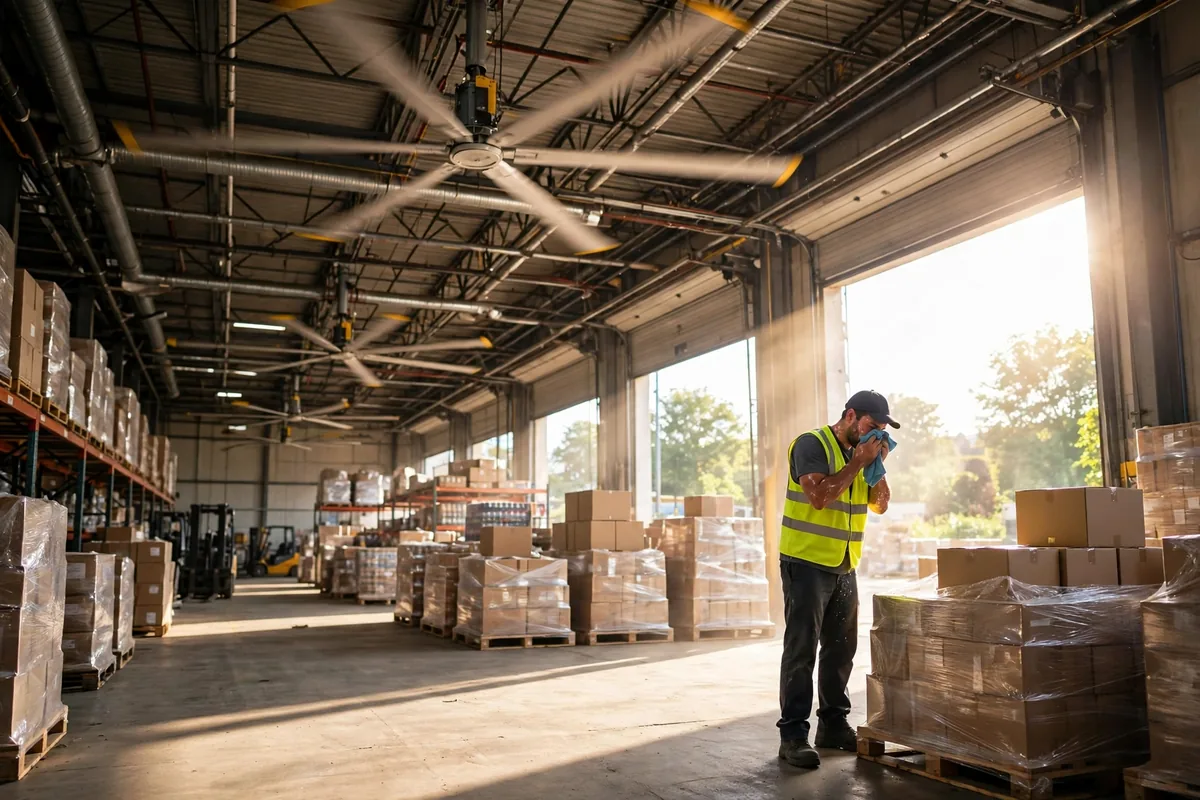
Listen — the hottest week of last summer, our night shift had two incidents. First, at 11 p.m., a picker in the high-bay area swayed on his feet and had to hold onto the racking for half a minute before he steadied himself. His temperature showed mild heat exhaustion. Second, the same week, an old scanner died twice in the heat. New battery, same problem — it only came back to life once it cooled down. That night I understood something plainly: cooling a warehouse is not about comfort. It's about whether people go down, whether equipment stops, and whether orders go out on time.
To be honest, the warehouse cooling HVLS fans vs air conditioning question comes up every summer, and I've walked both roads. Let's lay out the math for each.
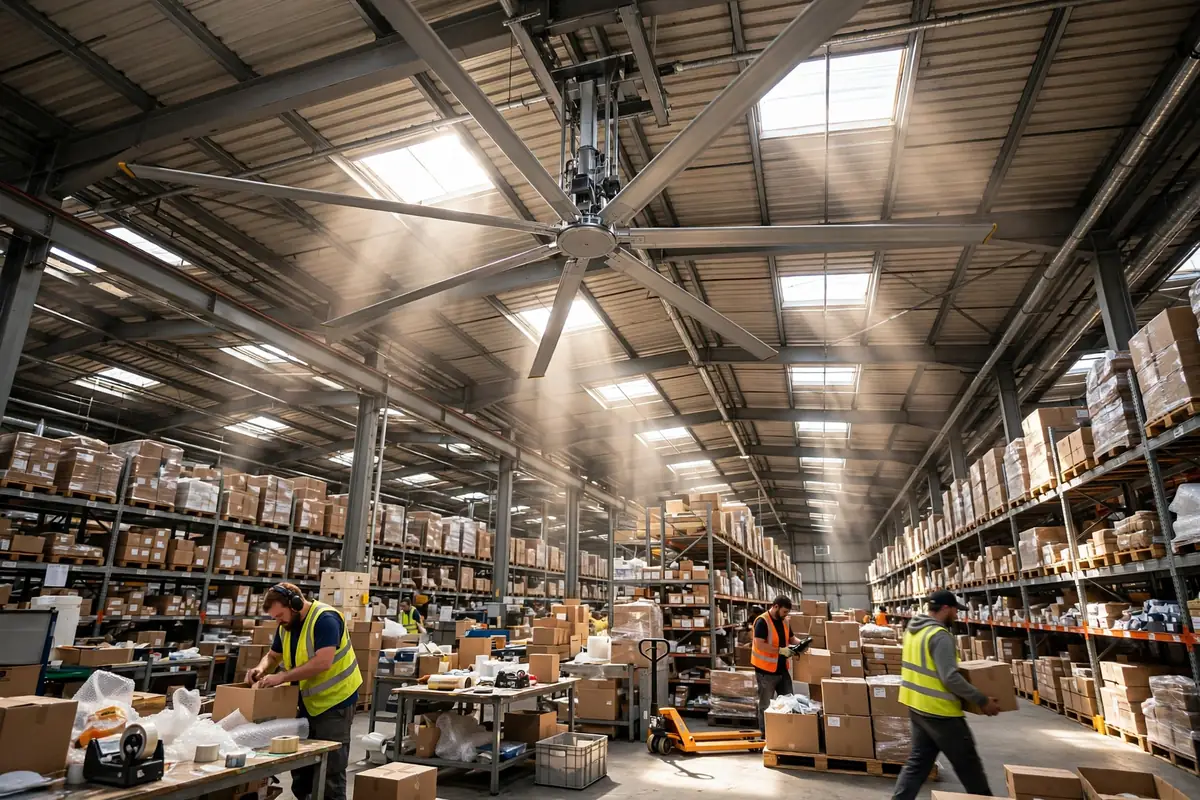
First, what is an HVLS fan? High-volume, low-speed. Diameters run from 7 to 24 feet, hung from the ceiling, turning slowly, pushing a huge column of air down to the floor and spreading it outward. A single 24-foot fan can cover more than 20,000 square feet. Here's the part people get wrong: a fan does not lower the air temperature. It lowers how the temperature feels. Moving air speeds up sweat evaporation, so people feel 4–8°F cooler — some manufacturers claim up to 10°F. You need a ceiling of at least 20 feet, and the fan must hang at least 10 feet above the floor. A low-ceiling shed can't take one.
We installed six 24-foot HVLS fans in 2023, covering the pick and pack zones. The first summer after that, the most visible change was that pickers stopped hiding in the shaded aisles. Before the fans, from 2 to 4 p.m. picking speed visibly dropped and mispicks climbed. After the fans, the speed came back. There was one change I didn't expect: in winter we reverse the fans and push the warm air trapped at the ceiling back down, and the heating bill dropped too. Manufacturers say winter heating savings run 20–30% — I haven't measured that myself, so take it as a manufacturer claim and verify it yourself.
Warehouse cooling HVLS fans: three lines that break in the heat
Summer heat hits a warehouse on three lines at once.
The first is people. Heat exhaustion is the direct risk — dizziness, vomiting, and in bad cases a hospital trip. There is a quieter line too: in the heat, attention drops and mispick rates climb. In every warehouse I've run, summer mispick rates run higher than spring and autumn. It happens every year.
The second is throughput. Pickers in heavy heat can't walk fast or lift fast, and right when order volume peaks, the team is at its weakest. Peak season is exactly when people can take the least.
The third is equipment. Scanners, label printers, conveyor motors — failure rates all climb in the heat. Equipment doesn't complain like people do. It just stops. One stop and the whole line waits, and the loss costs more than the fans would have.
Warehouse cooling HVLS fans vs air conditioning: two sums
Run the sums separately: the one-off investment, and the monthly power bill.
Power first. A single HVLS fan typically draws 0.5–1.5 kW. A single large air-conditioning unit easily draws tens of kW. Over the same floor area, the fans' electricity is a fraction of the AC bill. Industry sources say pairing fans with AC lets you raise the thermostat 4–6°F and cut cooling energy by 20–50%. That range is an industry claim — how much you actually save depends on your building, your climate, and how low you were running the AC before. Don't treat it as a guarantee.
Then the one-off cost. Full air conditioning means chillers, ductwork, and terminal units — big money, long installation, and in a warehouse with high racking and huge volume, the cold air doesn't stay where you want it. Fans are a rigging job, one at a time, working the day they're hung. Our six fans went from order to fully installed in under three weeks. The AC quote I got at the same time — price and lead time — I put it straight in a drawer.
| Option | How it cools | Power per unit | Coverage | Best for |
|---|---|---|---|---|
| HVLS fans | Air movement, feels cooler | 0.5–1.5 kW | One fan up to 20,000+ sq ft | Tall warehouses, pick/pack zones |
| Full air conditioning | Refrigeration, truly colder | Tens of kW per unit | Multiple units needed | Warehouses needing constant temperature and humidity |
| Fans plus spot AC | Fans as the base, AC where it matters | In between | Flexible mix | Most ordinary warehouses |
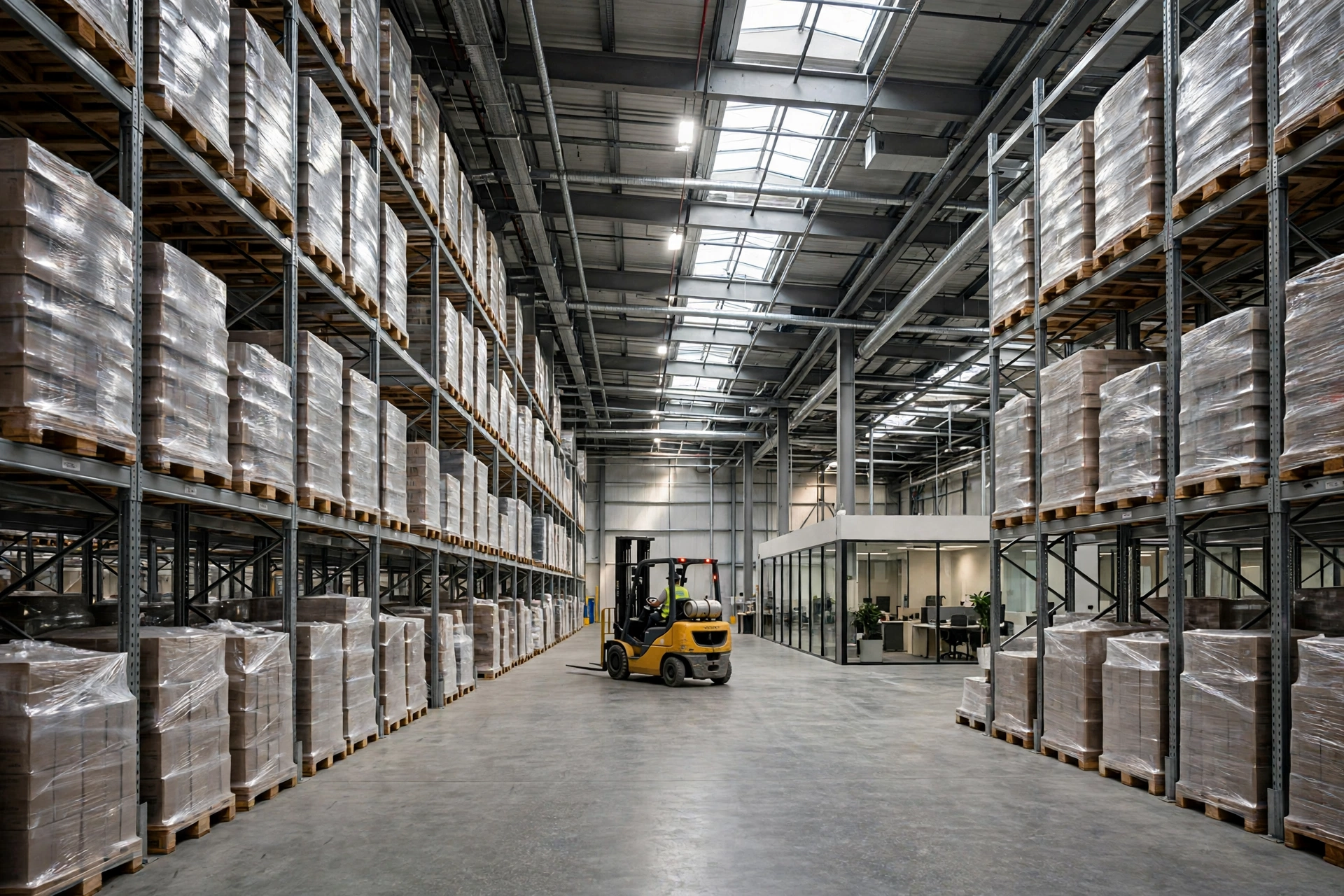
Here is the counterintuitive judgement: plenty of people think full air conditioning is the one-and-done answer. For a big warehouse it is the least worry-free option of all. Ten thousand square feet, ceilings ten metres up — cold air drifts up, hot air sinks down, and plenty of people run the AC flat out and still feel hot. The approach that actually pays for warehouse cooling HVLS fans vs air conditioning is fans as the base layer to bring the felt temperature down, then spot AC where it truly matters: the labelling room, the QC area, the server room. Spend the money where it counts.
On electricity prices I won't quote numbers — rates differ everywhere, so use your local tariff. Here is a worked example to show the order of magnitude, clearly labelled as an assumption: take a 10,000 sq ft pick zone with four large fans at 1 kW each, running 12 hours a day. That's 4 × 1 kW × 12 hours × 30 days = 1,440 kWh a month. The same zone on full AC, say one 30 kW unit, runs into five figures of kWh a month. Nearly an order of magnitude apart. Swap in your own power ratings and tariff and run it again.
What we do now — the fixed routine
Here's what our warehouse does now, every year, no exceptions.
First, inspect every fan before April: blades, hangers, motor, controller. Last year we found a loose hanger bolt on one unit during the check. I broke into a cold sweat when I saw it.
Second, a temperature ladder. At the first threshold, fans go to full speed. Higher still, spot AC comes on. Higher still, we shift the roster so the heaviest work avoids the hottest hours. Thermometers hang in the pick zone where everyone can see the numbers — no guessing.
Third, always leave people a way out. Water points in every zone, mandatory breaks in the hot hours. The money for cooling must never be saved on people. Save it on equipment, save it on the power bill — save it on people and you'll pay it back with interest.
There is no perfect way to answer the warehouse cooling HVLS fans vs air conditioning question. There is only the way that fits yours. How high is your ceiling, how big is the floor, what cargo do you handle, how hot does your summer get — measure those four things first, then decide whether the fans carry the load, the AC carries it, or the two work together. Don't wait until someone goes down beside the racking to run these numbers.
By Chen Feng, Warehouse Operations Manager