Let me be blunt. Warehouse color coding zone identification is not a paint job. It is the language your pickers use to find goods. A new hire walks in, looks up, and knows which way to walk without asking anyone and without reading the pick ticket three times. That is when the system works. If the paint looks great and new hires still need a veteran to lead them by the hand, you paid for decoration, not for operations. My verdict comes first: fewer colors work better, rules matter more than paint, and enforcement matters more than design.
The Verdict First: Color Is for the Picker, Not the Visitor
I have seen too many warehouses treat color as a showpiece. A customer visit is coming, so the floor gets repainted and fresh color boards go up a week early. The visit ends, and the colors go back to being irrelevant. Pickers still walk from memory. Forklift drivers still turn from habit. The colors live only on the tour route.
Look at it from two sides. A good-looking floor does help first impressions. But the daily bill your warehouse actually pays is slow picking, wrong-zone putaway, and slow training for new hires. A pretty wall does not pay that bill.
There is only one test that matters. Can a person on their first day find the goods without asking anyone? If yes, the system works. If no, it is decoration no matter how neat it looks. When I walk a client warehouse, I do not start by counting colors. I follow a new hire for one order and watch where they stop to ask. Where they stop is where the color system breaks. That test is harsh, and it saves a lot of self-deception. What color coding really measures is not the painter's skill. It measures whether a new hire can work alone by following color.
Warehouse Color Coding Fails When You Add Too Many Colors
A few years ago I worked with a consumer-goods third-party warehouse in the Inland Empire. The building was not small, and it had proper receiving, storage, staging, returns, and inspection areas. The problem was the palette. There were more than a dozen colors: dark blue, light blue, sky blue, grass green, dark green, orange-yellow, lemon yellow. From a distance it looked like a paint chart.
Veterans could tell them apart from experience. New hires could not tell light blue from sky blue in a busy aisle, and after asking twice they stopped asking and started guessing. One order that belonged in staging ended up in inspection. Inspection assumed it was a return and moved it to returns. The carton wandered around the building for two days until a customer chased the order and someone finally found it. Nobody made a deliberate mistake. The system made the mistake for them. When colors go beyond what the eye can tell apart at a glance, a signpost turns into a riddle.
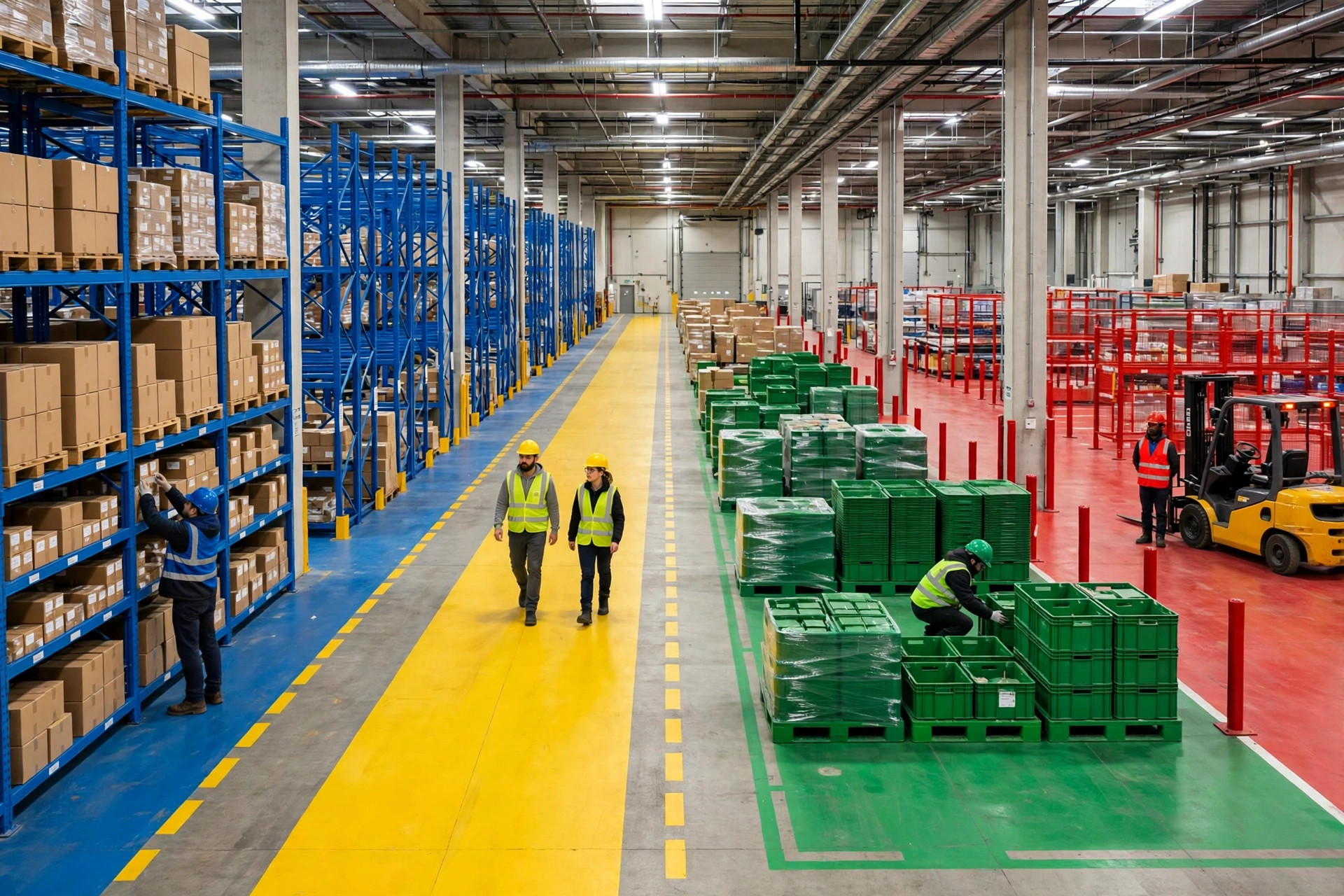
Here is the counterintuitive judgment most managers resist: more colors do not mean clearer guidance. They mean less reliable guidance. In a working aisle, under time pressure, nobody can reliably separate a dozen close shades. Every extra color adds training cost, maintenance cost, and correction cost. A system that actually holds up usually runs on three to five main colors, each tied to one big action: store, pick, stage, hold for handling, keep out. Finer detail belongs on location codes and zone signs, not on the floor paint.
How to Set Up Color Coding That Sticks
Before anyone opens a paint can, answer three questions. If you cannot answer them, you are not ready to paint.
First, what action does this color mean? Blue means storage. Yellow means aisle. Green means staging. Red means keep out or hold for handling. One color, one action, no exceptions. The classic failure is red doing double duty as both danger and fast-moving goods. A worker who sees red has to decide in a split second whether it means be careful or grab it fast. A color with two meanings has no meaning.
Second, who is allowed to change a color? Once the scheme is set, individual shifts cannot improvise. One supervisor likes orange, another repaints staging purple, and within six months the scheme exists only on paper. Put the color list in the operating manual. Changing a color goes through a change process. The old color comes fully off before the new one goes on. The floor is never allowed to carry old and new colors side by side as a so-called transition.
Third, who fixes color when it wears out? Floors scuff, tape lifts, and signs get blocked by pallets. That is everyday life, not an exception. Color with no owner looks ragged in three months and stops being trusted in six. Put maintenance on the shift lead's walk-through. A glance at color during a normal patrol costs far less than a big repaint once a year.
Once the rules are settled, the order of work is simple: divide zones by workflow, assign colors, make matching signs, train people, then inspect. That is the difference between paint on a floor and warehouse color coding zone identification as a working system. Zones should follow the flow of goods: receiving, storage, picking, staging, shipping, returns and holds. Signs must match the floor: floor color, a color block at the rack end, and a color stripe on the location label, all three saying the same thing. Training is not a classroom lecture. Walk a new hire through the colors once, and at each zone say what can happen there and what cannot. One walk is usually enough to teach the basic rules. This color coding routine is what turns paint from a one-time project into a working language used every day.
What the Time Savings Are Actually Worth
Do not judge this by the paint bill. Judge it by finding time. The table below is an illustrative way to run the numbers on your own warehouse. It is not an industry benchmark, but the method transfers directly.
| Step | Without a working color system | With colors that hold up |
|---|---|---|
| Finding one order | Memory and asking around, often several trips | Walk straight to the right zone, far fewer questions |
| Wrong-zone putaway | Staging and holds get mixed up regularly | A color tied to an action makes a mix-up visible at once |
| New-hire ramp-up | Days of shadowing before solo picking feels safe | One color walk teaches the basic rules on day one |
| Finding goods for a count | Search zone by zone for one carton | Narrow to the color zone first, then use the location code |
Here is the trade-off, and it cuts both ways. Color coding saves finding and correction time, but it costs time up front to set rules, make signs, train people, and maintain the scheme. If your warehouse has only a few dozen locations and slow turnover, a full scheme may cost more than it saves. A few color boards plus clear location codes may be enough. If locations are numerous and staff turnover is high, the savings stack up every single day, and the case gets stronger over time. Scale changes the answer. Copying another warehouse's palette is the easiest way to lose money on this.
One more trap: when you move zones, move the colors with them. Product mix changes, the fast-moving area shifts, and if the old color stays on the old floor, workers walk there, find nothing, and stop trusting color after a few misses. A zone move without a color move dismantles your own signposts by hand.
So ask the same question I ask every client. Can a new hire on day one find the right place without asking anyone? If you cannot answer yes, do not add another color. Get the three to five colors you already have explained clearly, enforced consistently, and maintained properly. Finding time will follow. Warehouse color coding zone identification pays off only when the colors are trusted, and trust is earned by rules, not by paint.
By Lao Mi, Supply Chain Veteran (20 yrs)