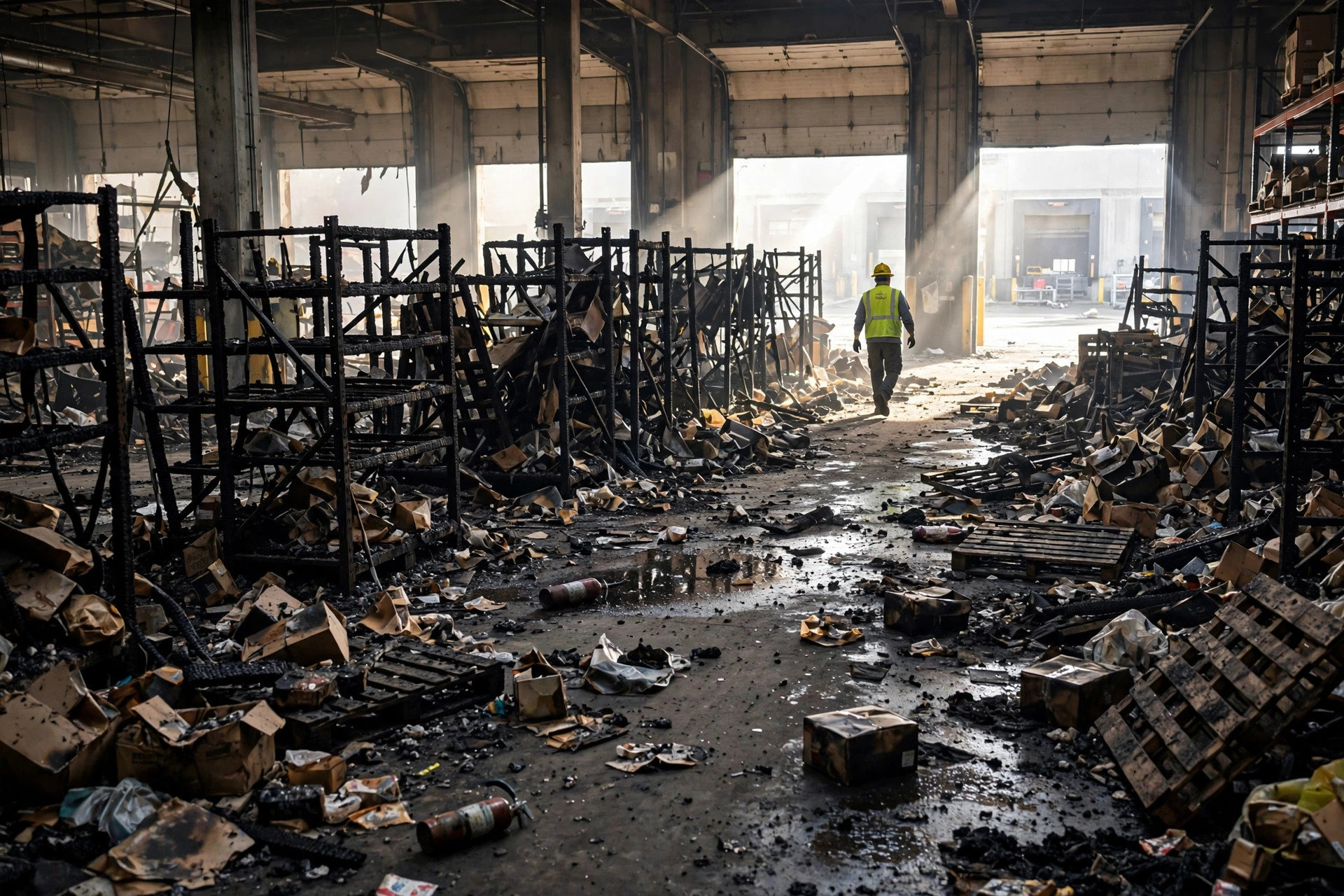
In August 2023, a 120,000-square-foot 3PL warehouse in Fontana caught fire when a forklift battery overheated in the charging area. Half the sort zone was gone. The fire was out in six hours, but the building sat idle for eleven weeks: fire marshal investigation, smoke remediation, sprinkler rebuild, re-inspection, one gate after another. The owner told me later that property insurance covered the burned inventory and equipment. What kept him up at night was those eleven weeks of dead time — rent paid in full, 60-plus employees on payroll, two anchor clients who couldn't wait and left. Property insurance paid exactly zero for the downtime. That was the first time he had ever heard of business interruption insurance. He hadn't bought it because it sounded expensive. The tuition for that lesson was eleven weeks of cash flow.
It doesn't insure things. It insures time.
Business income coverage — usually called BI — doesn't pay for what burned. It pays for the gap between the incident and the day you're shipping again. A fire, a burst water main, an electrical room failure: property insurance replaces the goods and the racking, but the revenue hole in between is BI's territory.
It pays three buckets of money. First, the net income you would have earned during the shutdown — the adjuster reconstructs this from your last twelve months of profit-and-loss statements, and a peak-season incident versus a slow-season one can produce wildly different numbers. Second, the fixed costs that keep burning while you earn nothing: rent, equipment loans, insurance premiums, payroll for the people you can't afford to lose. Third, the extra expenses you incur to get back on your feet faster — renting temporary space, overtime, emergency equipment rental. Some policies list this separately as Extra Expense; some fold it in.
Read the fine print before anything happens. Most policies carry a waiting period, commonly 72 hours — losses inside that window aren't covered. The indemnity period is usually 12 months and can be extended to 24 or 36 for additional premium; check your own policy wording. And the limit you declare matters enormously: it's based on your gross earnings, and under-declaring triggers a coinsurance penalty. Report 1.2 million when your real number is 2 million, and the adjuster pays you at sixty cents on the dollar. I've watched people learn that one the hard way.
The first 72 hours decide how much you get back
An adjuster once told me that seventy percent of a BI claim is determined by the evidence you preserve in the first week. Here's the checklist, and every line on it was paid for by somebody's mistake.
Notify your broker and carrier immediately. Late notice is one of the most common reasons claims get denied. People think "put the fire out first," then report three days late, and the adjuster's first question is why you waited.
Document everything before you throw anything away. Photograph and video the damage, and don't dispose of burned inventory until it's been counted — once it's gone, the quantity becomes your word against theirs, and adjusters only believe what they can see and count.
Keep a running ledger from day one. Every extra dollar needs a receipt: temporary warehouse rent, overtime, cleanup, equipment rental. Spending without invoices is spending the carrier won't recognize.
Mitigate. If you can rent temporary space and get partially operational, do it — insurance law imposes a duty to mitigate, and sitting idle while the meter runs gets your payment reduced. The adjuster will ask what you did to limit the loss.
Get finance to pull twelve months of P&Ls and tax returns. The entire "what would you have earned" calculation rests on those. Companies with messy books can lose two or three months right here.

And don't sign anything in a hurry. After a fire, cleanup contractors and public adjusters swarm the site, and some of their contracts carry fee terms your carrier may not honor. Run every outside contract past your broker before you sign.
Three traps that kill claims
The first is the waiting period. Seventy-two hours of waiting period means the first three days of downtime are on you. Plenty of small incidents shut a building for four or five days — barely past the deductible line, effectively uninsured. Before buying, ask yourself: when something goes wrong in my building, how long does it usually take to recover? If your history says three-to-five-day fixes, negotiate the waiting period down.
The second is under-insurance. Someone declares last year's gross earnings, business grows forty percent, and the claim gets paid at the declared ratio. Update the number every renewal. If you're in a growth phase, recalculate it annually.
The third is the civil authority clause. Say the fire department closes your whole street after a fire next door — your building is fine, but you can't get in. Some policies cover that, some don't, and the wording carries distance and time limits. The pandemic years taught a lot of people this lesson. Ask your broker directly: road closures, area lockdowns, government-ordered shutdowns — covered or not?
What it costs, and how to size it
Most people skip BI because they assume it's expensive without ever asking. Premiums are typically rated on your declared business income limit and usually ride along on the property policy, though standalone coverage exists. The rate depends on your industry, building construction, fire protection, and loss history — it varies too much for me to quote a number here without misleading you.
Size it this way: figure out what one month of downtime burns — rent plus payroll plus loan payments. Multiply by how many months you think a serious incident would keep you down. That's your rough limit. Take that number to two or three brokers for quotes. In my experience the premium is a fraction of the property premium, and it protects the one thing you can't replace: cash flow continuity.
At the end of the day, business interruption insurance buys you the ability to keep paying people while the building can't earn. Fire, water, power — any of them can idle a warehouse for weeks. Do one thing tomorrow: pull your policy and look for the Business Income section. If it's not there, ask your broker for a quote. It's cheap money for the months when the building earns nothing and the bills don't stop.