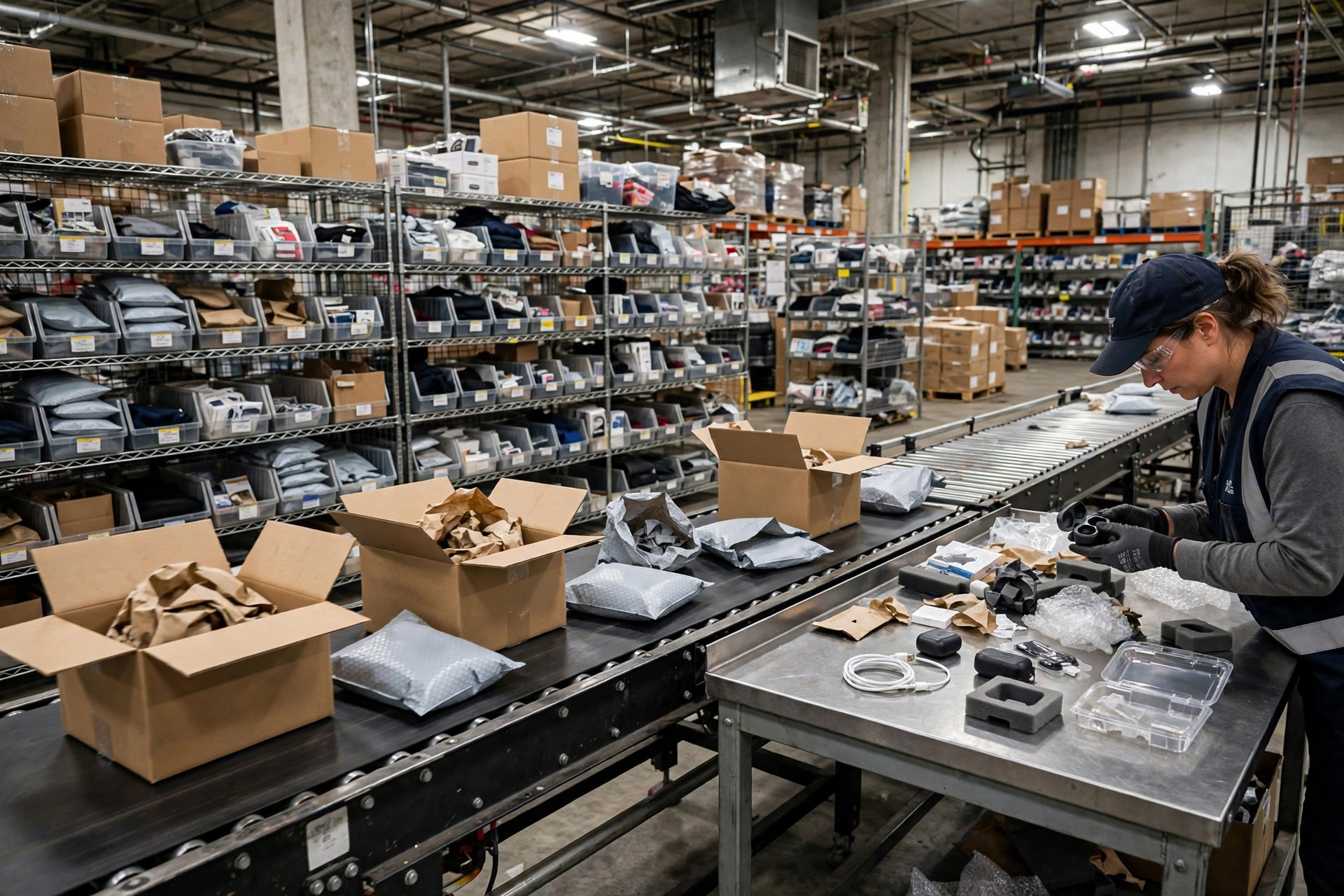
We had a client selling home storage bins on Walmart. Monthly orders grew from a few hundred to more than three thousand. He ran a small warehouse with two people packing. At first it worked. Then volume broke it: wrong items shipped, orders missed, delivery times slipped, bad reviews arrived, and traffic fell with them. He came to me asking whether to hand fulfillment to Walmart Fulfillment Services. I did not answer directly. I asked him to lay out three months of real numbers: packing labor, packaging, freight, returns handling, and the hours he and his partner spent shipping every day. He was surprised by his own math. The warehouse rent he thought he was saving had already been spent on labor and lost orders.
Many sellers start a Walmart Fulfillment Services conversation by asking about rates. Rates matter, but they are not the first calculation. The first calculation is what self-fulfillment actually costs you today, in money and in missed orders. Walmart's official rates, commissions, and warehousing rules change, so treat the current official policy as authoritative and do not rely on any rate card quoted from memory, including mine. The three calculations below are what you should run before you sign anything.
Walmart Fulfillment Services Starts With the Inbound Calculation
Inbound to Walmart Fulfillment Services works differently from self-fulfillment. Self-fulfillment lets you ship whenever you like. WFS requires your shipment to arrive prepared to its specification: outer cartons, labels, product barcodes, and packing lists all have to match. Any mismatch can delay receiving, force rework, or get a shipment refused. Our client learned this on his first shipment. He labeled cartons the way his own warehouse always had. At the WFS facility, label placement and carton rules did not match, and the whole shipment waited an extra week to become available. That week was a promotional period. Traffic arrived, stock did not, and competitors took the sales.
The second lesson is replenishment rhythm. WFS is not a place to dump stock and forget it. How much you send and when you restock has to follow sales. Send too little and you stock out and lose ranking. Send too much and storage fees accumulate month after month, with slow-moving stock eventually facing disposal decisions. I asked the client to keep a simple replenishment sheet: weekly sales for the past four weeks, on-hand stock, inbound stock, and days of safety cover, reviewed once a week, with replenishment sized for the next three to four weeks of sales. It sounds tedious. It is also the line between making money in WFS and quietly losing it.
There is also a product-fit question. Large, heavy, fragile, or specially packed items carry a very different cost structure in WFS than small standard items. Some sellers send everything in, then discover that freight and handling consume the entire margin. Test with one or two hero SKUs, run a full month, read the real invoice, and only then decide whether to expand. That is the least expensive way to learn.
Walmart Fulfillment Services Shipping Speed: What the Badge Is Worth Depends on Your Category
The most attractive part of WFS for many sellers is faster delivery and the delivery promise shown on the listing. Shoppers do respond to faster delivery. But how much that response is worth depends on your category. For standardized, price-sensitive products where shoppers compare listings side by side, a speed badge can lift conversion meaningfully. For differentiated products where shoppers decide on descriptions, photos, and reviews, speed is a bonus, not the deciding factor. Our client's storage bins were in the first group. Conversion rose after joining WFS. Returns rose too, because shoppers who buy more impulsively also return more readily.
So the second calculation has to be net, not gross: incremental orders from WFS, minus incremental returns and their handling cost. Many sellers count only the increment and wonder why the bank account disagrees at month end. I had the client recalculate one month on that net basis: gross margin from incremental orders, less return freight, inspection, and the cost of restocking or writing off returned units. The result was still positive, but nearly half of what he had first imagined. That net figure is the only honest basis for a decision.
| Comparison | Self-fulfillment | Walmart Fulfillment Services |
|---|---|---|
| Packing labor and space | You carry it, and it swings with volume | Handled by the platform under its rules, per current official policy |
| Delivery speed and badge | Depends on your own carrier | Faster platform delivery promise, helps conversion |
| Returns handling | You receive, inspect, and decide | Platform process, saves labor but returns still cost you |
| Inventory flexibility | Change anytime | Follows inbound and replenishment rules, needs planning |
| Best fit | Low volume, mixed SKUs, custom packing | Stable volume, standardized products, growth ambitions |
There is a counter-intuitive point in that table. WFS does not primarily save money. It saves your people and your time. At low volume, self-fulfillment is often cheaper, because your labor is already idle. Once volume forces you to hire, rent more space, and pack late into the night, the WFS calculation starts to work. The test is not the rate card. It is whether your order volume has crossed that threshold.
Walmart Fulfillment Services Returns and Contract Negotiation: Ask These Three Questions
Returns are the most underestimated cost in WFS. Platform returns handling is more standardized than doing it yourself, but returned goods are not always resalable. Opened, soiled, or incomplete units can become write-offs. Pull a separate returns sheet every month: return rate, top three return reasons, resalable share, and write-off value. If reasons cluster on description mismatch, fix the listing. If they cluster on quality, fix the supply chain. If they cluster on impulse buying, do not judge the listing by conversion alone; read conversion together with return rate.
When you negotiate, do not only ask for a lower rate. Rates and rules change. What protects you is the contract language on three points. First, who pays for rework when inbound fails or a shipment is refused. Second, how inventory discrepancies and lost units are compensated. Third, how exit works: how stock is withdrawn, how long it takes, and what withdrawal costs. If those three are vague, a low rate will not save you when something goes wrong.
Our client's final decision was split: his two hero SKUs went into WFS, while customized and oversized items stayed self-fulfilled. Three months later, WFS volume was up, returns were up, but net profit was positive. More importantly, he and his partner stopped packing until midnight and finally had time for suppliers and new products. That was the real value of WFS for him: not that it was cheaper, but that it got him off the packing table.
Next time you negotiate a contract, ask these three questions: if inbound gets stuck, who pays for rework? If inventory counts differ, how is it compensated? If we want out, how does stock come back? Answer those clearly, and you will have actually priced Walmart Fulfillment Services.
By Susan, 3PL Sales Director