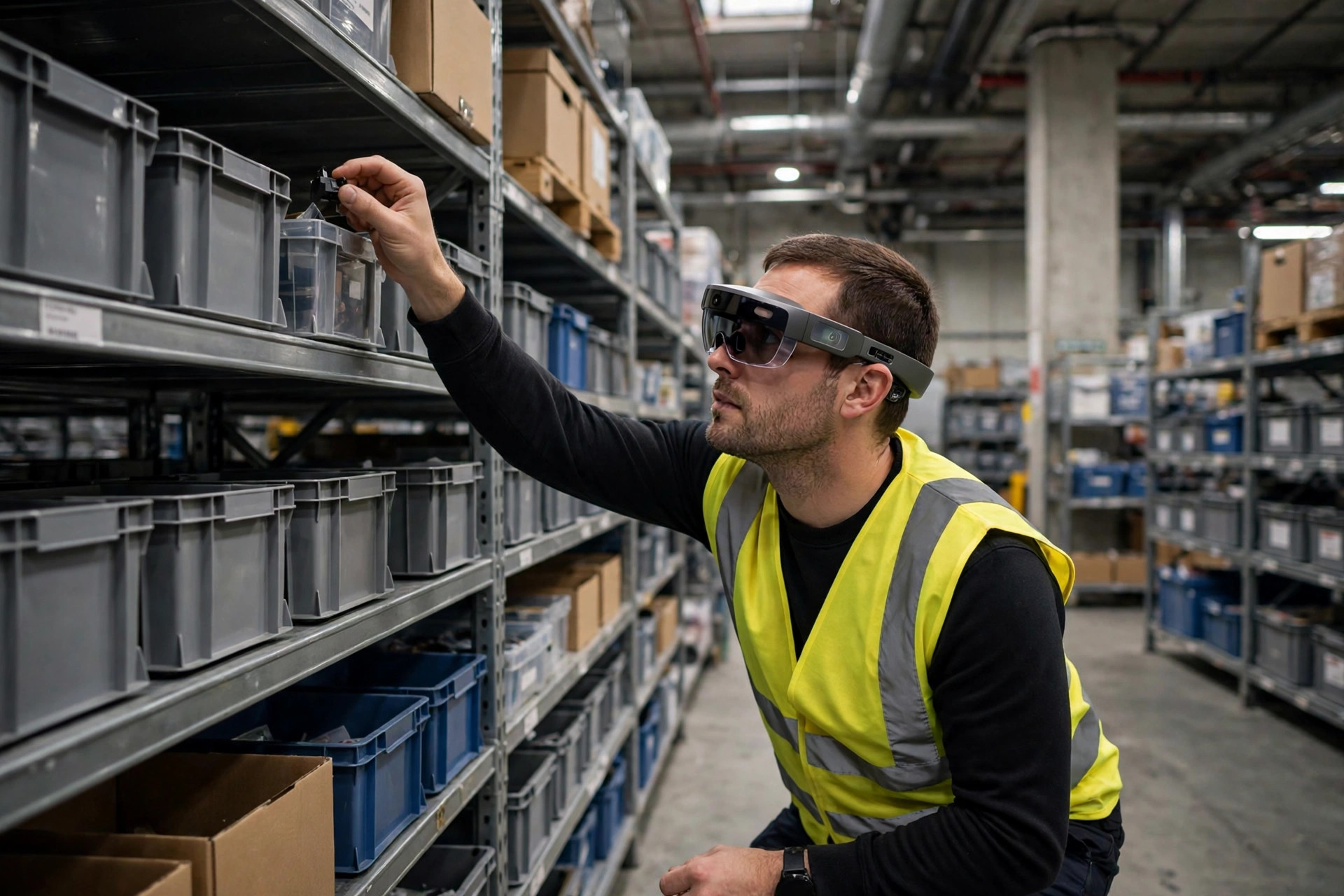
$1,799.99. That's the list price of a Vuzix M400 — the industrial AR glasses you'll find in most warehouse vision-picking pilots. For a 10-person team, you're at $18,000 in hardware before a single line of software is paid for. Now here's the question the vendor slides skip: what are you measuring that against?
In 2015, DHL ran a three-week pilot at a Ricoh warehouse in Bergen op Zoom, Netherlands. Ten pickers wore smart glasses, completed more than 20,000 picks across 9,000 orders, and came out 25% more productive than the site's usual RF scanning. Ten years later, that number still opens every AR vendor's pitch deck. I believe the number. I just don't think it's your number — unless you're still picking with RF guns.
This isn't a technology explainer; we already published one. This is about the money, and about where the line is.
Where the Money Actually Goes
Three buckets. All mandatory.
Hardware first. Industrial glasses aren't cheap: the Vuzix M400 lists at $1,799.99 a pair. Ten pickers, $18,000 — and in a warehouse, glasses are consumables. Cracked arms, dying batteries, scratched displays: plan on a two-to-three-year replacement cycle. Don't compare them to $300 consumer glasses; those won't survive a shift's brightness and battery demands.
Software second, and it's per user, per year, forever. TeamViewer Frontline — one of the mainstream vision-picking platforms — starts around $74 per user per month according to 2026 third-party pricing comparisons. Ten users: $8,880 a year. Stop paying, and the glasses become a paperweight.
Integration third. The glasses software has to talk to your WMS in real time — locations, tasks, confirmations. Workflows get rebuilt; people get trained. Quotes vary wildly, but don't expect a few thousand dollars to cover it — implementation often runs at the same order of magnitude as the first year's software fees. Get the integration scope in writing before you sign anything.
Add it up: a 10-person pilot starts at $30,000–$50,000 in year one. Keep that number in your head.
That Famous 25% Is Real — You Probably Won't Get It
The DHL pilot is legit: three weeks, ten people, 20,000+ picks, 9,000 orders, plus 25%. When DHL later rolled vision picking out globally, the official line from CIO and COO Markus Voss was an average 15% productivity gain, with onboarding and training times cut in half. A 2024 Aston University paper tallied more field results: Samsung saw 12–22%, Coca-Cola 6–8%, and Intel reported a 29% speed gain.
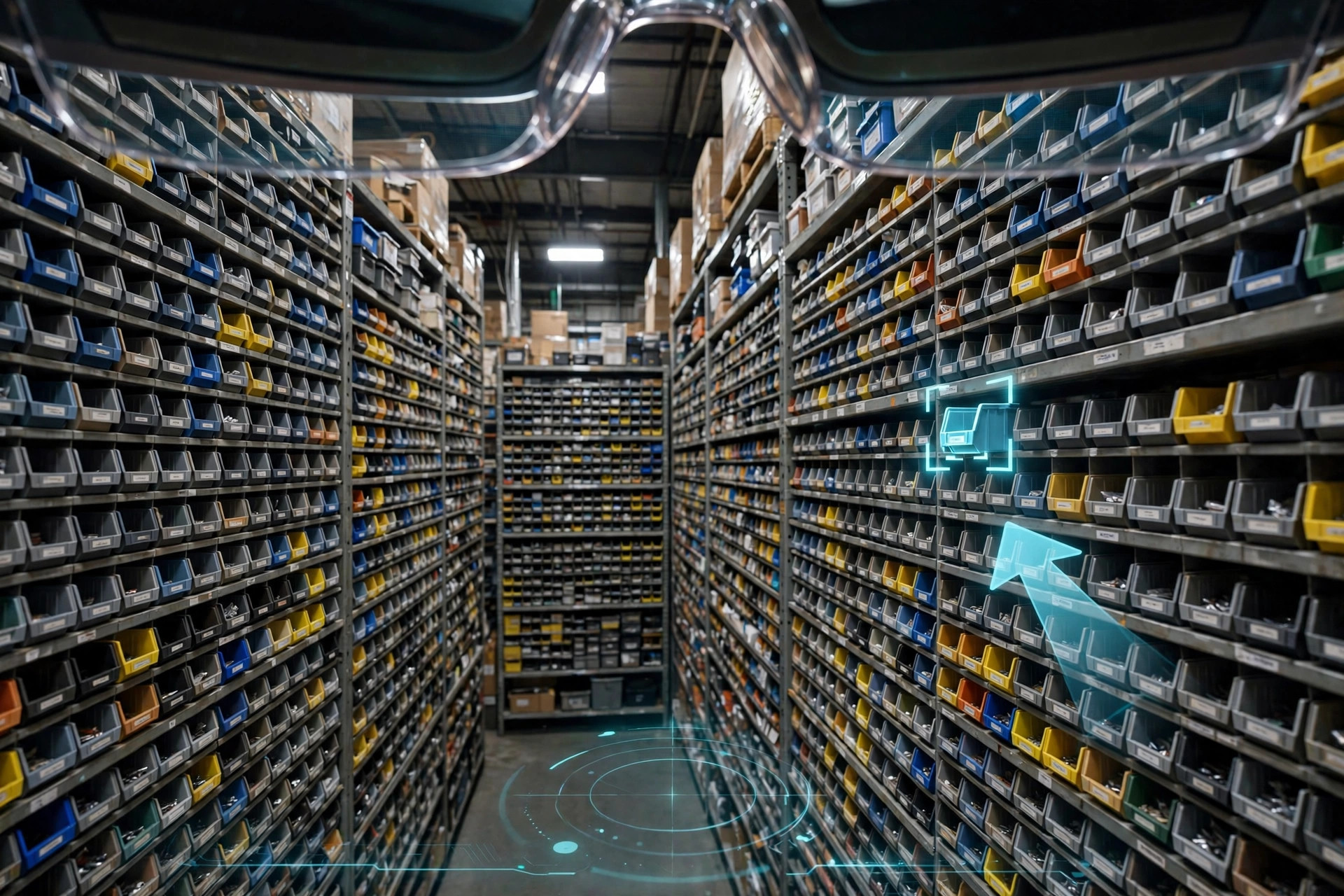
See the pattern? Those glossy numbers were measured against paper or RF-scanning baselines. A 2025 study in MDPI's Sensors journal compared methods head-to-head and found AR-glasses picking roughly tied with pick-to-light on speed — voice was actually the slowest — with error counts in the same ballpark for light and AR. Translation: vision picking's real rivals aren't RF guns. They're voice and light. And against those two, its edge is faster onboarding, not faster picking.
So do the math against your own baseline. Still on paper or RF? Vision picking's ROI looks excellent, and DHL's 15–25% is within reach. Already on voice or light? Don't budget for another 20%. The savings come from two places: labor hours and error cost. The U.S. Bureau of Labor Statistics puts the 2025 median wage for stock clerks and order fillers at $21.49 an hour; an Intermec industry study pegs the average mis-pick at about $22, with distribution centers losing nearly $390,000 a year to picking errors. Plug in your own pick volume and error rate — the ceiling becomes obvious fast.
Voice vs. Light vs. Glasses: Picking Your Poison
For the small-batch, high-SKU warehouse — thousands to tens of thousands of SKUs, multi-line orders, pickers hunting through aisles all day — it's a three-way choice, and each has a catch.
Voice picking's superpower is accuracy. Independent comparisons put voice at up to 99.9% accuracy versus about 99.6% for pick-to-light; Honeywell's own numbers claim voice cuts order error rates 50–90%, with up to 90% improvement over paper, 15% over pick-to-light, and 25% over RF scanning. It's also cheap — a headset and a terminal cost a fraction of AR glasses. The catch? Noise. Conveyors and sorters roar, new hires mumble, and recognition rates fall off a cliff. Voice is also a single audio channel: the picker never sees the big picture, and complex orders get confusing.
Pick-to-light's superpower is speed. For high-velocity small-parts picking, almost nothing beats it — even voice vendors admit that matching light on speed is the goal, not beating it. The catch: every location needs a light module and a button. SKUs move, slots get reconfigured, and the hardware has to move with them. In a dense zone with thousands of SKUs, that's serious money in hardware and maintenance. And lights only point at the slot — they don't confirm you grabbed the right quantity.
AR glasses' superpower is the experience. Hands-free, eyes on the rack, and onboarding time cut in half (per DHL) — which is gold in a warehouse where new hires drown in thousands of SKUs. The catches: the price tag above; wearing comfort — nose and ear pressure over an eight-hour shift drives most operations to "peak season only" usage; and the subscription that never goes away.
My ranking: tight budget and accuracy first, go voice. Concentrated SKUs, extreme pick density, stable slots — go light. Thousands of SKUs, high turnover, and training as your biggest pain — then take a serious look at AR.
Four Warehouses That Should Walk Away
One: under a thousand SKUs with simple, high-volume orders. Your problem isn't finding product, and AR guidance is overkill. Voice — or even RF — will do, and the savings can go elsewhere.
Two: veteran crews with already-low error rates. AR's biggest dividend is turning a rookie into half a veteran. If your team is all five-year hands, there's little headroom left, and a $30,000–$50,000 first-year investment will have a payback period that makes you question the whole idea.
Three: a legacy WMS with no standard API. Vision-picking software needs real-time task and inventory exchange with your WMS. No interface means custom development, and integration can easily exceed the hardware cost. Upgrade the WMS first; glasses come second. Don't reverse the order.
Four: freezers, heavy dust, or high vibration. Industrial glasses are rated for warehouse use, but batteries die and lenses fog in sub-zero freezers; dusty sites blind the cameras and sensors. If the environment doesn't qualify, the prettiest pilot data in the world won't survive deployment.
Here's what I'd do tomorrow if I were you: don't buy anything yet. Spend two weeks measuring your baseline — picks per hour, mis-pick rate, days for a new hire to work solo. Then rent or borrow five pairs of glasses and run a two-week head-to-head with one crew on the same orders in the same zone. The ROI formula is one line: (labor hours saved × hourly rate + errors avoided × cost per error) − (hardware amortization + annual software + implementation). Above zero, talk about rollout.
One question to take home: in your operation, what's the most expensive part of picking — the labor, the errors, or the fact that you can't hire anyone in peak season? If you can't answer that, AR glasses will just be the most expensive decoration in your warehouse.