Here is the bottom line: in Tunisia olive oil export warehouse logistics, the money most newcomers cut first is exactly the money they should never cut. Oil does not mind sitting still. It minds sitting in the wrong place. A tank of extra virgin leaves the mill in the Sahel with free acidity around 0.3%, then it gets sun, heat, and a week waiting for a ship, and by the time the buyer tests it at destination it is over the 0.8% line. At that point the whole shipment drops a grade, and the price gap eats a season of margin. Put simply, this business is not about how big your warehouse is. It is about whether the oil stays comfortable at every single step.
I have seen too many people handle olive oil like any other bulk commodity. Drums in an open yard, a tarp thrown over the top, job done. Wrong. The International Olive Council's storage guidance is blunt: keep olive oil between 13 and 25 degrees Celsius, in the dark, sealed, and the cooler and steadier the better. Research points to a dark room at 16 to 18 degrees as ideal, and anything above 25 degrees should set off alarms. Light, heat, and oxygen take turns doing the damage. Light strips out the antioxidants. Heat speeds up rancidity. Oxygen pushes free fatty acids higher. Acidity is a lab number, and a lab number does not negotiate.
There are two sides to this. One side is the oil itself, which is fragile. The other side is the rhythm of the Tunisian chain, which gives warehousing no slack at all. Look at the volume first. The International Olive Council estimates Tunisia's 2025/26 crop at about 450,000 tonnes, the second largest in the world behind Spain, with exports near 300,000 tonnes against domestic consumption of only about 50,000 tonnes. Roughly two-thirds of what Tunisia presses has to leave the country. The harvest runs from October to January, so hundreds of thousands of tonnes hit the market in a few short months, and every warehouse and port berth feels the squeeze at once. Then look at the map. Sfax, Tunisia's second city, sits about 270 kilometres south of Tunis at the doorstep of the central olive belt, and roughly half of the country's olive oil exports move through its port. Grove, mill, and port all sit on one short line. A short chain is an advantage, but it also means there is no buffer when one link slips.
Tunisia Olive Oil Export Warehouse Logistics: The Three Enemies
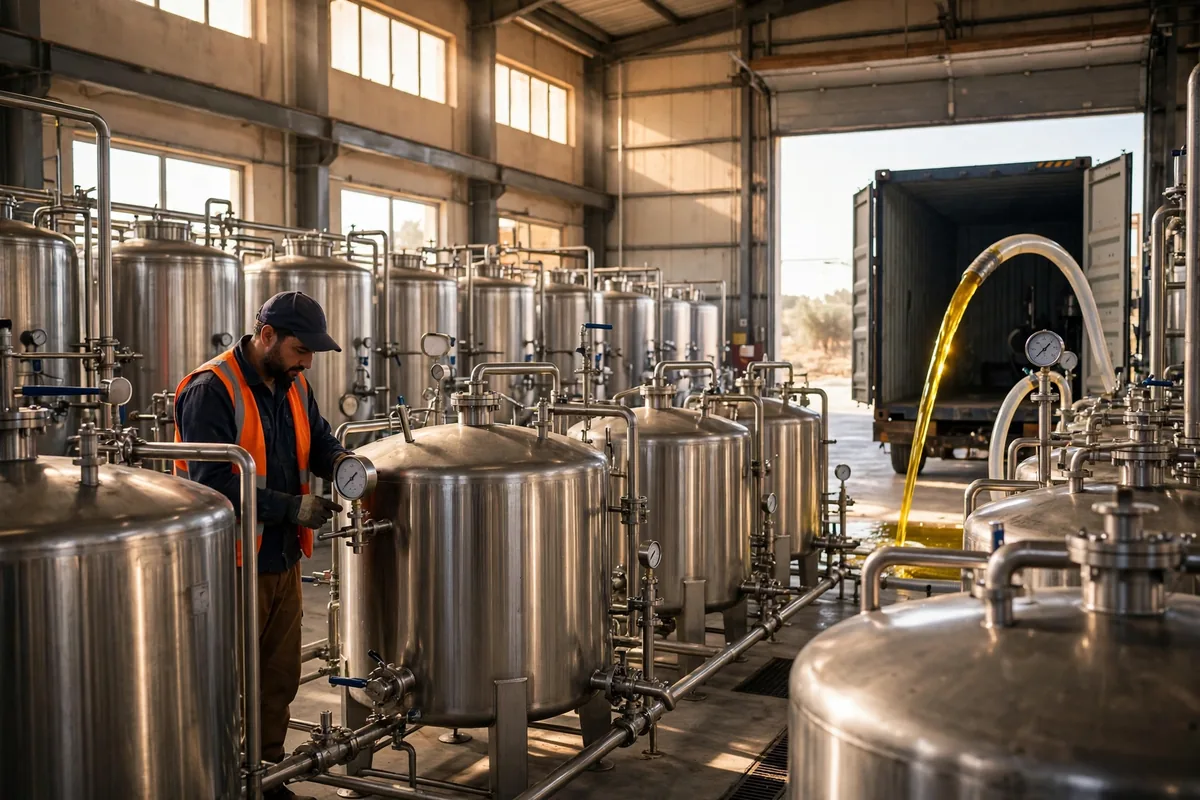
The first rule of the warehouse is to keep oil away from light, heat, and oxygen, and that rule turns into very concrete work. Tanks belong indoors or under cover, and the tank itself must block light. Food-grade stainless steel is the right call. Never improvise with an ordinary carbon steel tank, because once the inner coating flakes, the oil picks up off-flavours you cannot remove. Where you can, blanket the tank headspace with nitrogen so oxygen never gets a chance to sit on the oil. Temperature is a hard metric, not a feeling: put loggers on the tanks and in the warehouse, and set an alarm for hot afternoons in summer instead of discovering the damage after the fact.
One detail gets overlooked constantly: batch discipline. Oil pressed in October is not the same as oil pressed in January, and the acidity baseline differs. Store by press date and lab result, label every tank with batch, acidity, and intake date, and run first-in, first-out. Never blend tanks to top one up. One mediocre tank mixed into a good one drags the whole tank down to the mediocre grade. That is a calculation the warehouse supervisor should be making every day on rounds, not on loading day.
Where Oil Goes Bad Between the Mill and the Port
I have watched shipments go wrong in the same two places, over and over. The first is intake at the mill. During harvest season the mills around the Sahel run flat out, and fresh oil needs to move fast: into the tank, sealed, labelled, with samples taken on the spot for acidity and peroxide value. Some small mills have no temperature-controlled storage of their own, so the oil sits in an outdoor tank for a few days while they wait for a full truckload. The North African sun in late October is still fierce. An outdoor tank bakes all day and cools at night, and that daily swing quietly degrades the oil. The fix is contractual, not technical: agree a hard window, oil into a controlled warehouse within 48 hours of pressing, and write the penalty for missing it into the contract instead of relying on a handshake.
The second failure point is waiting for the ship at Sfax. Bulk oil, food-grade totes, and bottled cargo all pass through the same port, and the most dangerous scene is a loaded container sitting in the yard while the sailing keeps slipping. Three to five days in a summer container yard, with ground temperatures far above the air temperature, and the oil inside is stewing. Everything the cold warehouse achieved is undone in one hot week. My rule is simple: do not load early. Build the sailing buffer into the booking, keep the tank container in a shaded yard slot or pull it back to the temperature-controlled warehouse if the sailing slips, and load only when the vessel is firm. An extra truck run costs money. A downgraded container costs far more.
Bulk, Totes, or Bottles: What Tunisia Olive Oil Export Warehouse Logistics Really Costs
Tunisian olive oil mostly moves in bulk, with smaller volumes in totes and bottles. The warehousing bill looks very different for each. The table below is a hypothetical worked example for one container load, with illustrative figures only. Get real quotes before you commit.
| Method | Warehousing essentials | Main risk | Best for | | Bulk tank container | Food-grade tank, nitrogen blanket, controlled warehouse while waiting | Poor cleaning before loading taints the oil; sun exposure while waiting for the vessel | Large volumes, established buyers | | Food-grade IBC totes | Indoor stacking, kept dark, full batch labels | Loose lids let oxygen in; stacking too high deforms the totes | Small to mid volumes, mixed batches | | Bottled finished goods | Controlled warehouse, dark, cartons kept dry | Glass breakage is high; sensitive to shock and sun | Branded goods, premium retail |
Do not compare freight rates alone. Bulk looks cheapest per tonne, but one failed acidity test downgrades the entire container. Bottled looks expensive to store, but the breakage and downgrade risk is spread bottle by bottle. My rule for a new buyer: start with totes, small volumes, learn how their quality inspection works, and only then scale up to bulk. You are pricing risk, not freight.
The Contrarian Bit: Colder Is Not Better, and Bulk Is Not Easier
Most people hear temperature control and think colder is better, as if the oil belongs in a freezer. It does not. Olive oil stored near 4 degrees turns cloudy and can partially crystallise. It usually clears on warming, but repeated freeze and thaw cycles speed up quality loss, and a buyer who opens a cloudy shipment will spend your time and patience on explanations. The guidance says 13 to 25 degrees, and the point is stability, not cold. A controlled warehouse earns its money by holding steady, not by going cold.
The second surprise: bulk oil is harder on warehousing than bottled oil, not easier. A bottle is sealed, and oxygen stays out. A bulk tank meets oxygen every time a lid opens or a transfer happens. Every extra transfer on the chain is another exposure. So bulk export is a game of short chains and few handlings: straight from the producing area into a controlled warehouse, straight from the warehouse onto the ship, and cut out any transfer you can. Fewer steps, safer oil.
So here is my advice, and it is not complicated: do not gamble on warehousing when you export Tunisian olive oil. Quality is a lab number. Over the line is over the line, and there is no arguing with it. The rent you save on a proper warehouse today comes back tomorrow as a downgraded container, with interest. Get the building, the tanks, and the temperature records right first, and only then argue about price and sailing dates.
By Lao Mi, Supply Chain Veteran (20 yrs)