
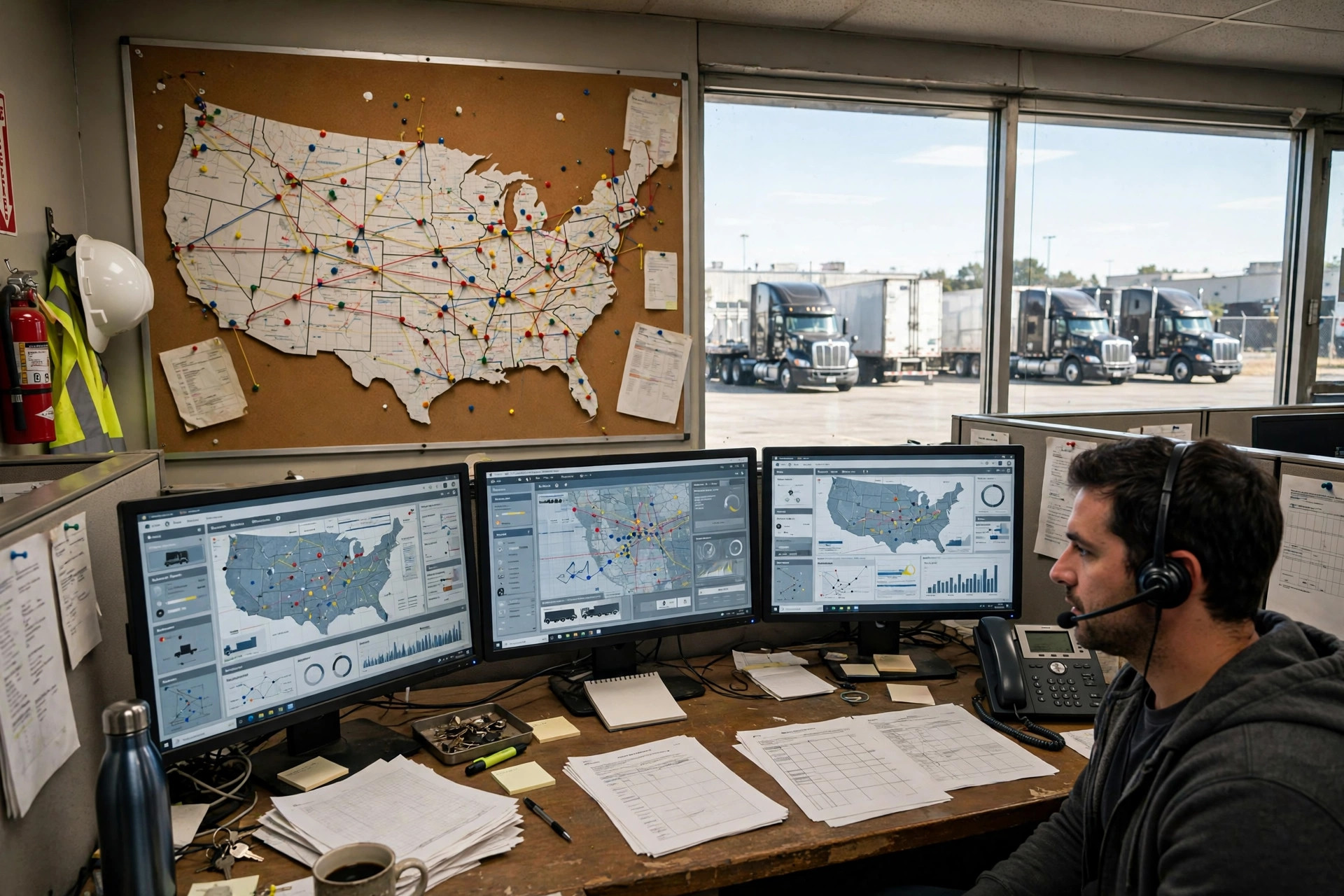
Last fall, a small fleet owner at a Barstow truck stop vented to me about TMS pricing models: three vendors, three quotes — per truck, per load, per user — and he couldn't tell which was the better deal.
After fifteen years on the road, I know that feeling all too well. TMS pricing models all look reasonable on paper, but each one hides its own trap. Today I'm going to break all three down, plain and simple, for the small fleets and shippers out here in the US.
Per-Truck Pricing: The Trucks Don't Move, But the Bill Does
Per-truck pricing is the most straightforward of the three: however many trucks you run, that's what you pay each month. For a fleet with stable size and steady freight, it's the easiest to budget — the number barely moves.
But here's the catch nobody mentions: your trucks have to actually be working. I know a guy in Arizona with 12 trucks. Last year he couldn't hire drivers, so three of his trucks sat in the yard for four straight months. Did the TMS bill shrink? Not by a penny — parked trucks still count. It's like renting 12 parking spots, driving out nine trucks, and paying full price for the three empty ones. Tell me that doesn't sting.
So who is per-truck pricing actually good for? Small fleets of roughly 5 to 15 trucks with stable drivers and fixed lanes. If your truck count swings a lot, or you're seasonal — say you only run hard during produce season — think twice before signing.
Per-Load Pricing: The More Freight, the More Sweat
Per-load pricing sounds the fairest: no loads, no charge. A lot of startups and small broker-style outfits fall for it at first glance.
Back in the winter of 2024, I met an old hand in Dallas, Texas — 25 trucks, and he'd gone with a per-load TMS. He told me the slow months were beautiful: few loads, thin bill. But come peak season, September through December, his load volume more than doubled — and the TMS bill doubled right along with it. The cruelest part? Peak season is when he makes his money, but it's also when cash is tightest — fuel, driver pay, repairs, all paid out of pocket first. And there's the TMS bill climbing beside all of it. He described it as "someone taking a cut of your harvest."

What's the lesson? Per-load pricing bakes your business volatility right into the price. If your volume is steady year-round, it works fine. But if your volume swings and you need to push hard in peak season, the real annual cost can run far higher than the quote suggests. Before you sign, pull your last 12 months of load counts and run the math at peak-season volume — not the average. Averages are the best liars in this business.
Per-User Pricing: Counting Heads Gets Complicated
Per-user pricing charges by account: dispatchers, customer service, accounting — one login each, one fee each. Sounds fair, right? The traps are in the fine print.
Trap one: do drivers count as users? Some TMS platforms charge for every driver app login. Ten trucks, ten drivers — your account count doubles overnight. Others don't charge for drivers but gut the driver app's features — load acceptance, POD uploads, settlement views. Miss one of those and you're on the phone with drivers all day; whatever you saved on licenses, you pay back in phone bills and missed pickups.
Trap two: ELD and EDI integrations. Running interstate in the US, ELD is a legal requirement, and the TMS needs to pull hours and mileage from it. Plenty of quotes don't include ELD integration in the base price — that's extra. EDI integration (electronic document exchange with big shippers and brokers) is almost always billed separately. Read that small print three times with a magnifier.
Trap three: the one-person-wearing-three-hats shop. In a small company, one dispatcher handles dispatch by day, settles accounts at night, and answers driver calls on weekends — three jobs, one account. Sounds like a bargain, until you hire someone new and the account count climbs. Ask upfront: what's the price per additional user? Is there tiered pricing? Don't discover after you're live that user number six costs twice what the first five did.
Running the Numbers: Three TMS Pricing Models Side by Side
Stories are nice, but let's do the math. The table below is illustrative — the dollar figures are hypothetical numbers I set up just to compare the structures, not any vendor's real quote (check each vendor's official website for current pricing). The structure, though, is real:
| Per Truck | Per Load | Per User | |
|---|---|---|---|
| Billing base | 10 trucks | ~300 loads/mo | 5 accounts |
| Monthly base (hypothetical) | 600 | 900 (peak 1,500) | 500 |
| ELD integration | Extra | Extra | Included or extra |
| EDI integration | Extra | Extra | Extra |
| Slow season (half volume) | 600 (flat) | ~450 | 500 (flat) |
| Peak season (double volume) | 600 (flat) | ~1,800 | 500 (flat) |
| Annual total (hypothetical) | Most stable | Most volatile | Middle ground |
See the pattern? Per-truck and per-user win on predictability — whether you run 200 loads or 500 this month, the bill doesn't move. For a small fleet, stability sometimes matters more than cheap. Per-load is genuinely cheaper in the slow season and genuinely brutal in peak season; over a full year it often ends up the most expensive of the three — unless your volume is flat all year.
The Counterintuitive Truth: The Cheapest Quote Usually Costs the Most
Fifteen years on the road taught me this one: if you pick a TMS by comparing monthly fees, you'll probably overpay.
Why? Because the monthly fee isn't where the real money goes. Three big costs live off the quote:
First, implementation. Data migration, workflow setup, integration with your existing systems — vendor consultants on-site for a week or two, billed per person-day. Some vendors quote a rock-bottom monthly fee, then hit you with an implementation charge worth two years of subscription.
Second, integration fees. ELD, EDI, accounting software, fuel cards — each connection can be a separate line item. Small fleets get burned here most: few trucks, few loads, you assume it can't cost much. But integrations are priced per connection, not per unit of volume. Connecting EDI for 10 trucks costs roughly the same as for 100.
Third — and this is the most expensive one — the cost of switching. You pick the cheap system, it turns out to be painful, your dispatchers curse it daily for six months, and you switch. Data migration all over again, workflows rebuilt, drivers retrained — you're paying implementation twice. I watched a 15-truck outfit switch TMS platforms three times in two years. They saved on monthly fees and burned enough on the churn to have bought the most expensive option outright, with change left over.
So here's my formula: (monthly fee × 12) + implementation + first-year integration fees, all divided by 12. That's your true monthly cost. Compare the three TMS pricing models on that number, and only that number.
Three Pieces of Advice for Small Fleets and Shippers
First, run your own numbers before reading anyone else's. Pull 12 months of truck counts, load volumes, and headcount, and model both slow and peak seasons. If you can't do your own math, the more carefully you read a quote, the more likely you are to get played by it.
Second, ask about the three costs off the quote: how much is implementation? What does ELD and EDI integration cost, each? And how do fees scale when I add trucks, loads, or users? If the salesperson gets vague on those three questions, there's a trap in there somewhere.
Third, don't chase cheap, and don't worship expensive. Fit is everything: stable fleet, go per truck; steady volume, go per load; small team wearing many hats, go per user. And revisit the model as you grow — what made sense at 5 trucks may not at 30. Reviewing your pricing once a year isn't embarrassing; it's business.
I'll leave you with an old saying from back home: the buyer is never as clever as the seller — but sellers are terrified of a buyer who can do math. With TMS, the numbers on the quote are all honest. The real game is in the math behind them. Get the math right, and you'll dodge most of the traps.
By Shifu Zhao, Trucking Veteran (15 yrs)


