Honestly, I got into tashkent uzbekistan warehouse logistics because shipping got too slow and too expensive to ignore.
Orders come in. Ads keep spending. The buyer keeps asking where the parcel is. And your stock is still somewhere on a road you cannot see. Every cross-border seller knows that feeling.
Tashkent looked like just a dot on the map to me. Then I ran the numbers, talked to sellers who had actually shipped there, and changed my mind a little. It is not a magic fix. But if you want a serious distribution point for Central Asia, you cannot skip this city in your planning.
This is a seller's view, not a brochure. How goods get in, what double-landlocked really costs you, local versus regional stocking, and how to pace your replenishment.
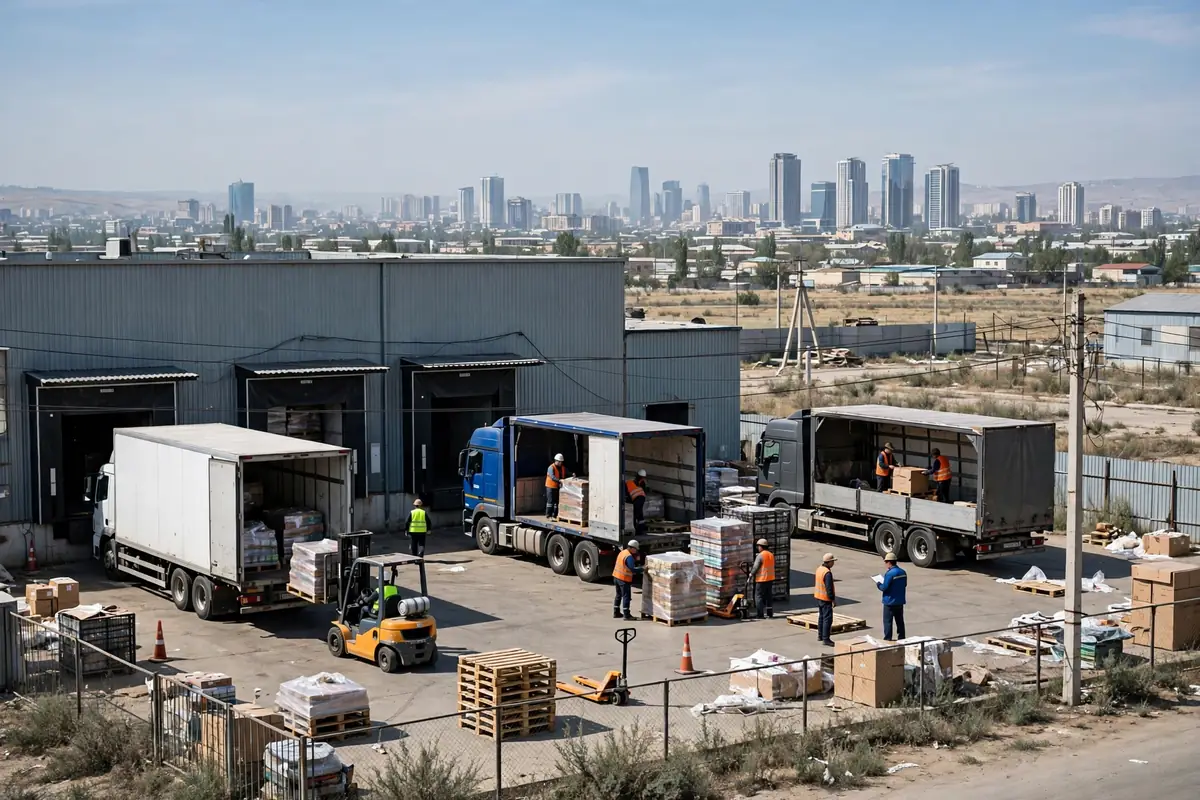
Tashkent Uzbekistan Warehouse Logistics and How Goods Actually Get In
Uzbekistan is double-landlocked. That means it has no coastline, and neither do its neighbours. Every shipment has to be handed over at least one extra time compared with a port city. That single fact shapes everything else.
In plain terms, goods usually arrive through a few kinds of routes: overland through Central Asian border crossings by truck or rail-linked transport, via a third-country port and then overland, or by air into Tashkent for local distribution. None of them is fast, cheap, and stable at the same time. You only get to pick which kind of instability you can live with.
The beginner mistake is renting space first and thinking about inbound routes second. Reverse it.
Decide the main route for your core SKUs first. Decide your fallback route for peak season. Only then decide how much space and how much stock you need, because the route sets your replenishment cycle, the cycle sets your safety stock, and safety stock sets how much cash sleeps in a warehouse.
Illustrative scenario (hypothetical example): Say you sell small home goods, compact and mid-priced. Route A normally takes about 25 days to replenish and stretches to about 40 days in peak season. Route B costs more, normally about 15 days, stretching to about 22 days. If you plan stock using Route A's normal timing and never add a peak buffer, a stockout is not bad luck. It is arithmetic. You treated a variable lead time as a fixed one.
For every core SKU I now keep two numbers: a normal replenishment time and a conservative one. Normal for the lower bound, conservative for the upper bound. The gap between them is simply the patience cost of selling into Central Asia.
One more trap. The route that worked for samples and a small trial order may not work the same way for a full shipment. Documents, inspections, and handover points behave differently at volume. For your first full shipment, leave a real buffer. Never tie the first arrival date to a promotion date.
Local Warehouse or Regional Hub: Do Not Buy the Slogan
Tashkent is often called a Central Asia distribution hub. That is true, with a condition: a hub only pays if your orders are actually spread across the region.
If almost all your orders are inside Uzbekistan itself, you need a good local warehouse. Close to your buyers, fast dispatch, easy returns handling. Paying regional-hub costs for local orders is just burning money on a nicer label.
If your orders are spread across several Central Asian markets, a regional setup starts to make sense. Stock once, distribute outward, instead of leaving a small pile of stock in every market and running out everywhere at once.
Here is the counterintuitive part: most small and mid-sized sellers live longer by starting local and earning the right to go regional later. A regional setup saves distribution efficiency but burns cash on inventory and management complexity. Before your order volume is real, the efficiency you save rarely covers the extra stock you carry.
This is the table I use for myself. Not a standard answer, just a way to stop deciding by gut feel.
| Decision question | Leans local | Leans regional |
|---|---|---|
| Order spread | Mostly one market | Stable orders in several Central Asian markets |
| SKU width | Few SKUs, hits-driven | Wide range, needs central stocking |
| Replenishment | Infrequent, slow turnover acceptable | Stable route, rolling replenishment possible |
| Team bandwidth | Nobody to watch multi-market fulfilment detail | Someone owns distribution, returns, exceptions |
| Cash flow | Tight inventory budget, protect turnover | More room in inventory budget for stability |
If three or more answers lean left, start local and do not apologise for it. A small operation that actually runs beats a big empty setup every single time.
Tashkent Uzbekistan Warehouse Logistics and Replenishment Rhythm
The most common restocking mistake in Central Asia is copying a US or EU rhythm.
Mature markets forgive late reordering because replenishment is predictable. The chain into Tashkent is longer and has more variables. If you still reorder at the last minute, you are digging your own hole.
I use three layers.
First, the always-on layer. Core winners that must never go dark, stocked on the conservative cycle. This layer does not join promotion gambling. Its job is survival.
Second, the promotion layer. Calculated separately before each campaign, with arrival locked in early. Arriving a few days early and paying a little storage is far cheaper than arriving late and losing both the campaign window and your ranking momentum.
Third, the testing layer. New products go in small. Watch real sell-through after they land, then decide whether to scale. Never stock a new product like a proven winner on day one. Feedback in this market is slower, and by the time you realise it is not moving, it has already slept in the warehouse for two months.
Illustrative scenario (hypothetical example): A seller puts the whole seasonal budget into two new products, both stocked at optimistic volumes. One takes off, one does not move at all. Because the budget is trapped in the dead product, replenishment for the winner lags and it stocks out mid-season. At the end, the warehouse holds unsold stock and the winning listing lost its traffic window. That is not a product-picking failure. It is a stocking-structure failure: testing stock and always-on stock were mixed together, so both failed together.
I watch only three numbers in my own review: sellable days left on core SKUs, days of stock already in transit, and real sell-through over the last 30 days. When sellable days fall faster than transit stock can cover, I expedite a small top-up immediately. When sell-through clearly slows, I brake new-product replenishment the same day. No meetings, no hoping.
Returns need a plan before you scale, too. Cross-border returns in Central Asia rarely flow back into resale as smoothly as in mature markets. The realistic path is inspection inside the local warehouse, relist what passes, and clear what does not through local bundles or clearance. If you have no returns path and you stock heavily anyway, you have quietly assumed every return is a total loss.
My honest closing take: setting up in Tashkent is not hard because renting is hard. It is hard because a longer chain forces you to change your own discipline. The route is slower, so your decisions have to be earlier. The market is spread out, so your focus has to be narrower at the start. Fix the rhythm and this warehouse makes you money. Keep your old rhythm and even the best location is just one more place to trap inventory.
This move worked for me when I tested it myself: run one full small cycle first — inbound, shelving, orders out, returns back — and only then scale. One tested cycle teaches you more than any agent's pitch deck.
By Ah K, E-commerce Seller (5 yrs)