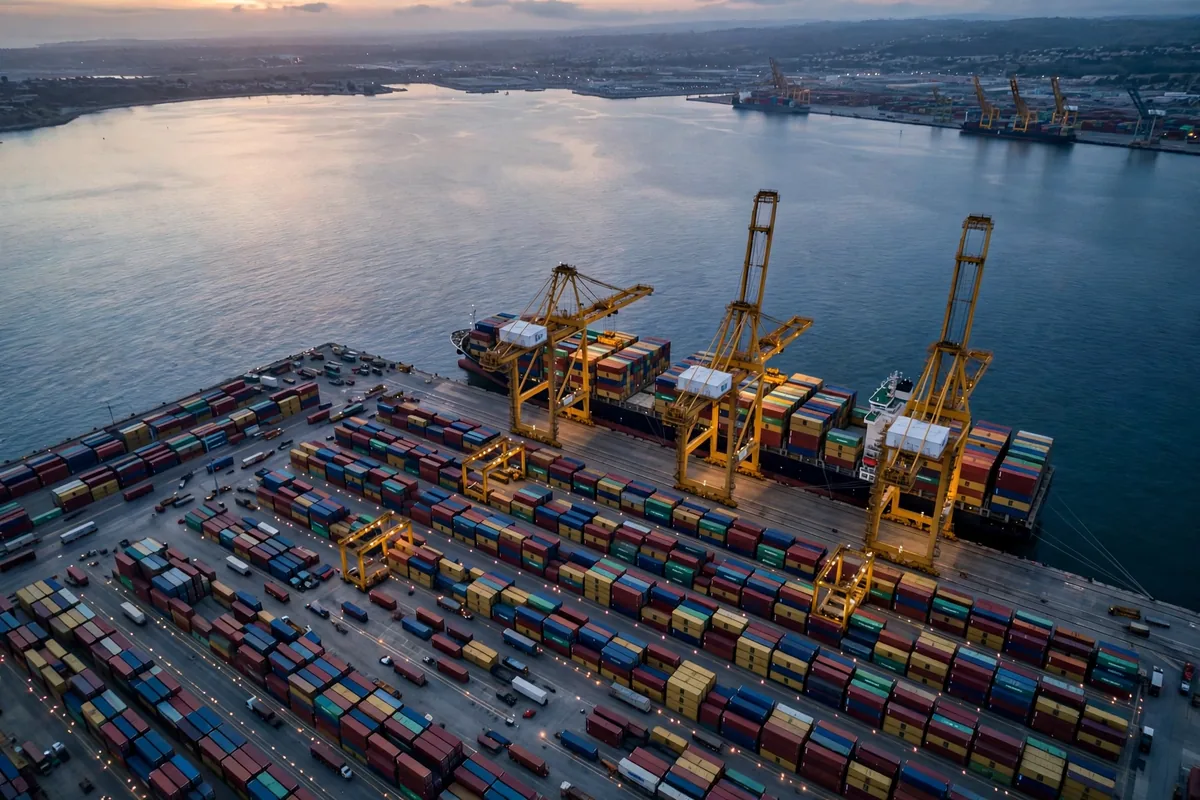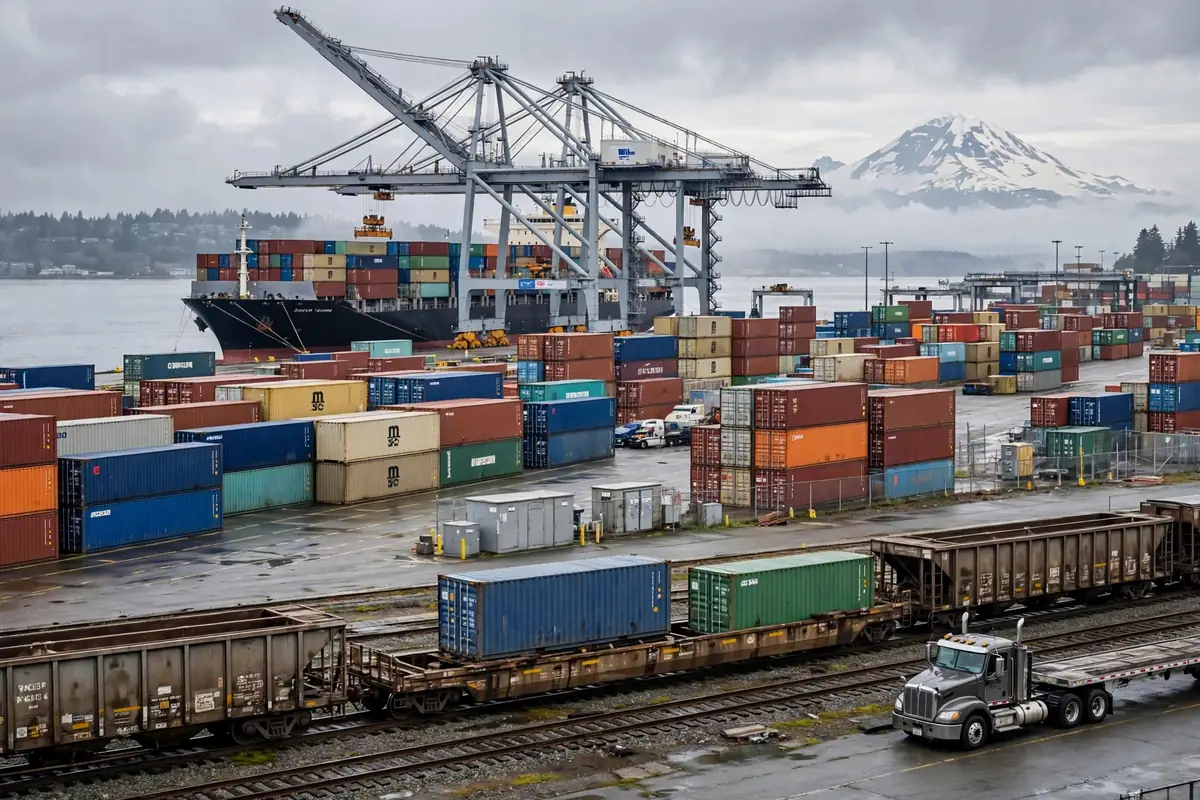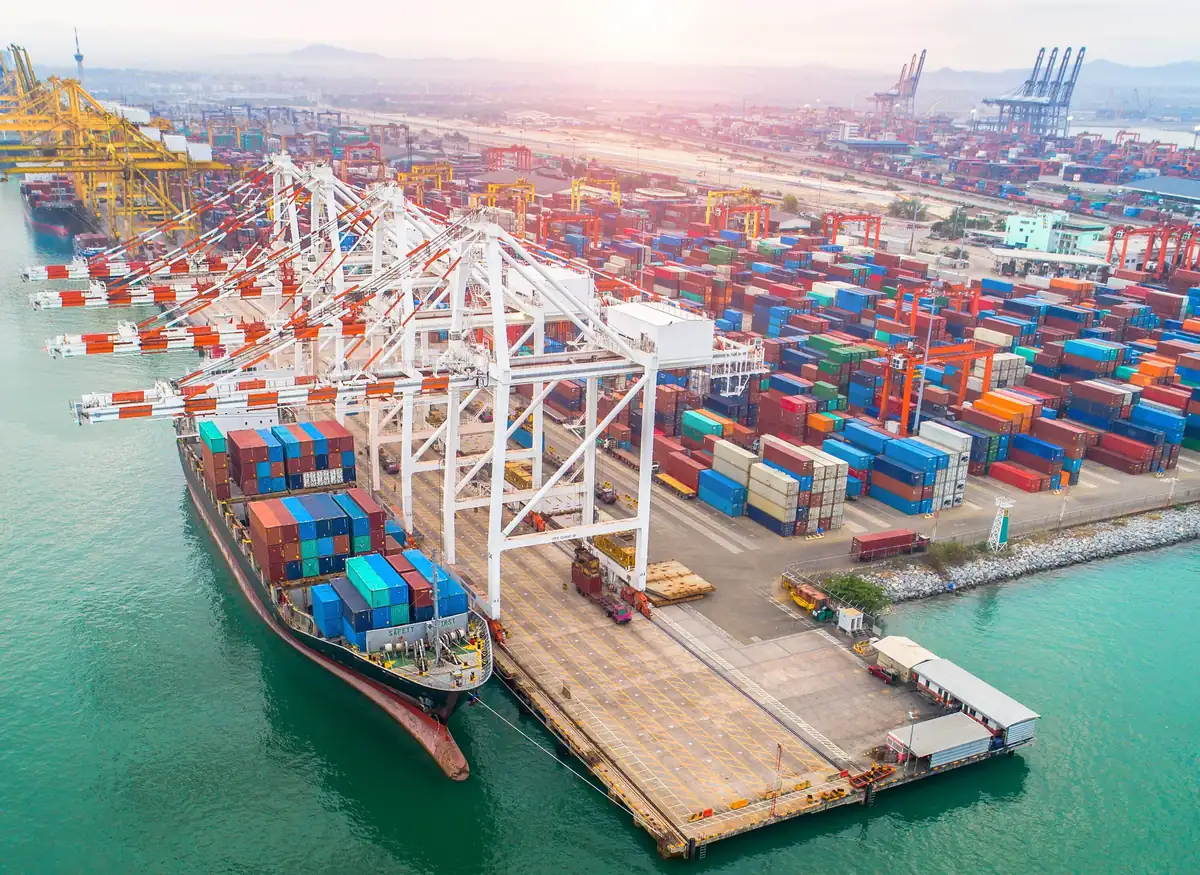
To understand Tangier Med port warehouse logistics, start with the map. The port sits on the southern shore of the Strait of Gibraltar, facing Spain across the narrowest stretch of water between Europe and Africa. According to figures published by the port authority, Tangier Med handled 11.1 million TEU in 2025, up 8.4% from 10.24 million TEU in 2024, with total cargo of 161 million tonnes, connections to more than 180 ports in 70 countries, and a global container-port ranking of around 16th. An African port in the global top twenty does not happen by accident: it sits exactly where east-west shipping lanes cross north-south ones.
That position defines the business. Tangier Med is first a transshipment hub and only second a gateway for Morocco's own trade. Warehouse logistics in a transshipment port is a different trade from in a gateway port: there, the warehouse serves local cargo owners and the rhythm follows local demand; here, it serves the sailing schedule — cargo comes off one vessel, waits a few days in the yard or a transit warehouse, and leaves on the next. Tangier Med's growth follows the same logic: as long as deep-sea and feeder services keep meeting here, its transshipment volumes have a floor under them.
What Tangier Med Port Warehouse Logistics Actually Runs On
The first layer is network density. More than 180 connected ports means a web: European cargo changes vessels here for West Africa, Asian cargo for the eastern Mediterranean and North African inland markets. A transshipment port's value is not its size in isolation but how many services it stitches together, and Tangier Med's climb is, at bottom, the story of that web getting denser year by year.
The second layer is terminal capacity still being added. The TC4 expansion is already in operation, and Tanger Med 3, operated by Maersk's APM Terminals, will add 4.5 million TEU of annual capacity and 1,200 metres of quay, with operations planned to start in mid-2031 — roughly the entire throughput of many mid-sized ports, added by a single terminal. The operator is placing capacity ten years ahead of demand. The direct effect for warehouse logistics is more yard and transit-warehouse space to turn vessels around faster, which makes the dwell-time window inside the port tighter. A transshipment port's warehouses compete on turnover speed, not on how much they can hold.
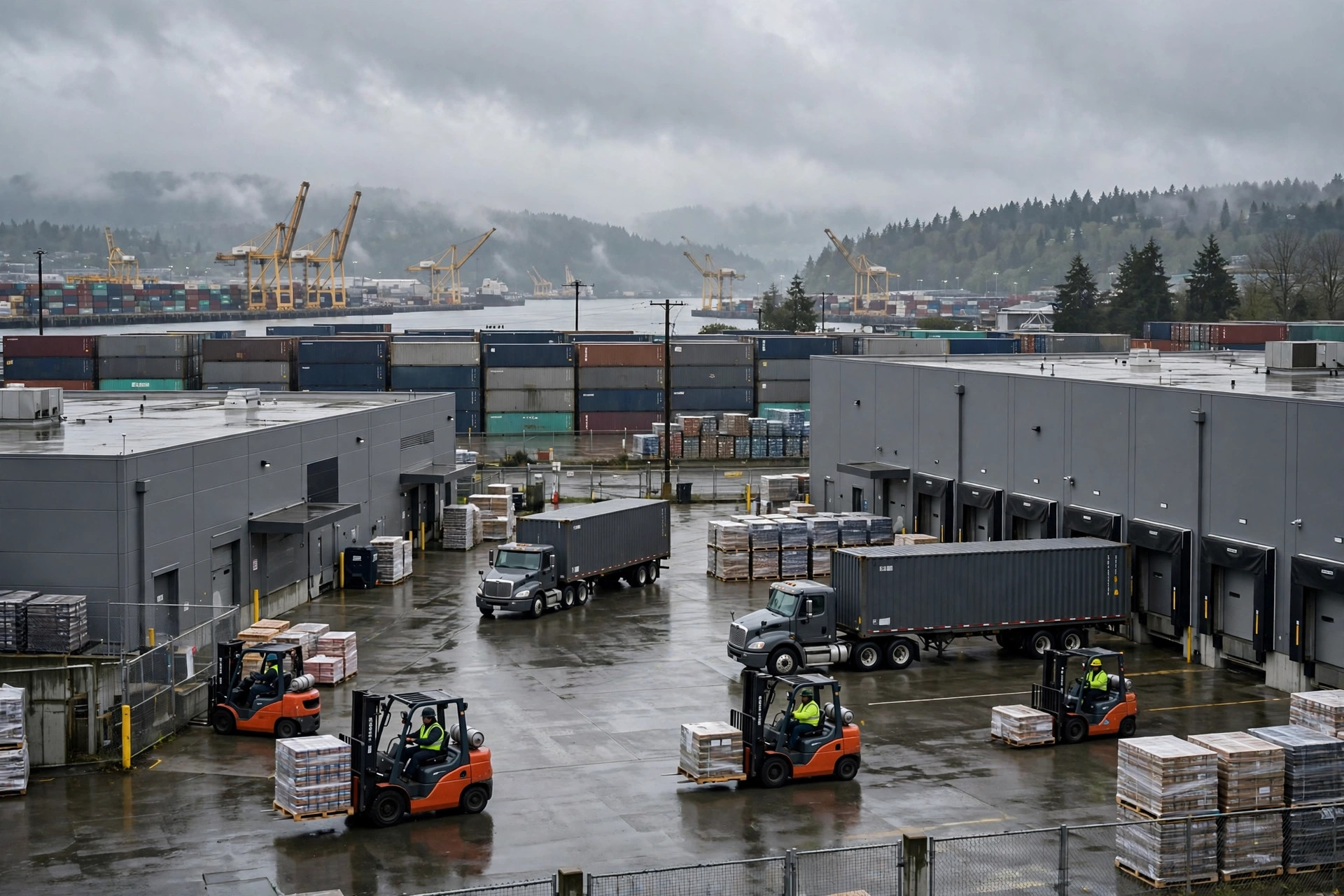
Here is the counterintuitive part: in a transshipment hub, the emptier the warehouse, the better the business. Plenty of people assume port warehousing is about renting space and keeping it full; at a hub like Tangier Med, the yard earns its keep by moving cargo through quickly. Cargo dwelling three days and cargo dwelling ten days are two entirely different businesses — high-frequency transshipment versus low-efficiency occupation. The real money is in the connections: vessel-to-vessel, customs-to-yard, feeder-to-deep-sea. The warehouse is only the buffer that keeps those connections from breaking. Anyone who walks in with a local-warehouse rent model will find the two arithmetics do not match.
The Warehouses Behind the Port: Tangier Med's Industrial Zone Moves In First
The other half of the story sits outside the terminals, in the economic zone around the port. The zone covers roughly 3,000 hectares, hosts more than 1,400 companies, and provides around 130,000 jobs across automotive, aerospace, textiles, agri-food, and renewable energy. The automotive cluster is the sample worth studying: vehicle makers and parts suppliers run factories inside the zone, parts arrive by sea from Europe, get sorted and sequenced in nearby warehouses, feed the production line on schedule, and finished vehicles load straight onto ships for export.
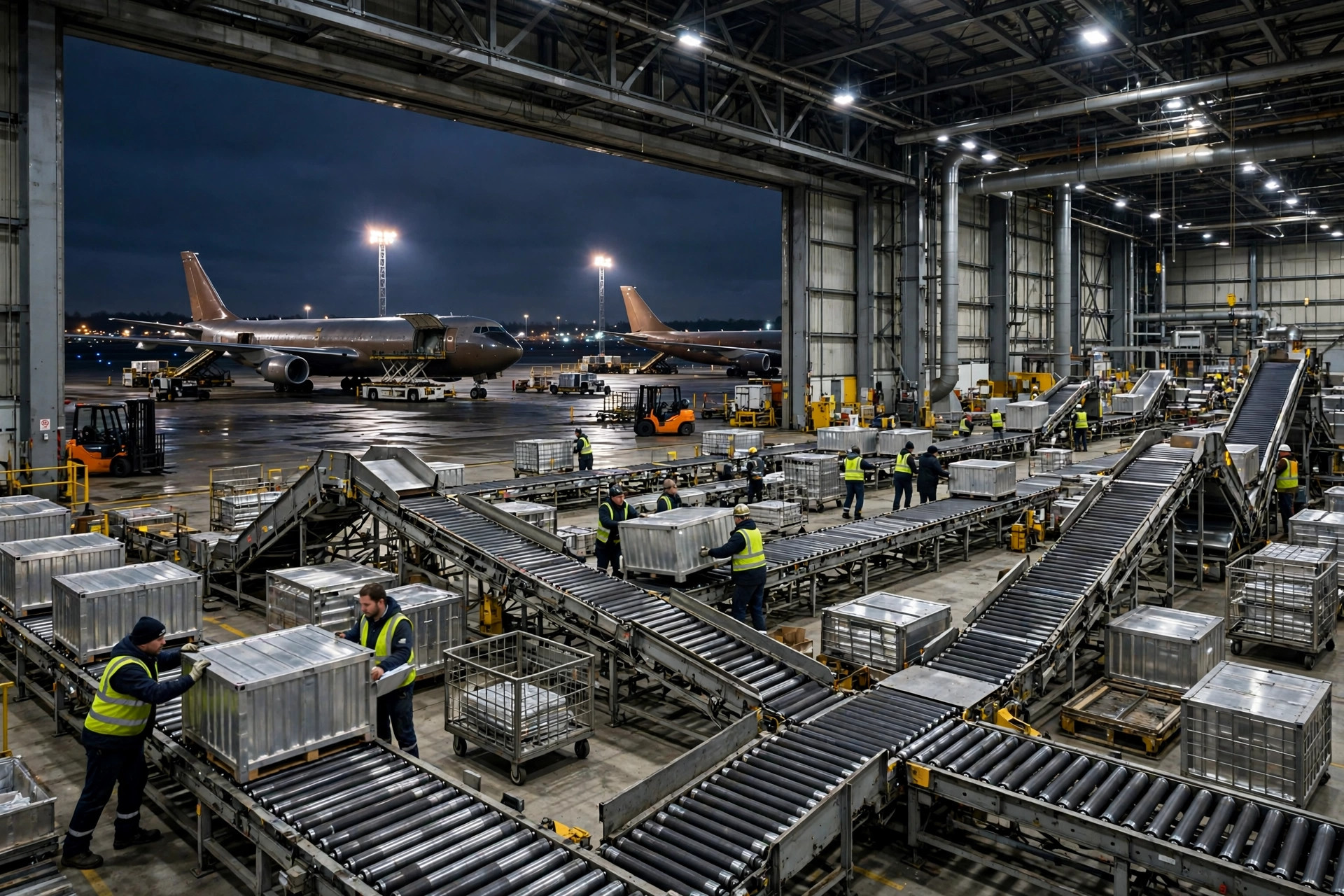
Picture the flow as an illustrative scenario. A European parts supplier ships two consignments a week into Tangier Med; on arrival they enter a bonded warehouse in the port zone, get sorted and kitted by vehicle model, and leave in batches matched to the factory's production plan, the freed space cleared before the next vessel arrives. Here the warehouse is not storing goods; it is sequencing them — turning bulk arrivals into line-ready kits, valued on kitting accuracy and on-time delivery.
Bonded and free-zone functions are the foundation. Companies in the zone can process, assemble, label, and distribute goods under bonded status, moving them inside the zone without first clearing customs, with duties settled on export under the applicable rules. For Chinese sellers and cargo owners, the opportunity is not "store goods in Morocco" but "use Morocco as a processing and distribution node into Europe and Africa": components or semi-finished goods arrive at the port, finish assembly or sorting under bonded status, then split toward European or West African markets. Duty and compliance treatment varies greatly by product category and rules of origin, so check the latest official policy and get written confirmation before the first consignment moves.
Tangier Med or a Southern European Port: How to Do the Math
The question cargo owners actually wrestle with is rarely "should we use Tangier Med" but "does this shipment transship through Tangier Med or through a southern European port". The trade-off can be framed in four dimensions: network connection, turnaround speed, total cost, and hinterland function.
On network connection, Tangier Med's edge is north-south: feeder services to West Africa and along the Mediterranean coast run more naturally from here, while southern European ports win on the European inland hinterland, where cargo moves straight onto road and rail. On turnaround speed, Tangier Med is built around vessel schedules and tight transshipment connections; southern European ports around hinterland distribution, with warehouses leaning toward storage and delivery. On total cost, comparing port tariffs alone is a trap: the real figure sums dwell time, feeder schedules, inland connections, and bonded warehousing, and specific rates should be checked against the latest official policy — no static price list gives a true total cost. On hinterland function, southern European ports sit behind mature European consumer markets, while Tangier Med sits behind a forming Moroccan manufacturing base and the West African market.
So the answer is not "which port is better" but "where is the cargo going". Cargo bound for West Africa or North African inland markets, or cargo needing bonded processing before redistribution, pencils out better through Tangier Med. Cargo heading for distribution deep inside Europe, needing large storage warehouses and a mature delivery network, still favours a southern European port. The two are not in a zero-sum fight; they are two nodes on the same liner network, and cargo owners split flows by destination as a matter of routine. If the 11.1 million TEU of 2025 keeps growing at roughly 8% a year, that division of labour will only get clearer.
What It Means for Chinese Sellers: Three Questions First
For Chinese sellers and cargo owners, Tangier Med matters along two lines. The first is offshore manufacturing: companies in automotive, home appliances, and textiles place production capacity in the Moroccan port zone, ship components from China, kit them in bonded warehouses, feed them into factories, and export finished goods to Europe and Africa. This line tests supply-chain design capability, not just logistics cost. The second is transshipment distribution: using Tangier Med as a regional distribution point for West African and Mediterranean markets, consolidating ocean freight into the port and splitting it by order to each destination country. This line tests order density and customs capability; without enough volume, the distribution-warehouse arithmetic does not close.
Before doing anything, three questions are worth settling. Is your cargo passing through or landing? Through-cargo is judged on vessel connections, landed cargo on zone policy and local supporting industries — the two sets of books cannot be mixed. How exactly do the bonded and rules-of-origin treatments apply to your goods? The same shipment can be treated very differently as bonded processing for re-export versus straight transshipment, so confirm the compliance details against the latest official policy and get written confirmation before the first shipment. Can your volume support a distribution node? A regional warehouse carries fixed costs; when volume is thin, using a third-party warehouse's flexible space is usually smarter than leasing your own.
The Tangier Med story is not finished. Tanger Med 3 does not start operations until mid-2031, and its additional 4.5 million TEU of capacity will lift the port's transshipment capability another notch, while industrial clustering in the port zone keeps deepening. Stretch the timeline into the early 2030s and the question worth watching is whether Tangier Med port warehouse logistics will tilt further from "serving vessels" toward "serving a regional manufacturing belt" across the western Mediterranean and West Africa. It is too early to call that a conclusion — the evidence is not there yet — but the direction is worth tracking.
By Dr. Chen, Supply Chain Researcher