Sri Lanka tea export warehouse storage begins not at the port, but in factory warehouses around Kandy. After withering, rolling, and drying, black tea remains highly sensitive to its environment: it absorbs moisture, absorbs odors, dislikes light, and crushes easily. Small deviations in storage conditions become larger differences later, when tea is blended, graded, and sold at auction. The starting point for understanding this system is a simple fact: the value of tea lies less in its weight than in the stability of its flavor, and flavor stability is decided in the warehouse.
Sri Lanka Tea Export Warehouse Storage on the Factory Floor
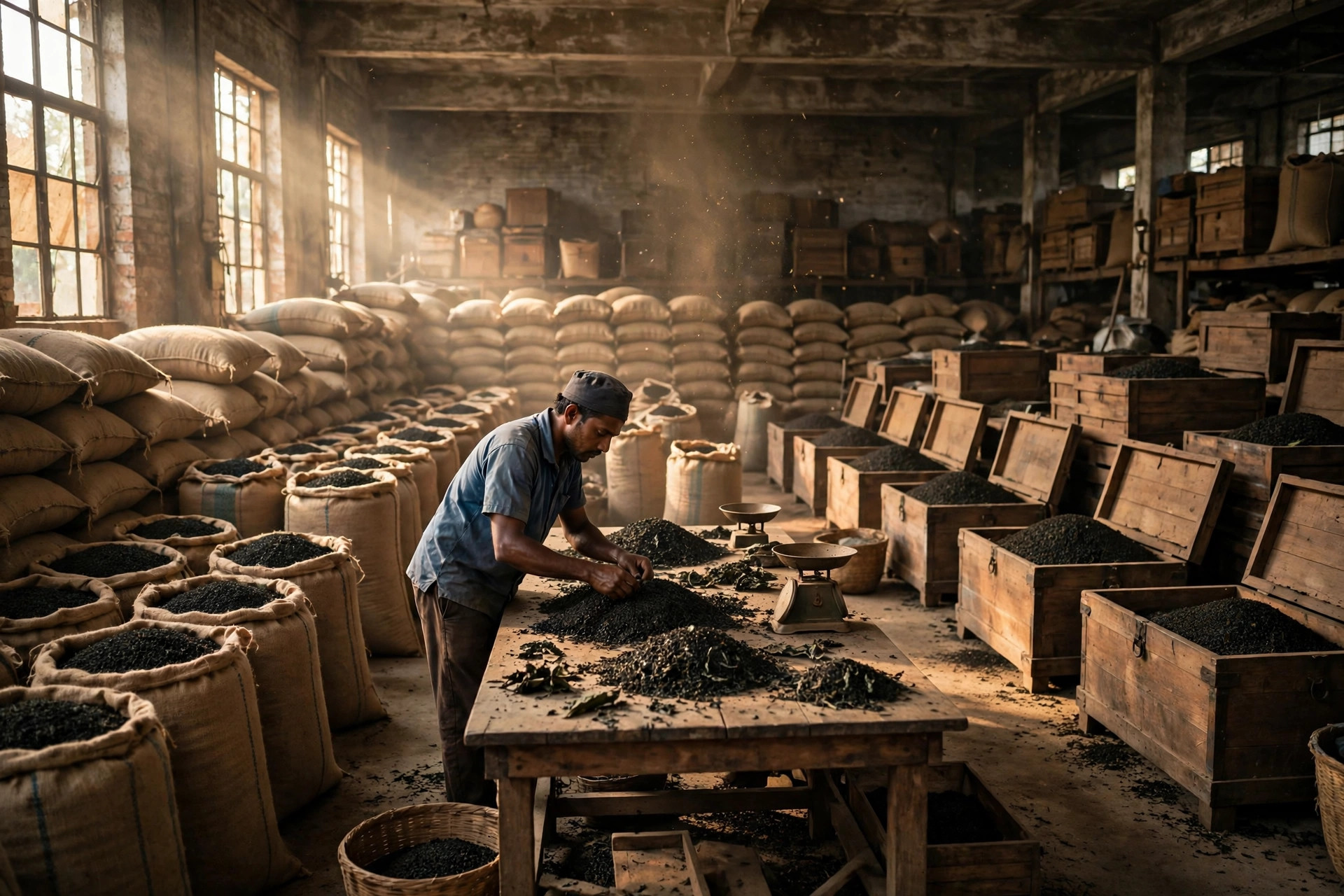
A tea factory warehouse near Kandy often looks unremarkable: high windows, ventilation, wooden shelving, and tea stored in large sacks or chests by grade. The decisive steps come right after drying. Tea leaves the dryer warm. If it is sealed into bags before it has cooled fully, condensation forms inside the bag and dulls the aroma of the whole lot. Grading then decides how the tea is stored. Different grades vary in particle size, density, and fragility. Mixing them in storage does not only create physical contamination; it also makes it impossible to trace each grade accurately when blending begins.
I once studied the storage routine of a mid-sized factory whose manager kept a rule that looked needlessly strict: every incoming lot had to record the garden, the plucking date, the processing batch, and the grade, with none of the four allowed to be missing. The value of that rule became clear only at auction. At the Colombo tea auction, buyers place a high premium on traceability. Lots with complete records earn trust more easily, while lots with vague records tend to attract more cautious bids. In this system, warehouse records are not administrative overhead. They are part of how price is formed.
Blending Warehouses: More Batches Are Not Better
The second core stage of Sri Lanka tea export warehouse storage is blending. Exporters seldom ship tea from a single garden directly. Instead, they blend teas from different gardens and grades in set proportions, aiming for a flavor profile that stays consistent and matches the taste of a target market. The management difficulty lies in the tension between the number of blends and flavor consistency.
A useful case comes from an exporter's blending room. The company once ran dozens of blends at the same time, hoping that variety would cover more buyers. The result was the opposite of flexibility: warehouse complexity rose sharply, different blends turned over at very different speeds, and some blends sat in storage long enough for their aroma to fade, forcing a downgrade. Afterward, the company cut the number of blends it managed at once to a controllable range, and built a separate storage file for each blend recipe, recording proportions, intake dates, and dispatch order. The lesson is that blending-warehouse efficiency depends less on diversity than on the predictability of turnover.
From a storage-management view, blending batches should follow first-in, first-out discipline. In practice, buyer orders disrupt that discipline constantly. A sudden order surge can force the warehouse to draw on a blend that has not rested long enough. A sudden order drop leaves finished blended tea sitting in stock. One practical answer is a buffer between blending and finished storage: blended tea rests in a settling area for a flavor-stabilization period before it moves to the finished warehouse. That buffer stops order volatility from hitting blend quality directly.
Colombo Auction Warehouses: Time Is Flavor
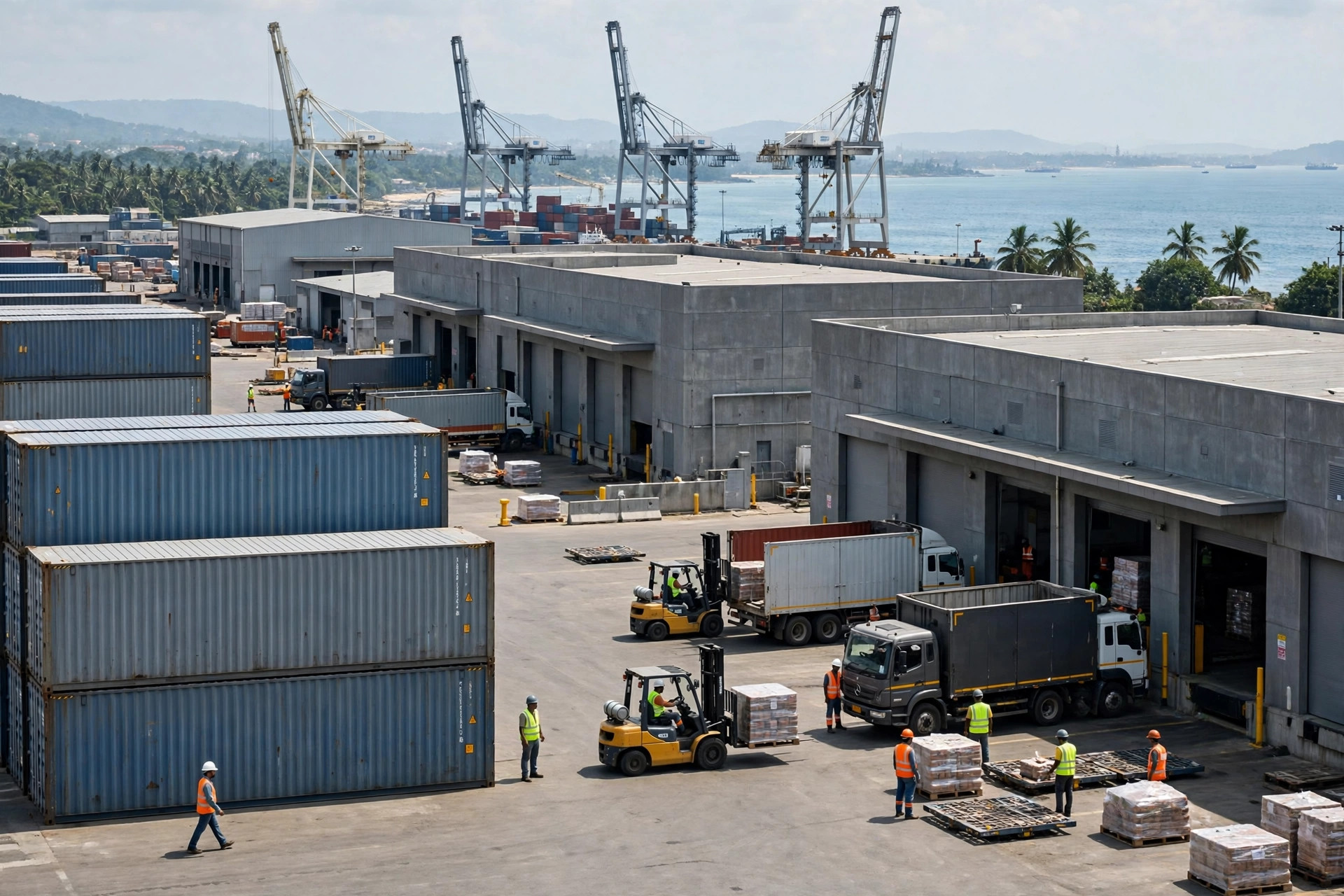
The Colombo tea auction is a central hub of the Sri Lanka tea export system, and the speed of its warehouses shapes both storage cost and quality. Tea arriving from factories goes through weighing, sampling, and display. Buyers bid on samples, winners arrange collection, and export stuffing follows. Any delay in that chain extends the tea's exposure to warehouse conditions.
Moisture and odor contamination are the two risks most often underestimated in auction warehouses. Tea absorbs odors aggressively, so storing it beside spices, coffee, or other strong-smelling goods can cause irreversible taint. Colombo sits on a humid tropical coast, so a warehouse without effective moisture control can let tea cake and stale quickly. Reliable auction warehouses combine zoned storage, sealed packaging, and regular inspection, and they keep tea strictly separate from strong-smelling goods. Those measures cost relatively little. The losses from missing them are hard to reverse.
Another trend worth noting is the gradual digitization of auction warehouses. Sample information, batch records, and collection schedules increasingly move through systems rather than paper slips. That change does not alter the physical nature of tea, but it shortens the time tea spends in an uncertain state. Digitized records let buyers verify batch information faster and let exporters plan stuffing more precisely. Time is flavor's largest enemy, and information speed is one way to protect it.
A Decision Framework for Sri Lanka Tea Export Warehouse Storage
| Decision dimension | Cost of chasing perfection | More workable compromise |
|---|---|---|
| Storage climate control | Full climate control is expensive | Ventilation, moisture control, and zoned storage combined |
| Number of blends | More blends, harder management | A controllable blend range with complete files |
| Inventory turnover speed | Rushing turnover hurts blend quality | A resting buffer after blending |
| Time in the auction warehouse | Process delays fade flavor | Documents and stuffing plans prepared in advance |
This framework points to a counterintuitive conclusion: the most expensive part of tea export warehousing is not always the part with the highest return. A fully climate-controlled warehouse sounds most professional, but for most small and mid-sized exporters, the combination of ventilation, moisture control, zoning, and record-keeping often delivers a comparable result at lower cost. The real bottleneck in warehouse management is rarely the ceiling of equipment. It is the consistency with which basic routines are performed, day after day. Equipment can be bought once. Consistent execution has to be renewed by every patrol and every record.
A Trend to Watch: Storage as Evidence of Quality
Pulling the observations together suggests a trend worth stating carefully: Sri Lanka tea export warehouse storage is shifting from a pure cost center to a provider of quality evidence. Buyers ask more about batch traceability, auction warehouses handle more information digitally, and export contracts pay more attention to inspection and storage records. Under that trend, the value of storage no longer shows up only as a per-kilogram holding charge. It shows up as a record system that can prove flavor stability.
That shift is both a challenge and an opportunity for smaller exporters. The challenge is that standardized, digitized warehouse management needs sustained investment. The opportunity is that standardized records are themselves a form of differentiation. When two teas taste similar, the lot with a complete warehouse file is more likely to earn a buyer's long-term trust. Trust accumulates slowly and disappears quickly, and the warehouse is where that accumulation starts.
An open question for the next few years is whether factory warehouses and auction warehouses will connect their data more tightly. If batch information could flow transparently from a Kandy factory all the way to the buyer, would the friction in the middle of the chain fall further? The answer depends less on technology alone than on how willing each link in the Sri Lanka tea chain is to share information. The endpoint of storage may not be keeping tea longer. It may be making every lot's journey verifiable.
By Dr. Chen, Supply Chain Researcher