Let me tell you something straight: last-mile delivery in South America is a different animal from what I was used to back home. Fifteen years behind the wheel taught me this: in São Paulo and Bogotá, the road can be on the map and the parcel still cannot reach the door.
South America last mile delivery is hard because four constraints hit you at once: traffic that barely moves, safe streets and rough streets separated by a single block, addresses written every which way — some with no street number at all, just a landmark — and plenty of buyers who still prefer cash on delivery. The parcel arriving is not the end of the job; the money still has to come back. Any plan built around "one van runs all day" falls apart on day one.
A Friday Afternoon in São Paulo: Where the Van Cannot Go
Let me start with a story from the road. One Friday afternoon a few years back, I rode along with a local delivery team in São Paulo. The van carried dozens of parcels bound for an old neighborhood east of the city, a short drive by navigation. But at the entrance we were stuck: narrow streets, cars parked on both sides, and a big van that could not make the turn. The driver shrugged. In places like that, he said, the van stops on the main road, and the rest is done on foot or by motorcycle.
That is what we did: the van became a transfer point on the main road, and two motorcycle couriers shuttled parcels in one trip at a time. We delivered everything, but it took more than twice as long as planned.
Here is the lesson: in South America last mile delivery, look at the road before you look at the vehicle. The biggest van is useless on a street it cannot enter. What looks like saving one van trip can easily cost twice the time and labor.
South America Last Mile Delivery: Three Tools, Three Temperaments
Put simply, you have three tools, each with its own temperament:
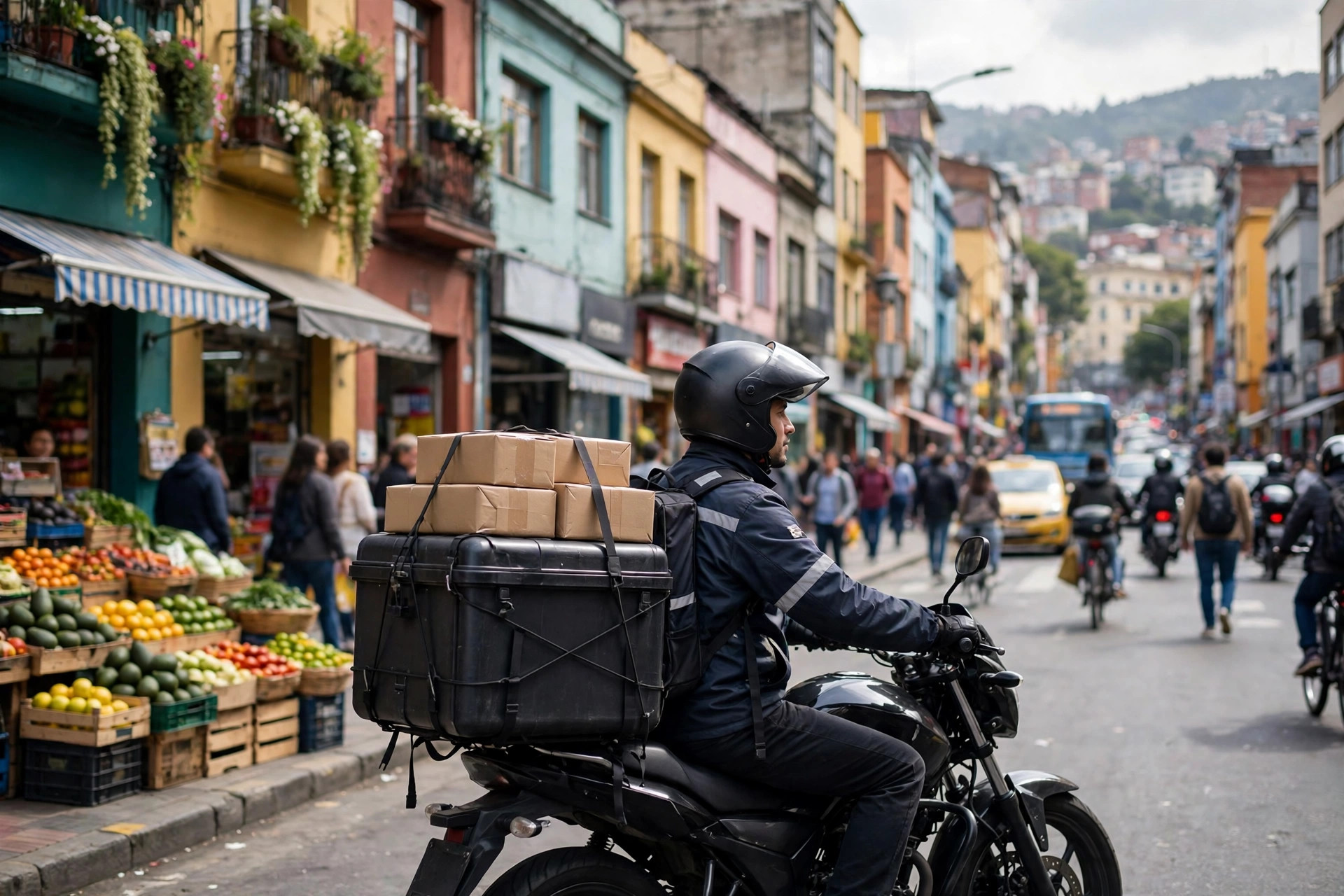
Motorcycle couriers: fast and nimble, but small and exposed. In gridlock, a motorcycle threads through gaps into streets and hillside neighborhoods vans cannot reach — ideal for documents, small parcels, and light goods. Downsides: only a few parcels per trip, risk in rain and at night, and high courier turnover.
Small vans: big capacity and low damage, but they hate traffic and narrow streets. For bulky goods or a dozen deliveries to one office building, a van clears the lot in one trip, and the cost per parcel comes down nicely. But in an old district at rush hour it becomes an oversized roadblock, burning fuel and time while going nowhere.
Pickup points and lockers: no doorstep visit needed, but only if buyers play along. Drop parcels at a convenience store, a pharmacy, or a locker bank, and buyers pick them up on their way home from work. First-attempt success rates jump, especially in office and shopping districts. The catch: many buyers want cash on delivery and want to inspect the goods in person, so some will simply cancel rather than walk to a pickup point. Running pickup points is not free work either — partnerships, inventory, and uncollected parcels all need managing.
Judge by the total bill, not the freight rate alone:
| Option | Best for | Speed | Cost feel | Biggest trap |
|---|---|---|---|---|
| Motorcycle courier | Small, light, urgent parcels | Fastest in traffic | Cheap for light goods | Small loads, rain and night risk |
| Small van | Bulky, heavy, clustered orders | Steadiest on open roads | Economical at volume | Helpless on narrow streets, at rush hour |
| Pickup point / locker | Standard parcels, office workers | Depends on buyer collection speed | Saves labor via consolidated drops | Cash-on-delivery and inspection habits push buyers away |
A Delivery in Bogotá: South America Last Mile Delivery by Phone, Not GPS
Another one, from Bogotá, a mountain city where the GPS leads you into a dead end. We had a parcel with what looked like a complete address, but the house numbers jumped around with no pattern at all. The courier finally got through by phone, and the buyer talked him in: "See the red gate, turn left, third house up the hill."
After all these years on the road, my rule is simple: in South America, the recipient's phone number matters more than the GPS. At checkout, collect the phone number, a backup contact, and a landmark description. Before the courier sets off, one quick call — "Are you home? What is the landmark near you?" — saves a wasted trip.
Cash on Delivery: Delivered Does Not Mean Paid
Here is the point Chinese sellers most often underestimate about South America last mile delivery: cash on delivery. Many buyers have no credit card or do not trust paying online in advance, so they would rather hand over cash at the door. That means couriers must carry change and handle cash safely, a buyer who changes his mind at the door sends the parcel straight back, and cash held overnight raises the question of who bears the loss if it goes missing.
My practical advice: first, confirm cash-on-delivery orders by phone before dispatch — buyer home, cash ready — and only then send the vehicle out. Second, set a hard rule: money collected today is handed in today, and couriers never carry large amounts overnight. Third, gradually steer buyers toward local electronic payment options, even at the cost of a small discount. Cash on delivery is workable; it just cannot be managed as if "parcel delivered" meant "job done."
What This Means for Chinese Sellers Expanding into South America
First, do not copy a "one national network" playbook from home. Every city has different roads, safety conditions, and address habits. Start with one or two key cities, get the operation working there, and then expand. What works in São Paulo may not work in Bogotá.
Second, a good local delivery partner matters more than your own fleet. New to the market, building your own courier team means recruiting riders, managing cash, and handling refused deliveries — all uphill. Work with a reliable local third-party or crowd-sourced platform first, and talk about your own fleet once volume justifies it. Before signing, ask how they handle cash-on-delivery money and orders where the address cannot be found. Those answers tell you more about reliability than any price quote.
Third, treat pickup points as a strategy, not a backup. Place them near shopping districts, offices, and universities, pair them with motorcycle top-up delivery, and your first-attempt success rate will climb. For cash-on-delivery orders, start with motorcycle delivery, then gradually guide buyers toward pickup plus online payment.
Fourth, on compliance and tax, go by the latest official policy. Import, tax, and consumer protection rules change fast across South American countries, so I am deliberately not quoting specific rates here — anything I wrote could be out of date by the time you read it. Before opening a warehouse, ask a local professional to confirm the current rules.
The Counterintuitive Truth: the Fastest Vehicle Is Not Always the Fastest Delivery
After all these years, here is a counterintuitive truth: in the South American last mile, the motorcycle is the fastest vehicle, but a network built entirely on motorcycles is not necessarily the fastest network; the van is the slowest vehicle, but used in the right place it is the steadiest. What decides speed is not how fast the vehicle moves, but whether the parcel is delivered on the first attempt. A failed first attempt means a second and third trip, doubling cost and time and wrecking the buyer experience.
So do the math in the right order: first check whether the address and the road are reachable, then look at the size and weight of the goods, then check whether the buyer will use a pickup point or pay in advance, and only then look at the per-parcel freight rate. Get the order wrong and every calculation after it is wrong too. South America last mile delivery is not won by whoever owns the most vehicles. It is won by whoever best understands the roads, the people, and the rules of the place.
Pick the right vehicle, learn the roads, treat buyers well, and the last mile will connect.
By Shifu Zhao, Trucking Veteran (15 yrs)