Should a warehouse doing 5,000 orders a day buy a cross-belt sorter or stick with manual sorting? Here's the uncomfortable number first: a linear cross-belt sorter rated at 8,000 parcels an hour typically prices at $850,000–$1.4 million installed. That figure alone scares most people off. But almost nobody has honestly done the manual sorting math either. Let's put both numbers on the table and see which one actually wins.
How a Cross-Belt Sorter Earns Its Speed
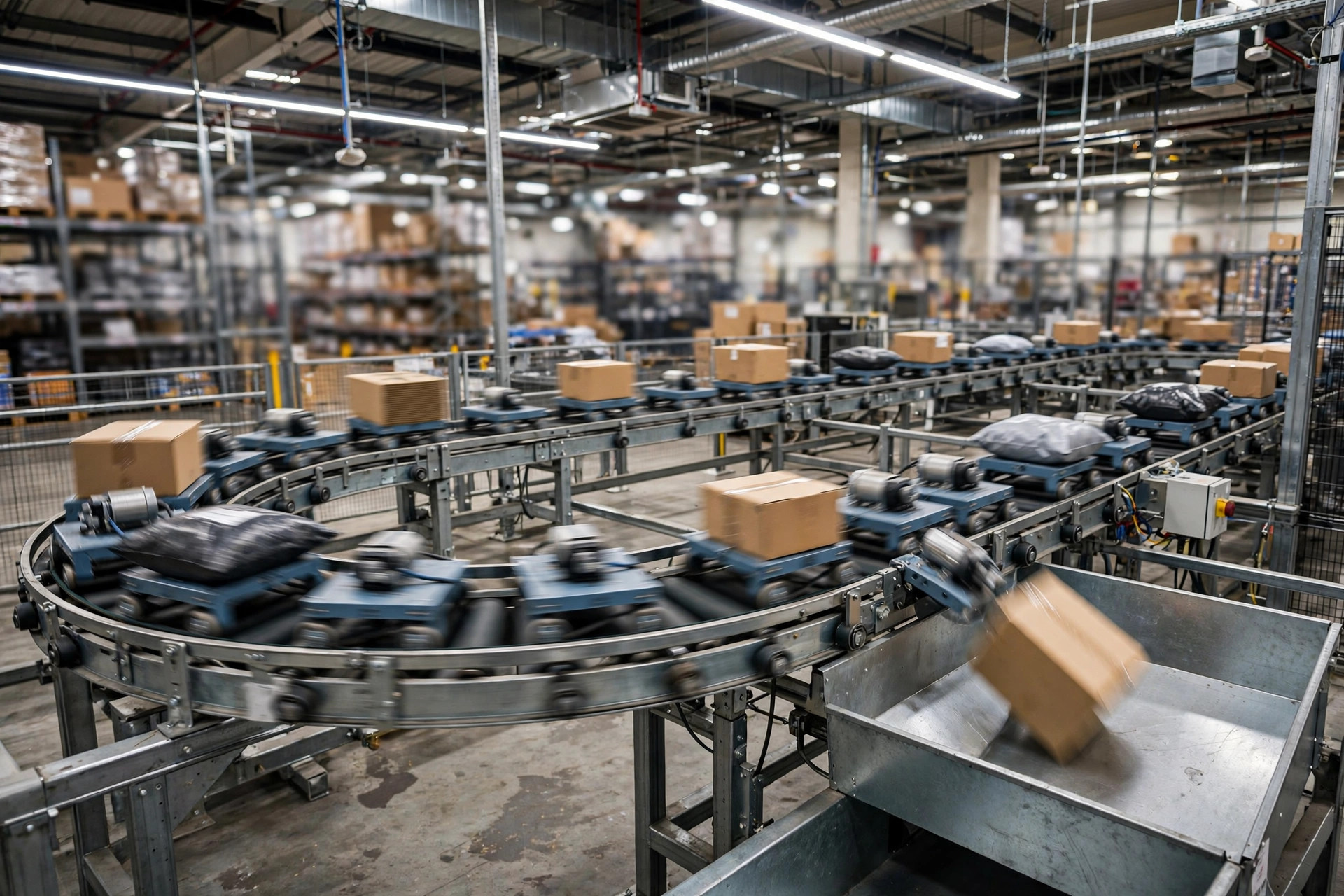
The principle is simpler than the price tag suggests. Think of it as a freight train where every car unloads itself: each carrier has its own little belt built in. A parcel gets scanned and assigned a destination at induction, rides its carrier around the loop, and when it reaches the right chute, the mini-belt fires sideways and kicks the parcel off.
It's the difference between a decathlon and a relay race. Manual sorting makes one person do four things in series: read the label, figure out the destination, walk over, toss it in the chute — each step waiting on the last. A cross-belt splits those four steps into a parallel pipeline: destination lookup happens exactly once at induction, the carriers just run, and discharge just fires. That's how you get belt speeds of 1.5 to 3.5 meters per second and single-loop throughputs of 5,000 to 20,000 parcels an hour, depending on carrier pitch and induction design.
For the spec-sheet crowd, the numbers that matter: sorting accuracy above 99.95% on a well-maintained system — fewer than 5 missorts per 10,000 parcels; equipment availability around 99.9%; parcel weights from 5 to 50 kg, cartons, polybags, and odd shapes all ride fine. A human? A skilled sorter sustains 200 to 250 parcels an hour across a shift, with a missort rate around 2% in most operations I've seen. That's not a people problem. It's the ceiling of serial work — no amount of hustle beats parallelism.
Manual Sorting vs Sortation Conveyor: Cost Per Parcel
Cost math needs a concrete scenario, no hand-waving. Assume 5,000 parcels a day, 300 operating days a year — 1.5 million parcels a year. US warehouse, fully loaded labor at $25 an hour, which already includes taxes and insurance and is honestly on the conservative side.
The manual sorting option:
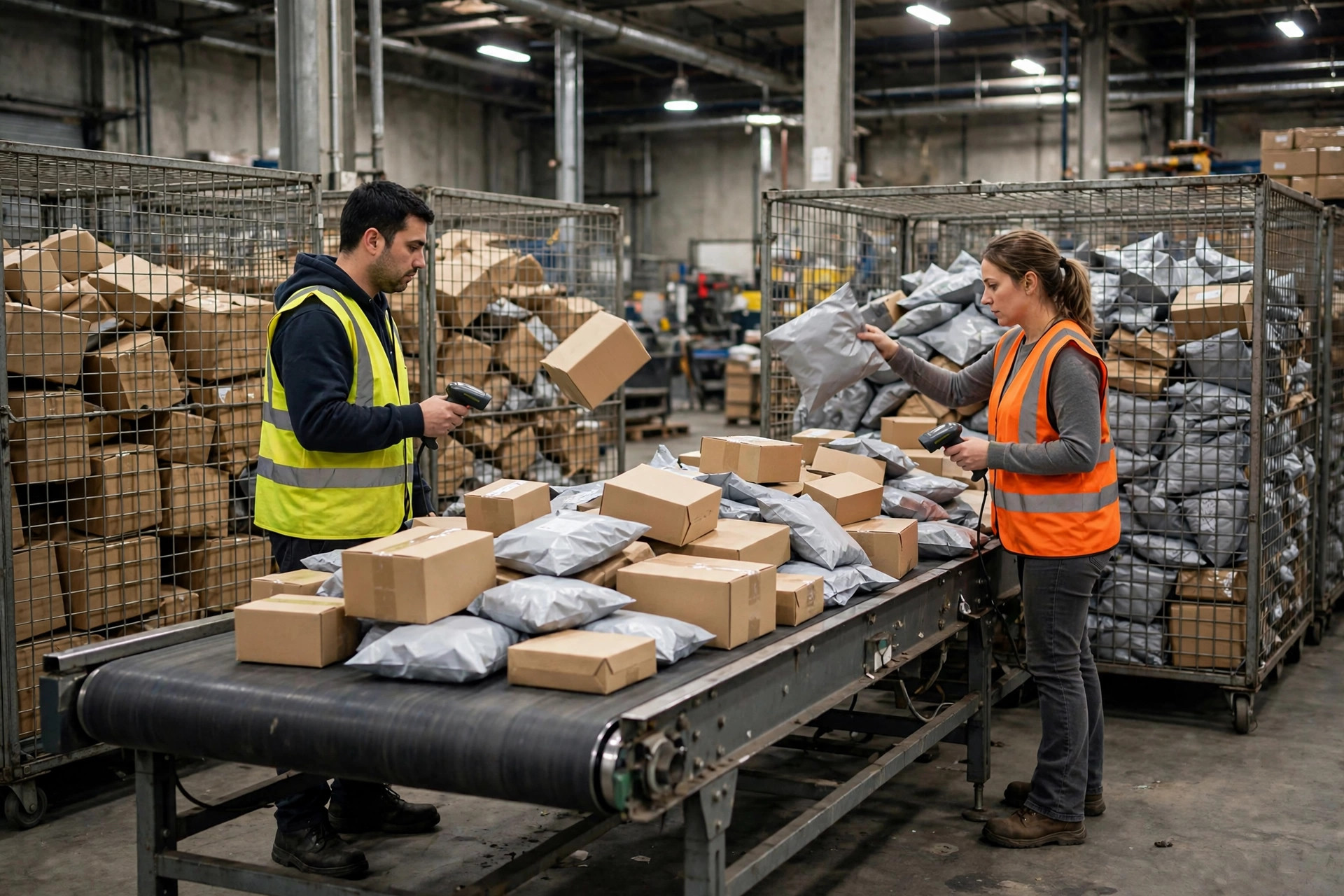
5,000 parcels over an 8-hour shift averages 625 an hour. But don't trust the average — 60 to 70% of volume crushes into the 4-hour peak window before carrier cutoff, so peak demand is really 875 parcels an hour. At 220 parcels per person-hour, that's 4 sort stations at peak, plus 2 inductors and 1 person handling exceptions and jams. Seven people per shift is the floor.
- Annual labor: 7 × $25 × 8 × 300 = $420,000
- Missort cost: 2% × 1.5M = 30,000 missorts a year; rework, redelivery, and customer-service headaches at $2.50 each = $75,000
- Manual total: about $495,000/year
The cross-belt sorter option (linear, 8,000 parcels/hour):
- Equipment $1.2 million, amortized over 10 years = $120,000/year
- Maintenance, spare parts, and power: $100,000–$120,000 a year (carrier mini-belts are consumables — that line item doesn't go away)
- Induction still needs people, 3 of them: 3 × $25 × 8 × 300 = $180,000
- Machine total: about $420,000/year
| Manual sorting | Cross-belt sorter | |
|---|---|---|
| Annual total cost | ~$495,000 | ~$420,000 |
| Cost per parcel | ~$0.33 | ~$0.28 |
| Missort rate | ~2% | under 0.1% |
| Peak elasticity | hire more people — if you can find them | headroom built into the machine |
| Upfront investment | near zero | $1.2 million |
See the awkward part? At 5,000 orders a day the annual numbers are basically a tie, with the machine slightly ahead. But that $1.2 million upfront takes 5-plus years to pay back. That's the 5,000-a-day trap: the machine wins on annual cost, manual wins on cash flow and risk.
The Selection Line: Where 5,000 Orders a Day Sits
After years on the integrator side, my dividing lines are brutally simple:
- Under 3,000 orders a day: don't touch a cross-belt. People, belt conveyors, and scan guns are the optimal answer. The machine would run under 30% utilization — that's just burning money on a fake requirement.
- At 5,000 a day: the tie zone — and the most agonizing one. It comes down to three variables: ① can your peak season hit 2× average or more; ② local labor cost inflation; ③ what one missort actually costs you in return freight and chargebacks.
- 8,000–10,000 a day: the sorter clearly wins, 3-to-4-year payback, just do it.
- 20,000+ a day: loop sorter. You don't need the math.
Time for some blunt talk: the most common fake requirement I see is a 5,000-a-day warehouse buying a 15,000-parcel-an-hour machine. A racehorse pulling a grocery cart looks impressive; it runs at 30% utilization while depreciation, maintenance, and power bills arrive at 100%. The first rule of sizing: size for peak demand, not for "maybe someday." If someday comes, linear sorters extend and loops take more carriers — that's what modular design is for.
One more trap beginners always miss: they stare at the loop and ignore induction. The bottleneck is always at induction, never on the loop. A manual inductor feeds 600–800 parcels an hour; an 8,000-parcel-an-hour loop with three manual induction stations can only be fed a little over 2,000 an hour in practice — the loop spins empty and the money evaporates. Induction method (manual, semi-auto, fully automatic) has to be sized together with the loop. Size them separately and the project fails.
And here's the counterintuitive part: what decides the ROI isn't average daily volume — it's peak multiple × labor inflation × missort cost. Most ROI spreadsheets only model the average, and that's wrong. Two warehouses, both at 5,000 a day: one peaks at 1.3×, pays $18/hour, and a missort costs $1 to fix; the other peaks at 2.5×, pays $28/hour, and a missort costs $8. For the first, the sorter is a money fire. For the second, skipping it is malpractice. Same machine, opposite answers.
Two projects from my history — details sanitized, numbers real:
In 2023, an apparel e-commerce 3PL in Ontario, California ran about 4,500 orders a day and spent $650,000 on a used cross-belt. Apparel SKUs were too scattered, too many soft irregular polybags, and induction never kept up — the line topped out at 3,000 parcels an hour, under 40% utilization. Worse, nobody owned maintenance: carrier mini-belts drifted out of alignment for three months, and the missort rate ended up higher than the manual line it replaced. Two years later they ripped it out and went back to people and conveyors. The $650,000 lesson: the used machine is the cheap part; the maintenance you didn't budget is the expensive part.
In 2024, an auto-parts distributor in Dallas ran 9,000 a day, spiking to 16,000 in peak season, and put in a $1.2 million linear cross-belt. Returning one auto part costs $8-plus in freight, so missorts were brutally expensive. The machine drove missorts from 2.5% to under 0.1%, saving over $200,000 a year in missort cost alone — payback in two and a half years. Same technology; they won on the missort-cost variable.
The Maintenance Trap: Affordable to Buy, Painful to Own
Finally, maintenance — the part integrators least like to discuss in detail.
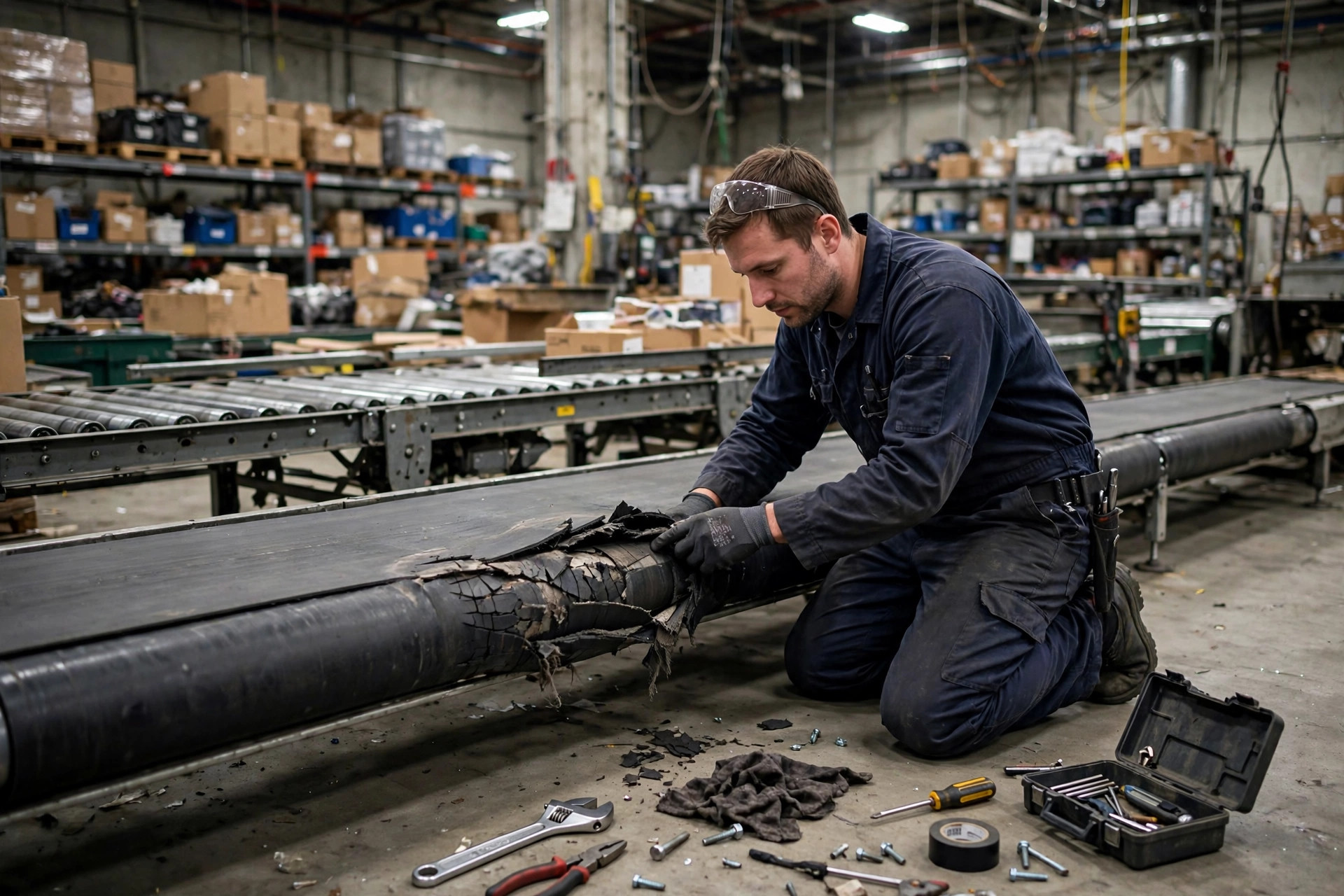
Carrier mini-belts are consumables. They drift, they wear, they need quarterly inspection and realignment. Scanner lenses collect dust; read rates slide from 99.5% to 97%, and missorts climb with them — wiping a lens is a five-minute job, and ignoring it is a five-figure problem. Keep at least 5% spares on hand: mini-belts, motors, sensors. Waiting on air freight from the OEM? Do your own downtime math.
And software — don't forget it. If the WCS sortation strategy is misconfigured and chutes are allocated unevenly, half your chutes overflow while the other half sit idle, and the fastest machine in the world won't save you. Simulate flow before go-live and tune chute allocation with simulated data — not real parcels.
And people. Budget at least one dedicated equipment technician — $60,000 to $80,000 a year in the US market — and put it in the ROI model, or the model is a lie. That 99.9% availability figure assumes maintenance is actually done; it doesn't come in the box. Buying the machine but starving the maintenance is the number-one cause of death for sorter projects.
Whether the money is well spent comes down to a single number: 2 million parcels a year. Above it, the cross-belt sorter almost always wins; below it, squeeze your manual process to the limit first. At 5,000 orders a day you're standing exactly on the line — so don't ask whether the machine is good. Ask yourself three questions: what's your peak multiple? Can you still hire next year? What does one missort cost you? Answer those three, and the math speaks for itself.
By Da Liu, Automation Engineer