Here's the verdict up front: with five trucks or fewer, don't bother. Ten trucks is the watershed.
That's not a gut feeling. Per-truck SaaS TMS pricing for fleets of 1–20 trucks currently runs roughly ten to thirty dollars per truck per month at published list prices. TorqueTMS lists $12 per truck with no setup fee; Vektor lists $30 per truck with a $300 monthly minimum that covers your first ten trucks. Run five trucks on the latter and you're effectively paying $60 per truck — real money for a fleet that small, better spent on making your spreadsheet discipline solid. At ten trucks, dispatch, reconciliation, and driver settlements pile up at once, and the bottleneck becomes people, not software.
Let me break down the math. Full disclosure: I don't sell software. Every price below is a published list price — go verify it yourself.
What Excel and Group Chats Really Cost
Fleets under ten trucks usually dispatch from a spreadsheet plus a driver group chat: the dispatcher tracks which truck is where and what it's hauling in a workbook, drivers report positions and send proof-of-delivery photos in the chat. It works. It's also expensive in ways that don't show up on any invoice.
The first cost is finding a truck. A shipper calls needing capacity; the dispatcher digs through the spreadsheet and scrolls chat history to figure out which truck will be empty near Los Angeles tomorrow. The more trucks, the longer the digging, and every missed window turns into deadhead miles or a lost load.
The second cost is reconciliation. Month-end with the shipper: your spreadsheet's loads don't match their system's, you're off by a load or two, and it takes a week of back-and-forth. Same on the driver side — miles, detention, tolls, all computed by scrolling chat history. Get it wrong once and the driver remembers. Small fleets already struggle to hire drivers; a driver with a grudge about settlements is a resignation waiting to happen, and replacing a driver costs far more than the disputed fifty bucks.
The third cost is people. Spreadsheet dispatch lives in the dispatcher's head. Vacation, sick day, resignation — dispatch stops. I've seen more than one seven-or-eight-truck fleet where the owner is the dispatcher, phone on 24 hours a day. That's not dedication. That's a missing system.
The fourth cost is compliance. Hours of service, driver vehicle inspection reports, maintenance records — federal rules require documentation. Tracking those in a spreadsheet means you can't produce them at a roadside inspection or an audit. What small fleets should fear isn't the fine; it's the out-of-service order. A truck parked at the roadside for a day costs you the entire load's revenue. A TMS pulls in ELD data and maintenance-due alerts automatically. For a TMS that's routine; in a spreadsheet it's torture.
The Three Things a TMS Actually Saves You
Ignore the vendor slide decks. For a small fleet, a TMS earns its keep in exactly three areas. Everything else is garnish.
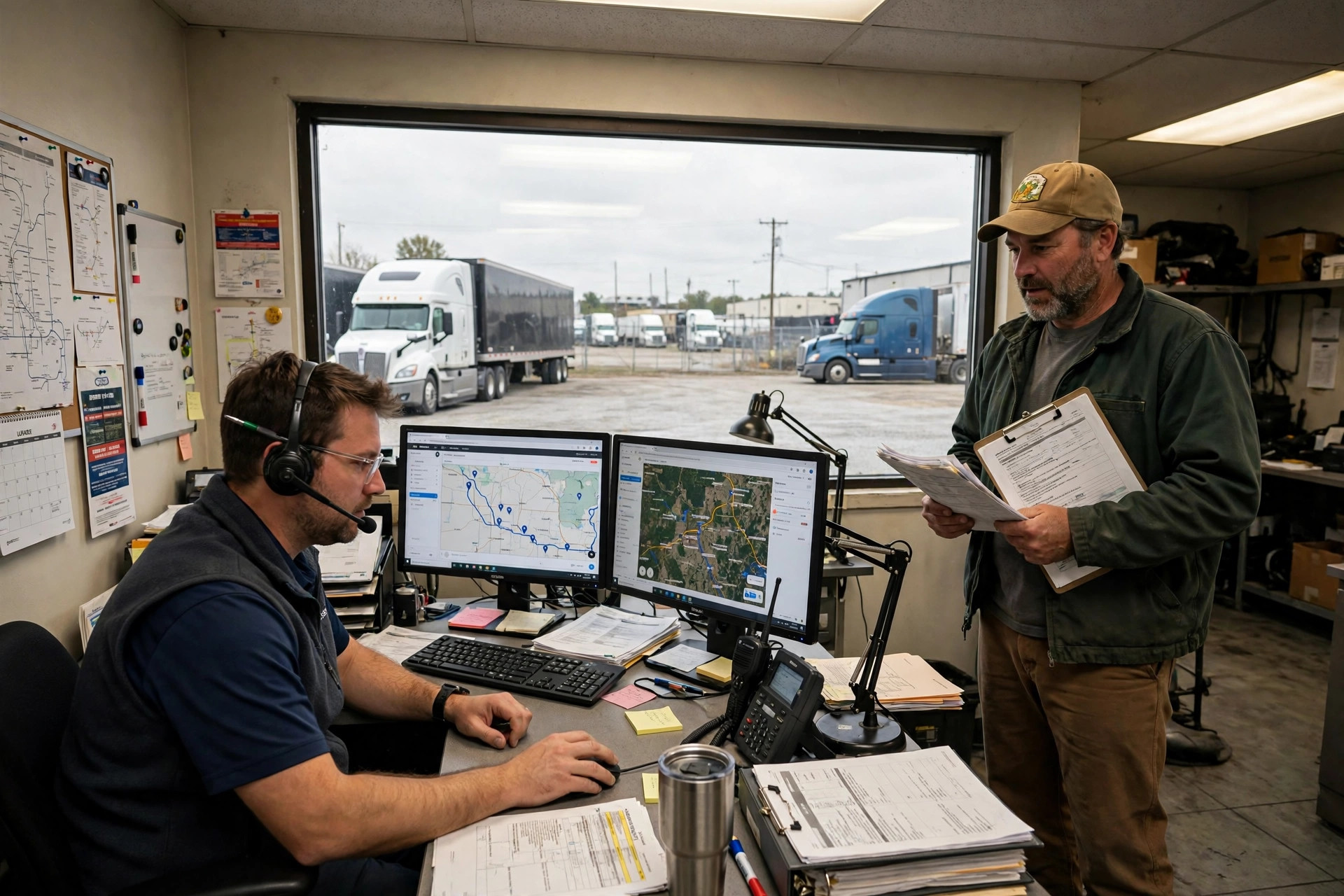
First, dispatch visibility. Every truck's position and status — empty, en route, loading, unloading — and every load's progress on one board. No spreadsheet archaeology; when a shipper asks "where's my freight," the answer takes seconds. This pays off hardest in peak season: ten trucks, twenty-plus loads a day, more than a human brain can route. I watched a nine-truck fleet where the dispatcher routed from memory and sent a truck still unloading in Phoenix to pick up in Los Angeles the next morning — over two hundred deadhead miles, fuel and hours burned for nothing. One glance at a board prevents that.
Second, freight reconciliation. Every load tracked from booking to signed delivery, POD photos uploaded by the driver straight from a phone app, receivables pulled in one click at month-end. Missed and mis-billed loads basically go to zero. The scale is worth feeling in numbers: ATRI's 2025 report on 2024 data puts the average US trucking operating cost at $2.26 per mile, and the truckload sector's average operating margin at negative 2.3%. Margins that thin mean one leaked invoice can erase a truck's profit for the week.
Third, driver settlements. Per-mile, per-trip, or percentage-of-revenue — configure the rules once and the system computes them; drivers see every line on their phones. Drivers are a fleet's biggest cost line: the same ATRI report puts driver wages plus benefits at nearly a dollar per mile in 2024, the single largest cost item, ahead of fuel. Get settlements wrong and you can't keep drivers; lose drivers and recruiting the replacement costs more than the raise would have.
The Math: How Many Trucks Justify It
Using published prices. Vektor: $30 per truck per month for 1–25 trucks, $300 monthly minimum covering the first ten. TorqueTMS: $12 per truck per month for 1–20 trucks. There are also free basic tiers — AscendTMS has one — thin on features, fine for learning the workflow.
Five trucks: on Vektor's minimum you're at $60 per truck per month, $3,600 a year. Load volume is modest at this size; a disciplined spreadsheet plus group chat gets the job done. My call: skip it.
Eight to ten trucks: Vektor works out to $30–37 per truck; TorqueTMS costs under $100 a month total. Dispatch complexity is climbing — driver scheduling, vehicle maintenance, IFTA filings (splitting miles by state for interstate runs is a nightmare in Excel). My call: buy it. Pick per-truck pricing, no setup fee, cancel-any-month terms.
Over ten trucks: one dispatcher plus Excel will break. A TMS is a requirement, not a debate.
One more dimension: business complexity. A dedicated-lane fleet — say Fontana to Phoenix, same lane every day — needs a TMS less at five trucks than an eight-truck fleet chasing spot loads everywhere. Unstable volume, scattered lanes, many customers: move the threshold down by two trucks.
Exceptions exist. A husband-and-wife two-truck operation where the owner drives and dispatches by phone — skip the TMS, it adds nothing for you. And if your small fleet mostly hauls for one big broker through their system, ask whether they offer a free carrier portal before spending your own money.
The Two Traps in TMS Selection
Trap one: buying more than you'll use. Enterprise TMS vendors sell by module — EDI, API, customer portal, intermodal — with a two-week implementation consultant and three rounds of training. A small fleet needs four things done well: dispatch, tracking, reconciliation, settlements. Before buying, ask: will I use this feature in the next three months? If not, don't pay for it. Prefer "one price, all features, per truck" over per-module or per-seat pricing — with a small headcount, seat fees are a trap. And pin down exactly what the meter runs on before signing: per truck, per load, or per seat are three very different bills. A quote that looks cheap can hide "per dispatcher seat" in the fine print — two dispatchers plus one person who needs the reports triples the monthly fee.
Trap two: implementation time. Ask the vendor for a reference customer roughly your size, then ask that customer directly: how long did it take, and which step hurt most. Anyone promising "live in two weeks" gets a follow-up: who migrates the history — drivers, equipment, customers, open loads? Data that never gets imported leaves you with an empty shell. In my experience, a small fleet's real TMS cost isn't the monthly fee; it's the two or three weeks you and your dispatcher spend on it. Before you start, clean up the spreadsheets — equipment, drivers, customers, rates, four lists reconciled — and go-live goes fast.
On contracts: monthly or annual? Annual is cheaper but locks you in, and fleet size swings — adding trucks in peak season, selling in the slow months. Annual billing means paying protection money for parked trucks. Prefer "active trucks only, parked trucks drop off the bill."
A word on lightweight alternatives: if you're not ready for the full jump, start with point tools — a driver app with electronic POD, or a TMS free tier — and solve "no lost paperwork, every invoice backed" first. Move to full TMS past ten trucks. The path is gradual; don't try to arrive in one leap.
Last word: a TMS isn't software you're buying. It's the certainty that the fleet keeps moving when the dispatcher quits. Under five trucks, that certainty is you. Past ten, stop using your own body as the system.