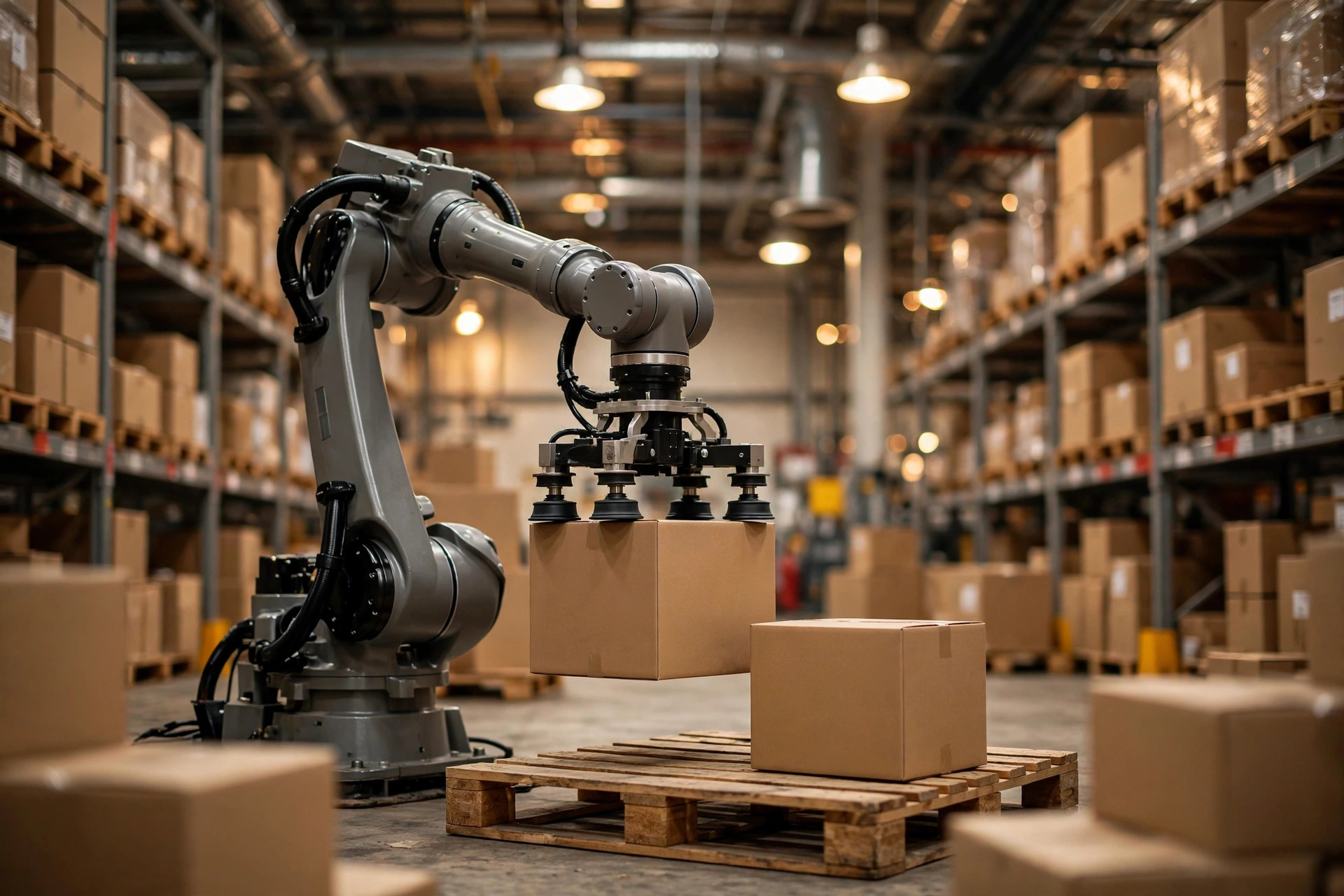
Start with the physics, because half of all robotic palletizing gripper mis-selections come from not understanding it. Robot palletizing end-effectors fall into three families: vacuum cups, clamp jaws, and hybrids. A vacuum cup grips by negative pressure — think of an octopus tentacle: the flatter and less porous the contact surface, the harder it holds. A clamp jaw grips mechanically — think of pliers — holding the box by friction plus clamping force. A hybrid does both: cups do the lifting, jaws do the stabilizing. Expensive, but rock solid. It's like choosing shoes: running shoes, hiking boots, trail runners — there's no best, only best fit. Your box is the foot.
The Physics of Robotic Palletizing Grippers: Understand First, Select Second
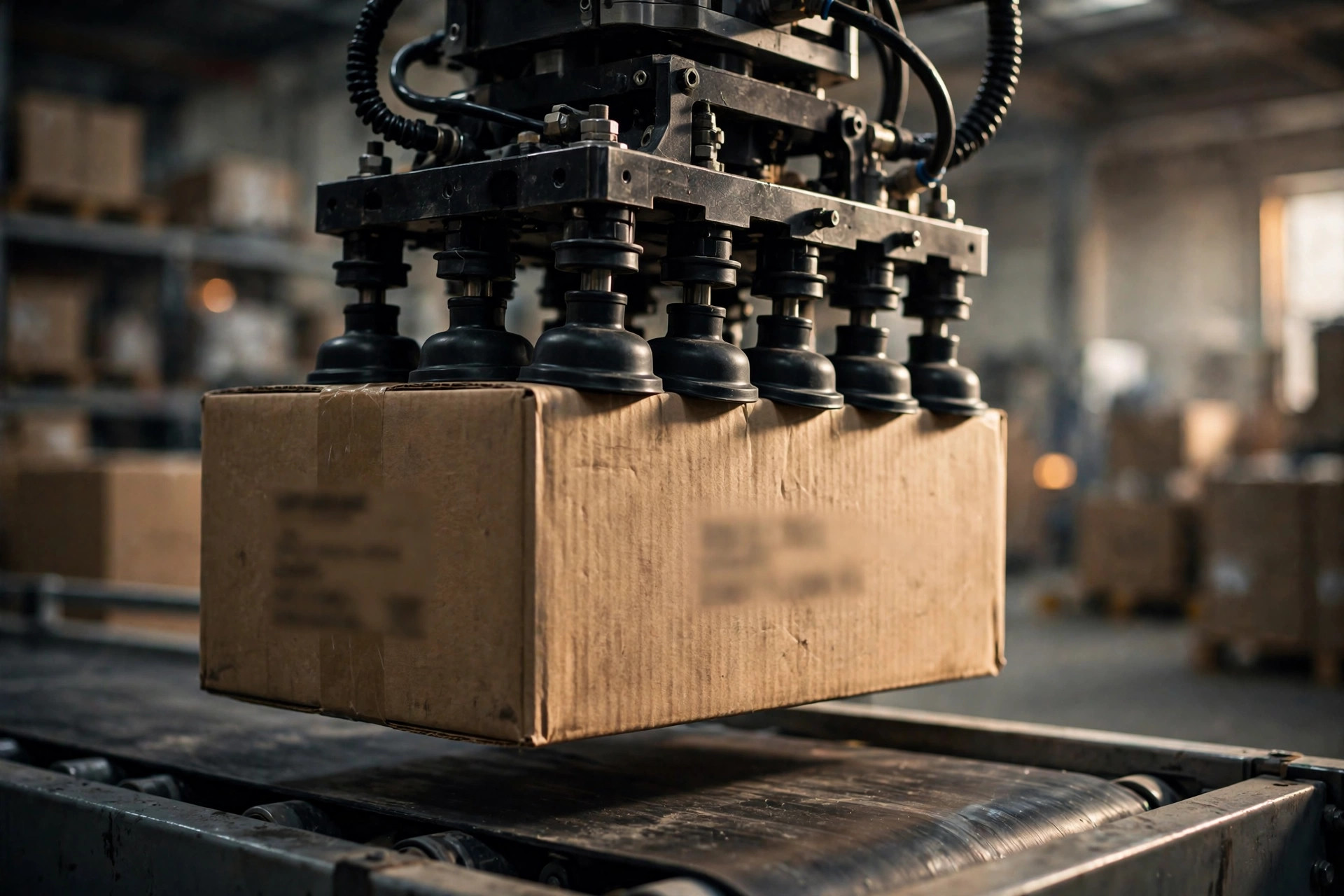
A vacuum cup lives or dies on two numbers: vacuum level and flow rate. You typically need at least -60 kPa (gauge). A single 120 mm cup at -70 kPa generates roughly 790 N of theoretical holding force; with a safety factor of 4, that's barely 20 kg of real-world payload for a 15 kg carton. Note the word "theoretical" — corrugated flutes create micro-leaks, stretch film leaks, and real holding force lands at 50–70% of theory. Flow rate matters more than vacuum level: when the system leaks, a high-flow vacuum generator keeps compensating while it's leaking; a low-flow one just drops the box. When evaluating cups, look at generator flow first, vacuum level second. Don't reverse the order.
A clamp jaw lives on clamping force and jaw stroke. Clamping force must beat box weight plus inertial load — palletizing robots typically pull 5–8 m/s² at the tool tip, so a 20 kg box needs 300 N or more of clamping force at a 0.4 friction coefficient for corrugated. Jaw stroke decides the box-size range: a 200 mm stroke handles 300–500 mm wide boxes, a 100 mm stroke is married to one box size. Jaws don't care about air leaks. They care about soft boxes — thin-wall corrugated crushes under the jaws, crushed means less friction, less friction means a dropped box.
The hybrid runs cups and jaws together: suction carries about 70% of the load, jaws handle lateral stability. It costs 2–3x a cup-only setup but pushes grip failure below 0.1%. When is it worth it? High unit value (one dropped box costs thousands), box mix too chaotic to categorize, or takt above 8 cases per minute. Any one of those justifies it.
The Selection Thresholds: How to Actually Choose a Robotic Palletizing Gripper
| Box profile | Recommended gripper | Why | Avoid |
|---|---|---|---|
| Standard corrugated carton, flat surface, 5–25 kg | Vacuum cup | Holds well, fast changeover, cheap | Clamp jaw (overkill and slower) |
| Film-wrapped packs (stretch/shrink film) | Clamp jaw or hybrid | Film leaks air; pure suction loses half its force | Pure vacuum cup (leaks = drops) |
| Irregular items / bags / soft packs | Clamp jaw (contoured fingers) or hybrid | No flat surface to suck on — you have to hug it | Pure vacuum cup (nothing to grab) |
| Mixed line, width spread > 200 mm | Hybrid or quick-change jaw | Compatibility first | Fixed-stroke jaw (constant re-teaching) |
| Heavy boxes, 25 kg+ | Clamp jaw | Cup safety margins don't cut it | Pure vacuum cup (too risky) |
Treat this table as a threshold map, not scripture. Threshold means: whichever cell you land in, start there; crossing cells is allowed but price the consequences yourself. The worst project I ever saw: an entire beverage line running film-wrapped cases, spec'd with pure vacuum cups because "cups are cheap and change over fast." First month of production: 3.2% grip failure rate. Dropping a pallet a day was the mild version — a dropped case once smashed a conveyor photo-eye and stopped the line for 2 hours. They retrofitted hybrids at a $40k-plus premium. Classic physics-ignored selection: film leaks air by the laws of physics, not by a parameter you can tune away.
Grip Failure Rate vs. Takt: The Math You Can't Skip
Most buyers stare at the gripper's purchase price and ignore the failure rate — the biggest pseudo-requirement trap in gripper selection. Run the numbers: a line at 6 cases/minute, two shifts, 16 hours = 5,760 cases theoretical. A 1% failure rate drops 58 cases a day; each drop costs about 3 minutes (stop, manual recovery, reset) — that's 174 minutes gone daily, nearly 3 hours of effective capacity, an 18-point OEE hit straight off the top.
Now the money: cutting failure from 1% to 0.2% saves 46 drops and 138 minutes a day. At a fully-loaded line cost of roughly $110/hour (depreciation plus labor), that's about $250 a day, $75,000 a year over 300 days. And the premium for a hybrid over a pure-cup setup? Typically $20k–35k. Payback in under six months. So here's my blunt conclusion: don't select grippers on purchase price. Select on failure rate. Whether the money is well spent comes down to one number — grip failure rate.
Two Field Stories
July 2023, a food plant in Ningbo palletizing 10 kg film-wrapped rice bags. Vacuum cups, fine for the first three months, then drops started in month four. Robot checked out, program checked out — the culprit was cup aging. Nitrile rubber cups in a 35°C shop full of flour dust hardened and cracked at the sealing lip in 4 months. Switched to fluororubber cups, service life stretched to 10 months, problem gone. The lesson: a suction cup is a consumable, not equipment. Set the replacement schedule at selection time: standard nitrile 3–6 months, fluororubber 8–12 months, food-grade silicone 6–9 months. Manage cups like consumables — keep a replacement log, swap on schedule, don't wait for a drop to investigate.
September 2024, an e-commerce warehouse in East China, clamp jaws palletizing parcel cartons. Thin-wall 3-ply corrugated, jaw force set to the textbook 350 N — then peak season humidity softened the boxes, the jaws crushed them, friction collapsed, and the drop rate spiked from 0.3% to 2.1%. Two fixes on the table: retrofit pressure feedback on the jaws for real-time force control ($11k retrofit), or change the box — push procurement to switch to 5-ply corrugated at $0.04 more per box, dropping the failure rate back to 0.2%. They changed the box: $17k a year in extra carton cost, cheaper than the retrofit, with lower transit damage as a bonus. The moral: sometimes the fix for a gripper problem isn't the gripper — it's the box. Box spec is an input you can change, not a law of nature. People who dare to change the box usually save more than people who dare to change the gripper.
The Maintenance Traps: Cup Aging and Foam Wear
Robotic palletizing gripper maintenance has two consumable killers. First, cup aging — covered above. Remember "manage like consumables": keep a log, set the schedule, stock spares. Keep 20% spare cups on the shelf, and don't trash retired cups — ones with lightly worn sealing lips can be downgraded to light-duty stations.
Second, foam-cup wear. Foam vacuum cups (full-face foam seal) are brilliant on uneven box surfaces, but foam takes a set — compressed long enough, it stops rebounding, permanent dents form in the sealing face, and leakage creeps up. The trigger metric: when the vacuum generator's duty cycle runs 30% longer than at install under identical conditions, the foam is done. Don't wait — watch the data.
One last shot, at a pseudo-requirement: the "adaptive intelligent gripper." Some integrators sell AI-vision adaptive grippers that "handle any box," at 3x the price of a standard setup. I've torn down two. The "adaptivity" is extra cup zones plus vision pre-positioning; failure rate 0.5%, no better than a well-tuned hybrid, with double the maintenance complexity. On lines with stable box profiles, pick by the threshold table and spend where it counts. Only mixed lines with thousands of SKUs changing daily earn the right to talk about intelligence. Pseudo-requirements always sound beautiful and price out ugly.
Whether the money is well spent comes down to one number: grip failure rate. Get it under 0.3% and any gripper earns its keep. Can't get it there, and the smartest gripper is decoration.
By Da Liu, Automation Engineer