Let me save you some money up front: if your warehouse ships fewer than 30,000 cases a month and carries more than 500 SKUs, a robotic case packer will most likely sit there looking expensive. I've run the math on this more times than I can count.
A friend who runs a small home-appliance operation called me last month. He'd fallen in love with a robotic case packing cell at a trade show, quote in hand, and wanted my blessing. I asked him three questions: how many cases do you ship a month, how many SKUs drive most of that volume, and how many carton sizes do you run? He couldn't answer any of them. We put the project on hold. Let's walk through those three questions properly.
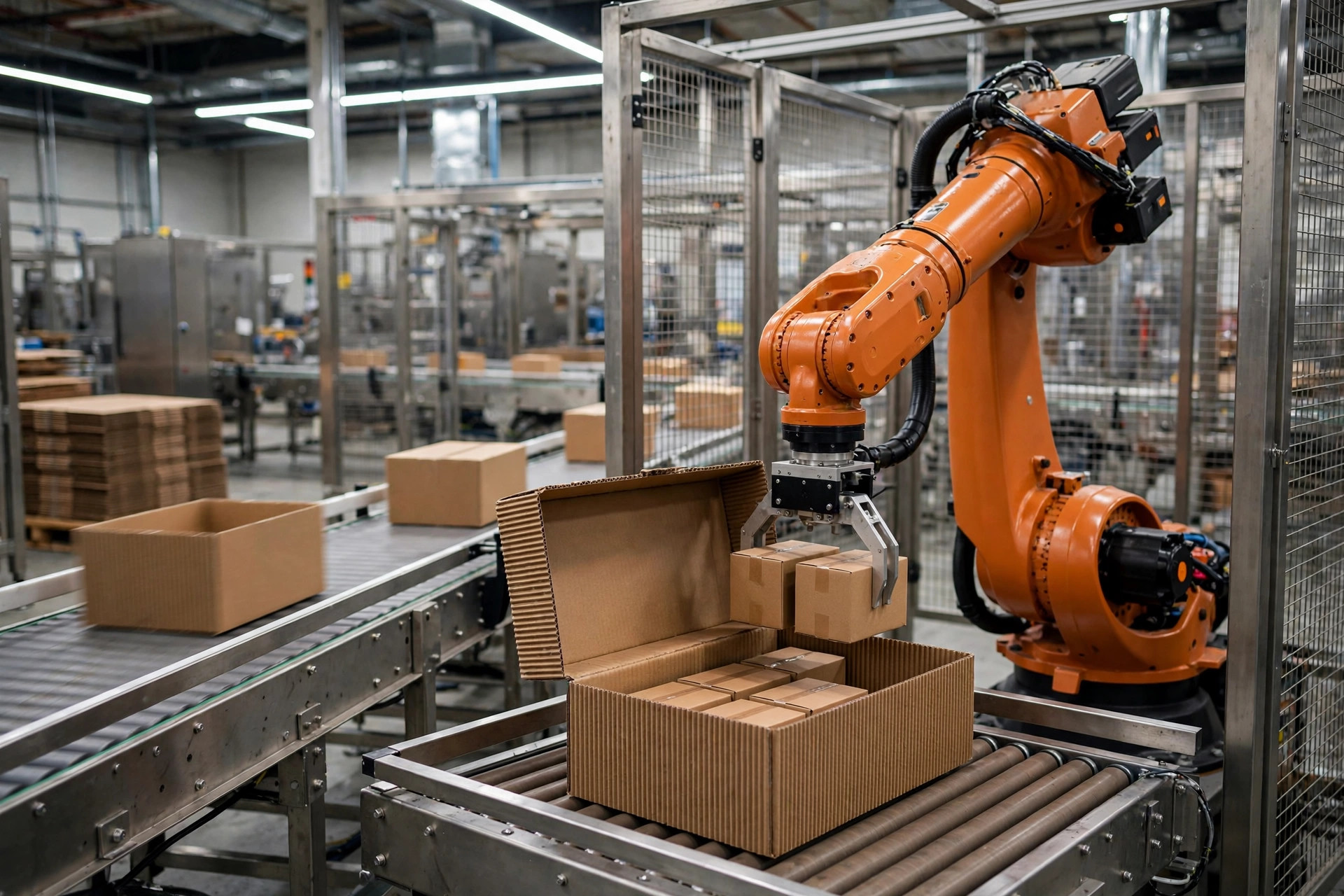
Robotic case packing sounds irresistible — an arm placing products into cartons, or collating full rows and sweeping them in, running around the clock. But the technology has a temperament. It only eats one kind of diet: high volume, few SKUs, uniform cartons. If your operation isn't on that diet, forcing it will hurt.
Who makes money with it, and who's just window shopping
The real home of robotic case packing is the high-volume, low-SKU, uniform-carton operation. Food plants, beverage plants, high-volume personal care — one machine running flat out, and the payback math can look genuinely good.
Flip that around and you get the nightmare customer: small batches, hundreds of SKUs. The robot's worst enemy is changeover. Product A in the morning, product B after lunch, three different carton sizes in a day — the gripper needs adjusting, the vision system needs reteaching, the program needs switching. A good technician takes half an hour per changeover, minimum. Do that four or five times a day and your machine spends half its life waiting for people and the other half waiting for product. You bought a robot; you're feeding a changeover specialist.
I walked the MODEX show floor in 2024 and stopped at no fewer than ten robotic case packing booths. Every demo was beautiful — arms flowing, cartons stacking perfectly. I asked each one the same question: how long does a product changeover take? Answers ranged from twenty minutes to two hours. Under trade show lights, nobody thinks that's a problem. Back in your warehouse, that's your Tuesday.
Then there's vision. Uniform shapes are easy. Irregular packaging, reflective pouches — misread rates climb fast. The demo at the booth always uses the easiest product in the catalog. The hardest product in your warehouse is the one sales never volunteers to demo.
And the machine architecture matters. A six-axis arm is flexible, handles different pack patterns, but it's slow. A row-forming case packer — full rows of product swept into the case in one motion — is fast but only speaks one carton size. The high-mix warehouse picks the arm and complains about speed, or picks the row former and discovers half its SKUs don't fit. Lose either way.
Changeover time is the silent killer
Most ROI calculations I see make the same mistake: equipment cost on one side, labor saved on the other. For a high-mix warehouse, the first cost you should model is changeover time.
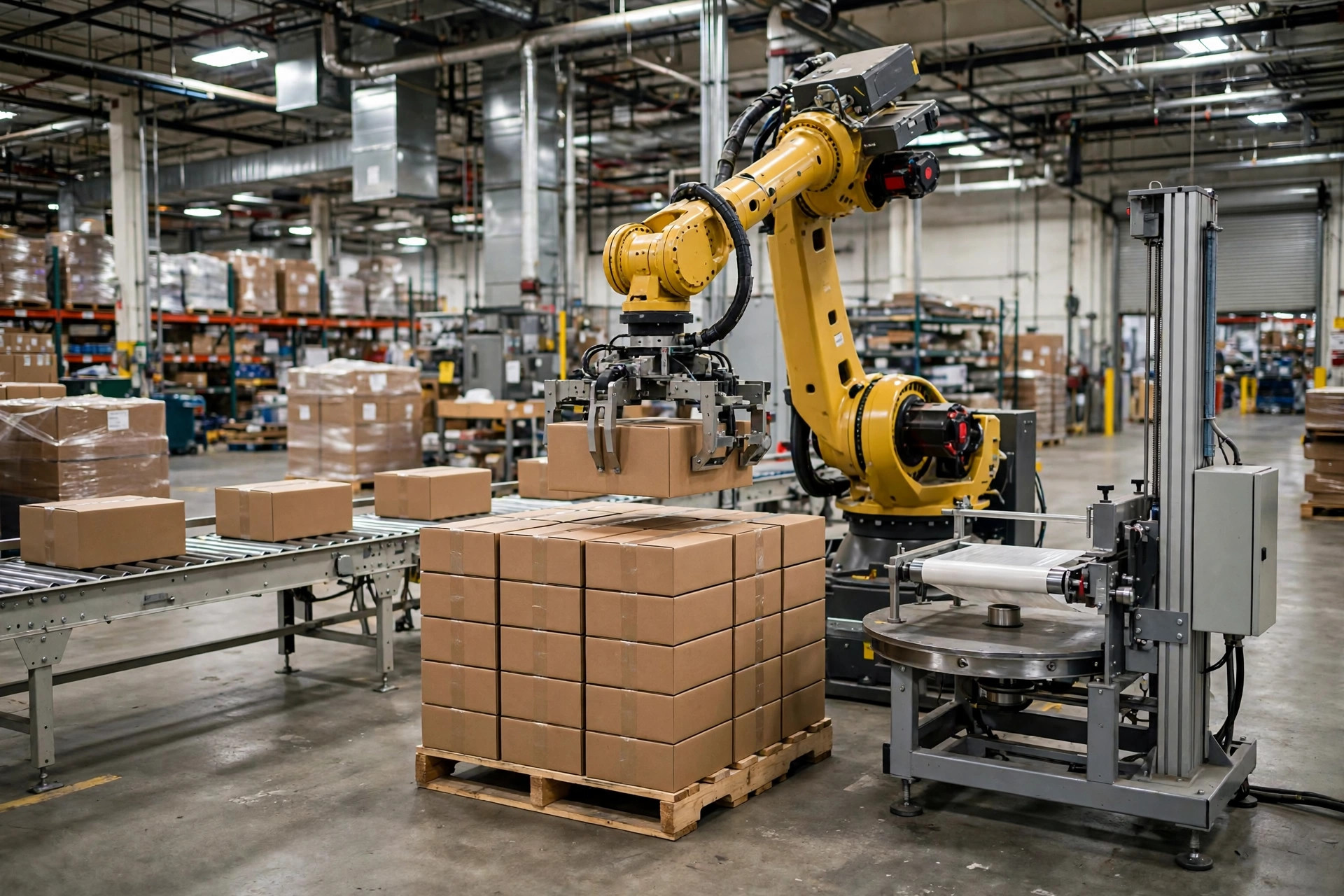
Take FANUC's M-410 series — a palletizing robot with an excellent reputation in the industry, rugged and dependable. But note what it is: a palletizing robot, not a case packing robot. Case packing is an order of magnitude harder than palletizing. Palletizing just stacks boxes neatly. Case packing has to manage the arrangement inside the box, product orientation, dividers, dunnage. Don't transplant palletizing success stories onto case packing. Different animal.
Second, count your carton sizes. In many warehouses, carton specs are archaeological layers: one size from supplier A, another from supplier B, a promo size on top. Robots are far less forgiving about carton tolerances than people are — a few millimeters off and the product won't seat or the gripper misses. Want a robot? Get your carton count down to single digits first. Can't do that? Don't start the conversation.
Third, look upstream at your infeed. If product arrives from the production line in neat, metered rows, the robot is happy. If it arrives loose after manual sortation, you need a collating and metering system in front of the robot — another layer of investment. Plenty of integrators "forget" to mention that unit in the quote. The budget surprise arrives after the contract is signed. Ask about infeed handling before you sign anything.
And maintenance. The arm itself is tough, but grippers, suction cups, and vision cameras are consumables. When something breaks, you wait for the factory technician — two or three days isn't unusual for a remote site. For those two or three days, your packing line is dark. Manual packing never "waits for the engineer." A sick operator gets replaced by another operator; a dead robot holds the whole line hostage.
Here's a calculation most people skip: re-lay your manual packing stations lean-style. Infeed at elbow height, cartons pre-opened, tape machine within arm's reach. Same people, same volume, and a twenty to thirty percent lift is not unusual. That investment is pocket change, and it pays back immediately.
If you do go talk to vendors, make them run a trial with your actual product. Your SKUs, your cartons, your line speed, on your floor, for at least a week. Trade show videos and lab data are for inspiration, not decisions.
The line in the sand
Here's the verdict, no hedging. Shipping many tens of thousands of cases a month, fewer than fifty SKUs driving the volume, carton sizes down to five or fewer — have the serious conversation, and make the vendor prove it with a live trial. Anything else — under 30,000 cases a month, hundreds of SKUs, a dozen carton sizes — standardize your cartons first, get your ABC classification done, and put the money into conveyors and better manual packing stations. Faster payback, far less risk.
Robotic case packing isn't bad technology. It's picky technology. Don't let trade show lighting make your capital decisions.