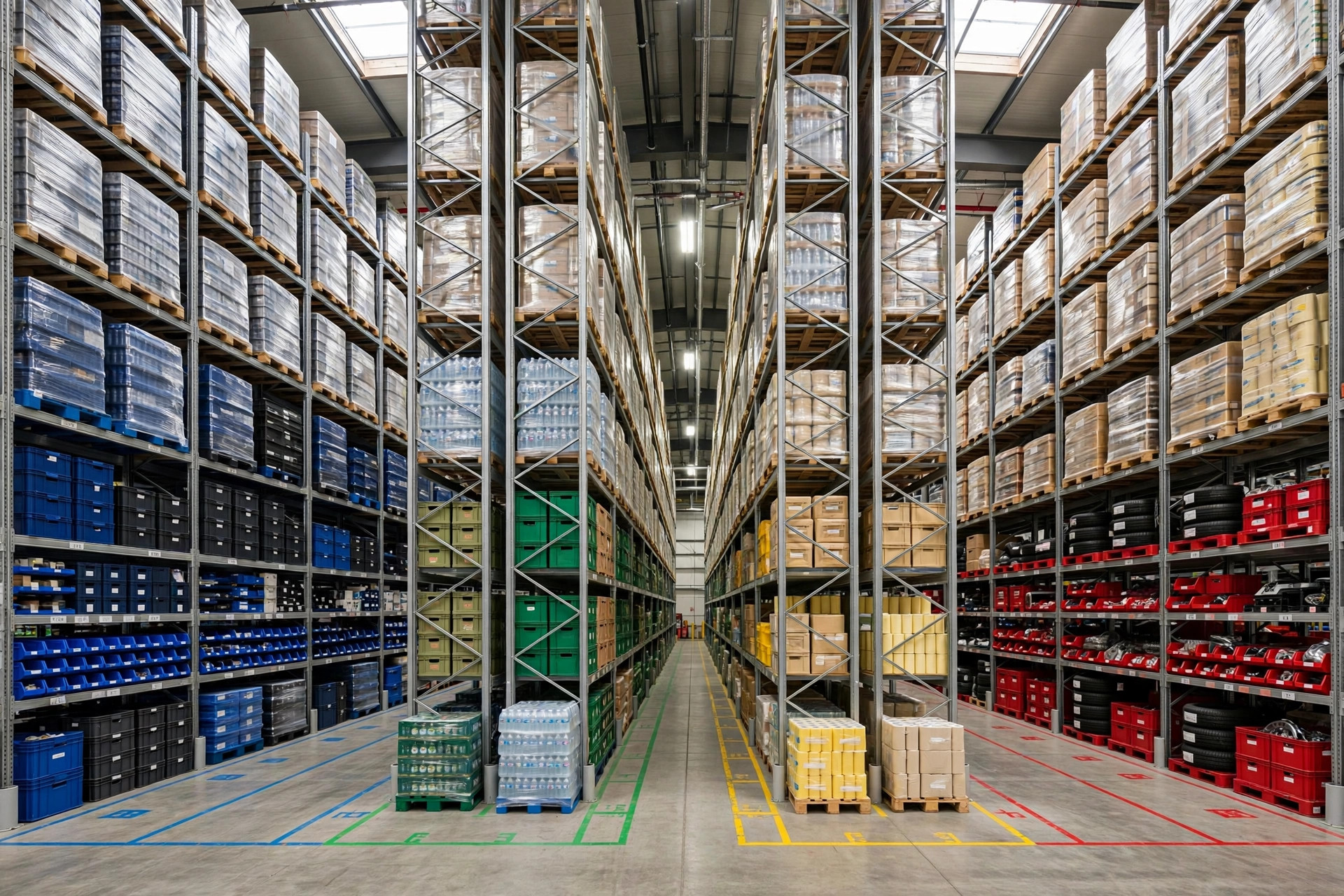
My warehouse is a 3,000-square-meter box with fewer than 400 forward pick locations. For a few months there, I lived between two kinds of collapse: in the morning a picker would tell me "the hot SKU is out, orders are stuck," and by the afternoon someone else would report "we over-replenished the slow stuff, you can barely walk down the aisle." When I finally did a post-mortem, the root cause was embarrassingly simple: our replenishment trigger points were wrong.
Set the trigger too high and the forward slot overflows — cartons end up in the aisle and pickers weave through them like a game of Snake. Set it too low and the pick face goes empty — pickers stand in front of a bare shelf twiddling their thumbs while orders pile up waiting for replenishment, easily costing you an hour or two a day. Big companies have engineers who do nothing but tune this. A small warehouse like mine can't afford that kind of money — so I had to tune it myself, the ghetto way. Here's what the tuition fees taught me.
Both Ways to Die, and I've Died Both
Death by trigger-too-high. Last November, right before peak season, we had a hot household-goods SKU moving 200+ cartons a day. Scared of a stockout, I set the forward slot's trigger at 12 cartons, thinking "better safe than sorry." On day two of the rush, the replenisher hauled 12 cartons over from bulk storage — but the forward slot only holds 8. Six cartons went straight into the aisle. During the picking rush, that aisle was blocked for nearly 40 minutes with pickers queuing to get through. We missed close to 300 orders that day. I hid in the office and let the customer-service phone ring.
The post-mortem: the trigger only thought about "don't stock out" and never asked how much the forward slot could actually hold. Your trigger ceiling = forward slot capacity minus one economical replenishment batch. That lesson cost me 300 orders.
Death by trigger-too-low. Burned once, I overcorrected and slammed the triggers on our slow movers down to 2 cartons. Then one Thursday night in March, with only 3 people on the night shift, a normally sleepy SKU got hit with 40+ orders at once. Two cartons were gone in fifteen minutes. The replenisher was unloading a truck at the other end of the building; someone shouted in the WeChat group three times before anyone could break away, twenty minutes later. Pickers stood around for 20 minutes, those orders shipped the next morning, and the marketplace dinged us for late shipment.
The post-mortem: a trigger set too low is a bet that "the replenisher happens to be free." In a small warehouse, the same hands do replenishment, unloading, and receiving. Your trigger has to cover consumption during the whole window from trigger to restock. Lesson number two, also paid in full.
The Three Trigger Logics, Translated for Small Warehouses
Big-company WMS software offers three trigger logics. Here's my small-warehouse translation:
- Fixed-quantity trigger: replenish when the forward slot drops below N cartons. Dumb and simple — perfect for steady movers. Pick a number and move on.
- Percentage trigger: replenish when stock drops below X% of slot capacity. Good when your shelf sizes vary — you never have to redo the math when you swap SKUs.
- Per-shift check: someone walks the slots at the start or end of every shift and replenishes anything below the safety line. Ideal for short-staffed shops like mine — it turns replenishment from a random event into a fixed routine.
Now the counterintuitive part — honestly the most valuable sentence in this whole article: a replenishment trigger point isn't an inventory number, it's a time number. You're not setting "how many cartons are left." You're setting "how many minutes of head start the replenisher gets." My dirt-simple formula: trigger ≈ expected consumption during response time + safety buffer. Example: if it takes your replenisher 30 minutes on average to respond and restock, and this SKU picks 3 cartons per 30 minutes, your trigger needs to be at least 3 cartons plus 1–2 of buffer. Once you see it this way, tuning stops being voodoo.
The ABC Tuning Table, Currently Taped to Our Office Wall
We split SKUs into A/B/C by velocity, one trigger rule per tier. This table lives on our office wall, and all tuning follows it:
| Tier | Daily picks | Trigger logic | Trigger point | Top-up target | Notes |
|---|---|---|---|---|---|
| A (hot) | 50+ cartons/day | Percentage | 40% of slot capacity | Refill to 90% | Replenish often, never gamble on a stockout; top priority |
| B (regular) | 10–50 cartons/day | Fixed quantity | 4–6 cartons | Refill full | Check per shift, once in the morning, once at night |
| C (slow) | Under 10 cartons/day | Per-shift check | 2 cartons | Top up to 4 | Don't overdo it — for slow movers, overstock costs more than a stockout (it eats prime pick-face space) |
Three tuning lessons:
First, for A-tier, err high — but hard-cap the trigger at "slot capacity minus one replenishment batch." Not one carton more. Death number one taught me that.
Second, for C-tier, do the opposite: err low. A stockout on a slow mover costs you an order or two; one overstock eats a precious forward slot and risks expiry. The cost of a stockout and the cost of overstock are asymmetric — and they flip depending on the tier. Most people tuning triggers never think through this trade-off.
Third, two weeks before peak season or a sales event, bump every trigger up one notch, and drop them back the day the rush ends. Don't ask how I know. Ask how much tuition I paid.
Ghetto Methods vs. System Auto-Triggers: Our Field Test
We run a hybrid now: A-tier SKUs get automatic WMS triggers (the system fires a replenishment task on schedule), B and C tiers get the ghetto treatment. Two ghetto methods:
Ghetto method one: the red tape line. Stick a strip of red tape on the side of the forward slot at the height that matches your trigger point. When a picker sees red, they drop a line in the WeChat group: "shelf X hit the red line." Cost: a few bucks for a roll of tape. Result: B-tier stockouts dropped from 7–8 a month to 1–2.
Ghetto method two: the shift-change walk. Fifteen minutes before every shift change, the shift lead walks the aisles with a phone, and anything below trigger gets called out in the group, tagging the replenisher by name. Once a random event becomes a fixed routine, night-shift stockouts basically vanished.
The honest comparison: automatic triggers are precise, but they need WMS support and someone to maintain the parameters — a small warehouse can't afford a full-time tuner. The ghetto methods are crude, but they cost nothing, everyone participates, and for B/C tiers they're plenty. The big-company playbook doesn't fit us, and that's not embarrassing. The right system is the one that fits your warehouse.
Three Tips for Fellow Small Warehouses
- Measure your forward slot capacity before you set any trigger. Tuning triggers without knowing capacity is driving blind. Go measure the shelves with a tape measure first.
- Work the trigger backward from your replenishment response time — don't guess. Time how long it takes your warehouse, on average, from trigger to restocked, then plug it into the dirt-simple formula.
- Review monthly: how many stockouts, how many overstocks, then nudge one notch in the opposite direction. Tuning isn't a one-time project; it's monthly homework.
Today we run auto-triggers for A-tier and red-tape-plus-shout-outs for B/C. Stockouts and overstocks are both down to 1–2 a month, and no aisle has been blocked since. Total investment? One roll of red tape and a WeChat group.
Small warehouses have their own way of doing things.
By Xiao Ma, Small Warehouse Owner