Start With the Chain: RCS vs WMS Through a Single Task
In the RCS vs WMS debate, start with one transport task and watch how it flows.
Think of ride-hailing: the WMS is the passenger, the RCS is the dispatch algorithm, the AMR is the driver. The passenger only says "move one pallet from A to B" - which car, which route, who yields at the intersection, the passenger never touches any of that.
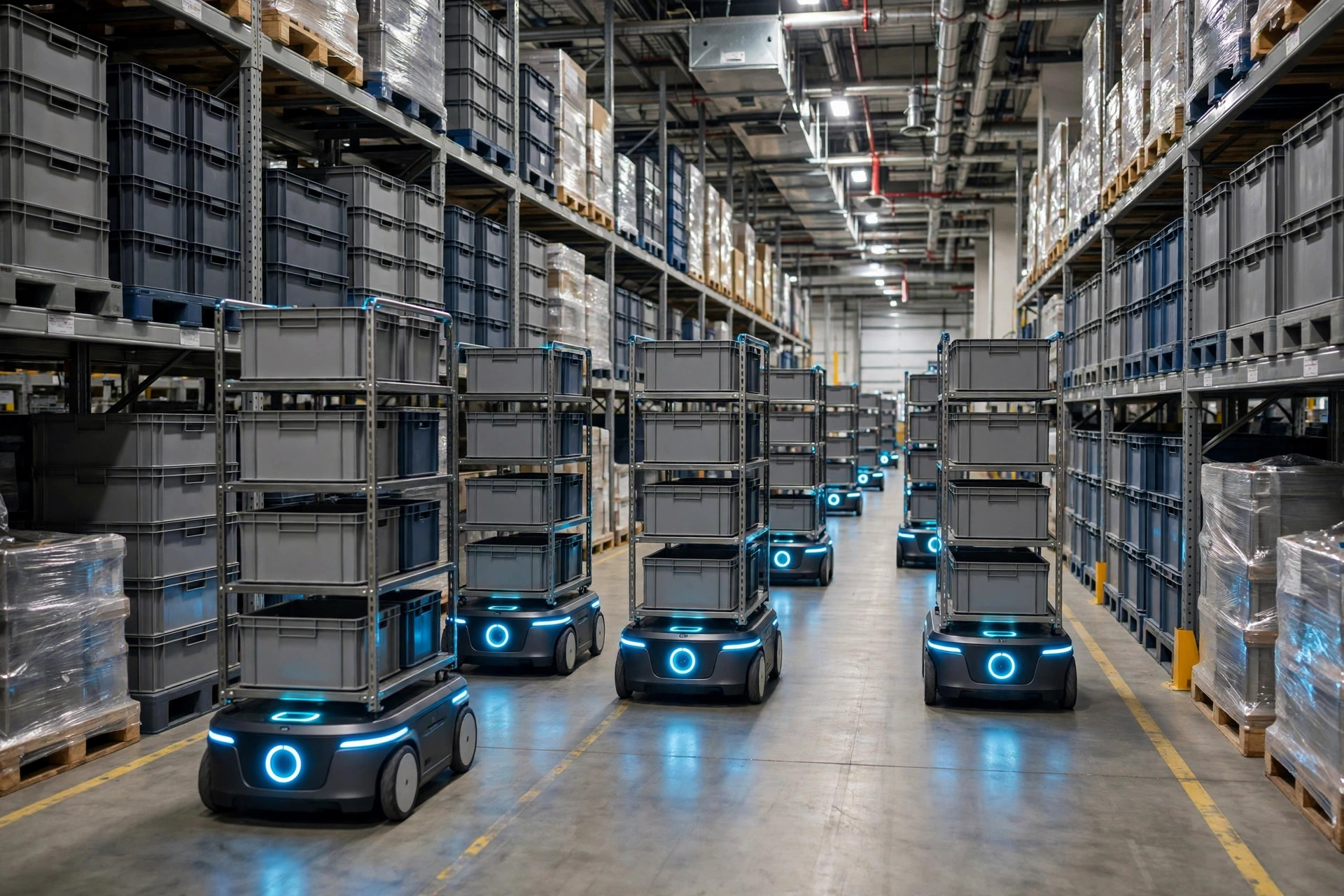
In a warehouse it works the same way. The WMS owns business documents - an outbound order needs 20 units picked from slot A and delivered to the packing station. It generates a "transport task": origin, destination, cargo info, priority, time window, and hands it to the RCS. The RCS does the fleet dispatcher's job: which AMR has enough battery, sits closest to the origin, and is idle; it plans the route; when two robots are about to fight over one intersection, the RCS runs traffic control and tells one to yield. The AMR just drives the path it was given, stops for obstacles, and returns to the charger when the battery runs low.
Three layers, clean chain: WMS issues tasks → RCS dispatches robots and manages routes → AMRs execute. Get this right and 90% of the finger-pointing never happens.
The Responsibility Matrix: Who Owns What, No Ambiguity Allowed
I put the RCS vs WMS division into one table. Stick it on the wall at the project kickoff - it saves at least three months of arguments:
| Item | Owner | Notes |
|---|---|---|
| Business documents (picking / replenishment / cross-dock) | WMS | The "why" of the task |
| Task generation (origin / destination / priority) | WMS | The "what" of the task |
| Which robot takes the job | RCS | Scored on battery, position, current load |
| Route planning | RCS | Map, stations, no-go zones all live in the RCS |
| Traffic control (intersection yielding) | RCS | The core skill of multi-robot coordination |
| Charging scheduling | RCS | Which robot charges when, and for how long |
| Robot health monitoring (battery / faults) | RCS | Real-time collection, exception reporting |
| Task completion receipt | RCS → WMS | "Move done" - only then can WMS close the order |
| Exception reporting (cargo never arrived) | RCS → WMS | WMS decides: re-dispatch or go manual |
One iron rule: the WMS never commands an individual AMR directly. The WMS says "I need goods from A to B"; the RCS decides "robot 7 takes aisle 3." I once saw a WMS vendor build a "light dispatcher" sending commands straight to the robots while the RCS dispatched the same fleet. One robot got two contradictory orders and spun in place for 40 minutes. Two bosses, one confused robot.

The Selection Cutoff: What Scale Actually Deserves a Standalone RCS
This is the most-asked question, and the biggest fake-demand zone. First shot: 5 AMRs or fewer do not need a standalone RCS. Period.
Five robots in a small warehouse barely create traffic conflicts; the vendor's built-in fleet manager handles it. Paying six figures for a standalone RCS there is like hiring an HR department for a five-person startup - money spent, nothing extra done.
I draw the cutoff with three lines - fleet size and scenario complexity:
Line one: fleet size. Under 5 robots, the vendor's built-in dispatch is enough. Between 5 and 20, it depends on scenario complexity. Above 20, a standalone RCS is close to mandatory. The next two lines matter more.
Line two: multi-brand fleets. Two or more AMR brands in one warehouse makes a standalone RCS non-negotiable. Each vendor's dispatcher only speaks to its own robots - vendor A's system cannot run traffic control for vendor B's. You need a neutral RCS as master dispatcher, talking to each fleet through a standard interface like VDA 5050. Single brand? The vendor's own dispatcher usually runs smoother than any third-party RCS - proprietary protocol, custom tuning.
Line three: task complexity. Pure point-to-point moves need simple dispatch. But multi-robot collaboration (two robots relaying one oversized load), dynamic priority preemption, joint charging-and-task scheduling - that is where built-in dispatchers hit their ceiling. A good RCS earns its keep in algorithms: well-tuned, fleet uptime holds above 95%; badly tuned, 20 robots deliver the throughput of 10.
Three lines drawn, one framework: single brand + under 20 robots + point-to-point moves = skip the standalone RCS; hit two of three lines, buy it.
War Story One: Blurry Interface Ownership, Both Sides Point Fingers
2023, an e-commerce warehouse in East China: 12 AMRs, WMS and RCS from two vendors. Three weeks after go-live, outbound tasks kept timing out. WMS vendor: "We issued tasks ages ago - the RCS is slow." RCS vendor: "We received them five minutes late - the WMS is slow."
Two weeks of arguing. I added a logging layer between the two systems, recording "task issued" and "RCS received" timestamps. The data told the truth: tasks took 4 minutes 37 seconds on average to travel from WMS to RCS. The culprit was the middleware message queue - the WMS vendor batched delivery for "load smoothing," and the RCS interface had no delivery acknowledgment. Neither side lied; both were at fault.
The lesson: the WMS-RCS interface contract must define three things - the real-time requirement for task issuance (say, within 3 seconds), the RCS delivery acknowledgment, and the timeout-and-retry mechanism. Write all three into the technical appendix, and the next dispute gets settled by logs in one minute.
War Story Two: The Head-On Standoff Over "Who Runs Traffic Control"
2024, a 3PL warehouse in South China: 18 AMRs across 6,000 square meters, narrowest aisle 2.2 meters. One morning, two loaded AMRs met head-on in a narrow aisle, both emergency-stopped, deadlocked 20 minutes until someone manually moved one. About 300 orders missed cutoff that day.
The post-mortem found it: the RCS traffic logic had the narrow aisle configured as two-way, because someone copy-pasted the wide-aisle template during implementation. And the WMS? It never knew the aisle was narrow - in the WMS's world, maps do not exist.
Here is the counterintuitive takeaway: the biggest RCS vs WMS landmine is not "who dispatches," it is "who maintains the map." The map - aisle widths, one-way vs two-way, no-go zones, charger locations - is the RCS's core asset. But map changes (a pallet staged somewhere, an aisle under maintenance) are noticed first by people on the floor. The chain should be: floor staff → WMS (the system operations uses daily) → synced to RCS. In too many projects the WMS and RCS each maintain their own map, and within three months the two no longer match.
The fix: the RCS map is the single source of truth; the WMS issues tasks and never touches the map. Floor changes sync through a standard process within 24 hours. The day the maps diverge is the day the robots deadlock.
The Maintenance Traps: Go-Live Is Only the Starting Line
The biggest RCS pitfalls are not in selection - they are in operations:
First, nobody tunes the charging strategy. The RCS default is usually "charge below 20%," but if 20 robots hit low battery at once, the charger queue blows your deadlines. The right approach is wave-based charging: bulk-charge during wave gaps, keep robots above 30% running through peaks. Tune it against real wave data.
Second, nobody reads the MTBF numbers. The MTBF on the vendor datasheet is lab data; your real-world MTBF is measured on your own floor. The RCS logs every robot's fault history - pull it monthly. The robot whose MTBF drops fastest needs a wheel or LiDAR replacement soon. Waiting until it dies costs five times more in downtime than preventive maintenance - I worked that out from three projects' repair bills.
Third, RCS and WMS upgrades fall out of sync. The WMS upgrades and changes a task-interface field; the RCS never follows; task issuance starts throwing errors. With two vendors, every upgrade needs a joint integration test - write it into the ops SOP. Never trust "backward compatible" promises; the on-site failure rate is 100%.
Is the Money Worth It? Watch This One Number
Back to the original question - RCS vs WMS, who commands the AMR? Layered command: the WMS owns the business, the RCS owns the fleet. One sentence: the WMS decides "what to move," the RCS decides "how to move it."
Whether a standalone RCS is worth the money comes down to one number: fleet efficiency = actual tasks completed ÷ (robot count × theoretical max tasks per robot). Measure a month before, a month after. Up more than 15% - money well spent. Under 10% - you never needed a standalone RCS; the vendor's built-in dispatcher was fine, and the budget would have bought two more robots.
By Da Liu, Automation Engineer