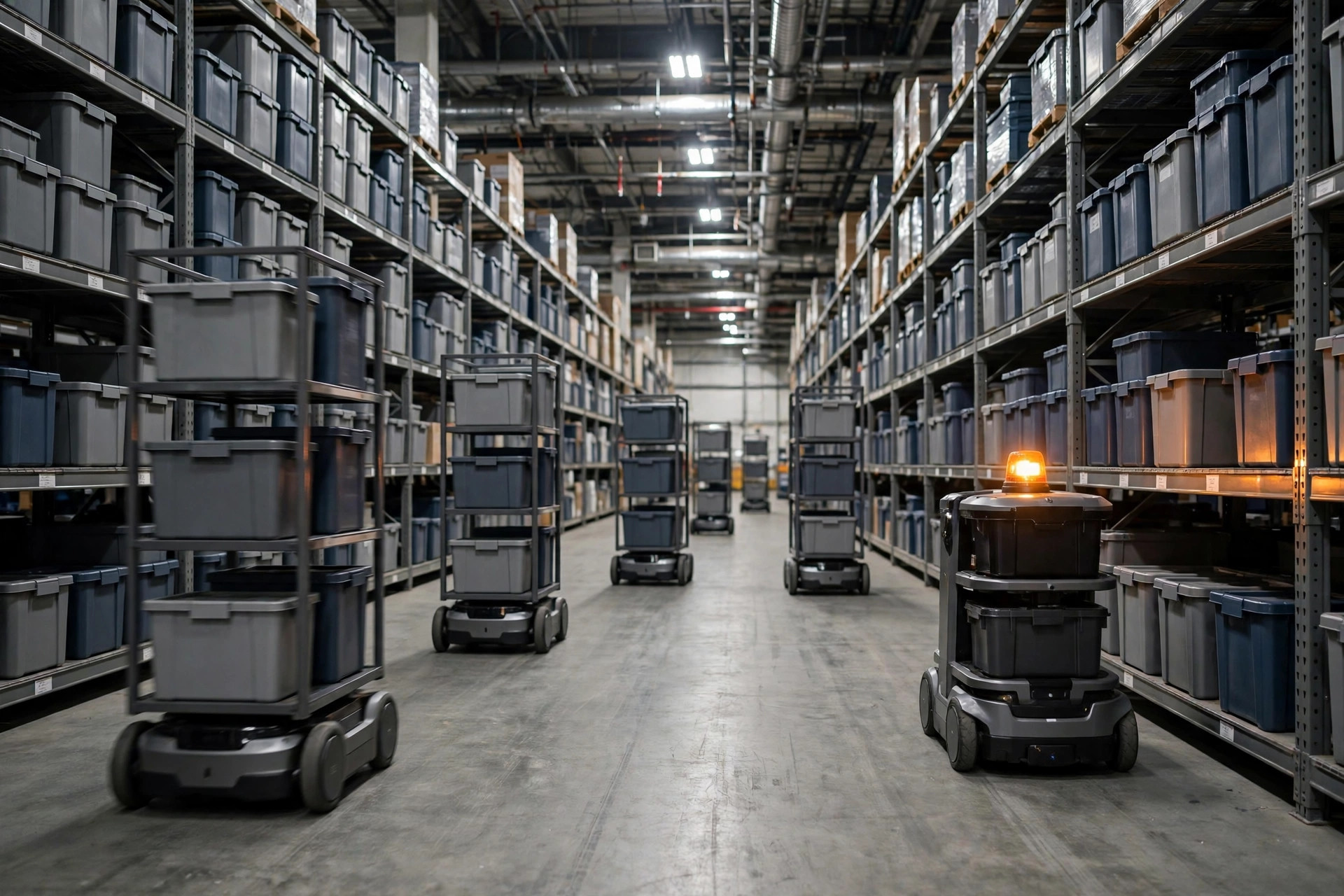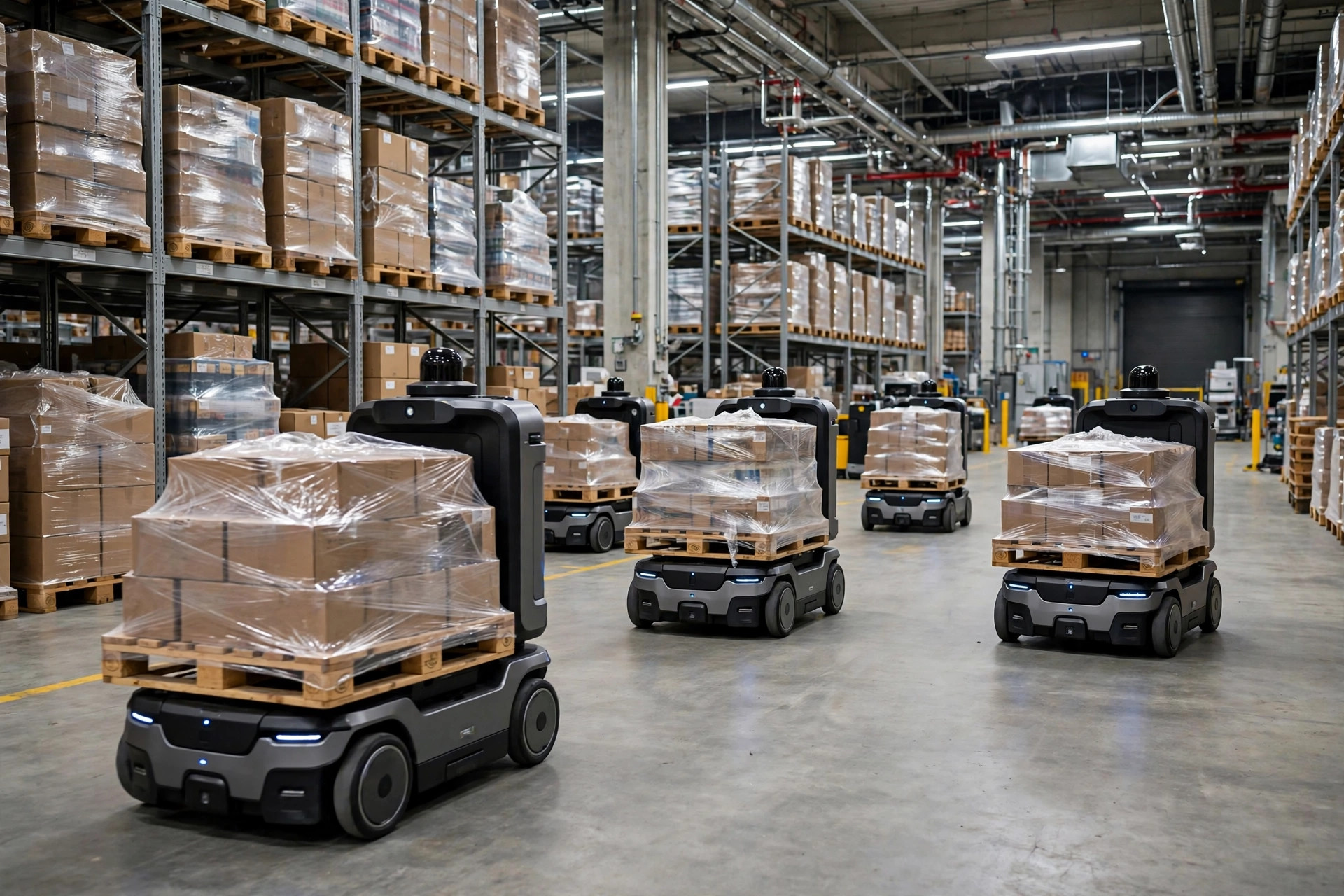
Last fall I walked a 3PL warehouse outside Tianjin: 42 AMRs, two brands, each on its own fleet software. The ops manager pointed at the main intersection — "every day at 4 p.m., traffic jam, right on schedule." Both brands' robots yielding to each other, nobody moving. Deadlock. The owner spent a fortune on robots and lost to one problem: three crews of drivers, three brains, none listening to the others. If you're confused about RCS vs WCS warehouse setups — who commands the fixed equipment, who commands the fleet, and when you actually need one unified robot brain — this article sorts it out: three layers, one table, two failures I've seen, and a buying line you can use tomorrow.
RCS vs WCS vs WMS: three layers, not one
People mix up these acronyms. Don't. They're three layers, and the hierarchy matters.
WMS sits at the top and does the accounting: is inventory right, which order ships first, where tasks come from. It only issues instructions — "move pallet A from slot 1 to dock 3." How the route is driven, which robot goes, it doesn't care.
WCS — the warehouse control system — runs the equipment bolted to the floor: conveyors, sorters, lifts, shuttles. It talks to PLCs in milliseconds and does real-time control work: when the belt turns, which chute the sorter drops into. Think of it as the production supervisor of a fixed line, watching the takt.
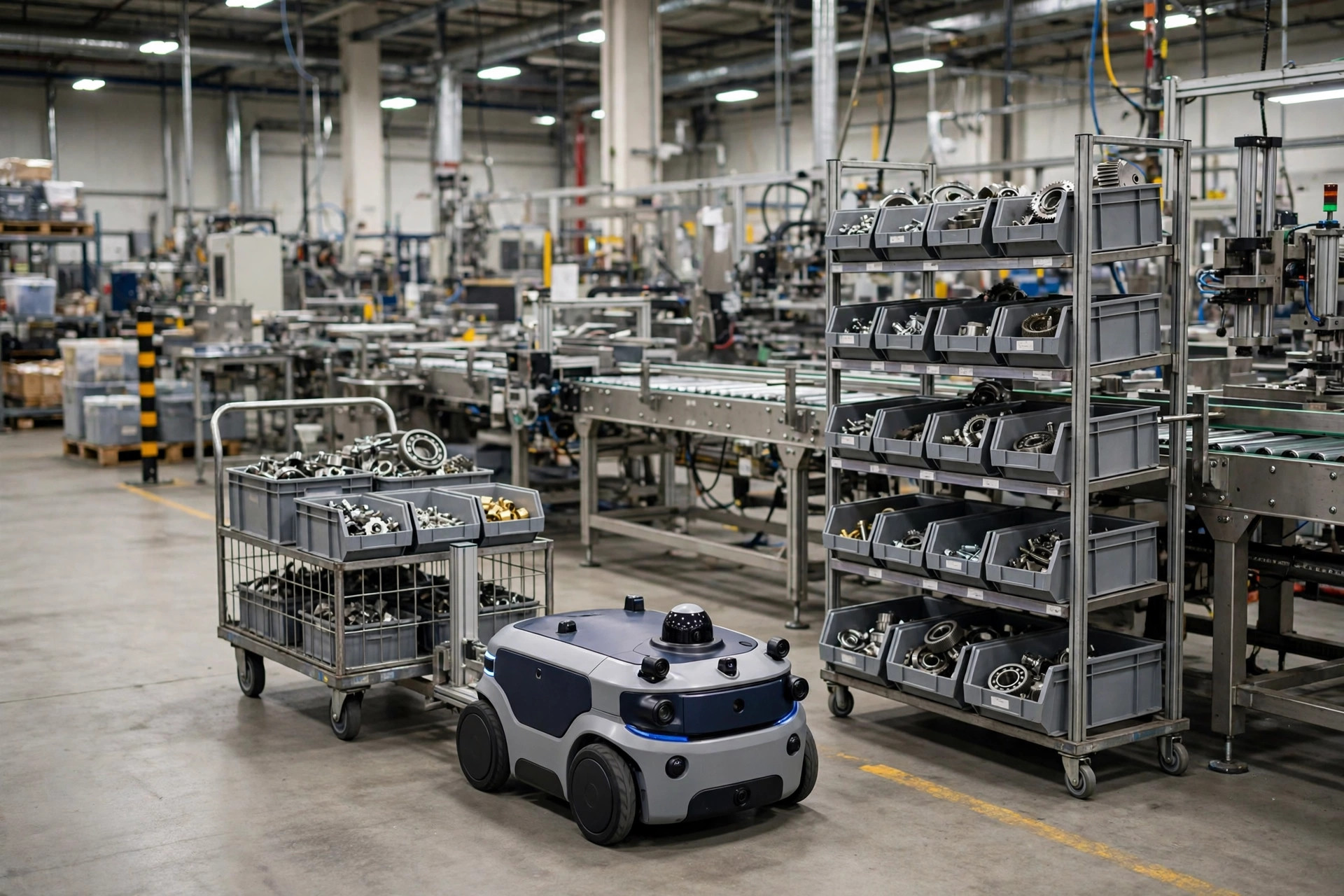
RCS — the robot control system — runs the things that move: the AMR/AGV fleet. Four jobs: task allocation (which task goes to which robot), traffic control (who goes first at an intersection), charge scheduling (which robot charges when), and map management. Here's the analogy: WMS is the general manager, WCS is the line supervisor, RCS is the fleet captain. The GM only cares that freight gets delivered; the fleet captain makes sure the trucks don't crash into each other.
That's the real RCS vs WCS difference in a warehouse: one commands fixed equipment, the other commands a moving fleet. Equipment doesn't move, so it's about takt time; robots move, so it's about right-of-way.
RCS vs WCS vs vendor fleet software: one table
| WCS | RCS | Vendor's own fleet software | |
|---|---|---|---|
| Controls | Conveyors, sorters, lifts — fixed equipment | AMR/AGV fleet, can span brands | Only its own brand's robots |
| Core job | PLC real-time control, takt sync, interlocks | Task allocation, traffic control, charge scheduling, path planning | Per-robot status, basic dispatch |
| Takes orders from | WMS, equipment-level tasks | WMS, transport tasks | WMS or RCS handoffs |
| Typical failure | Only knows its own equipment | Useless if not unified across brands | Every brand for itself at intersections |
The vendor's own software is like each squad bringing its own sergeant — fine for its own people, useless for the squad next door. Under 10 robots, single brand, the sergeant is enough. The moment brands mix, you need a captain over all captains. That's where an independent RCS sits.
Why a mixed-brand fleet needs one unified RCS
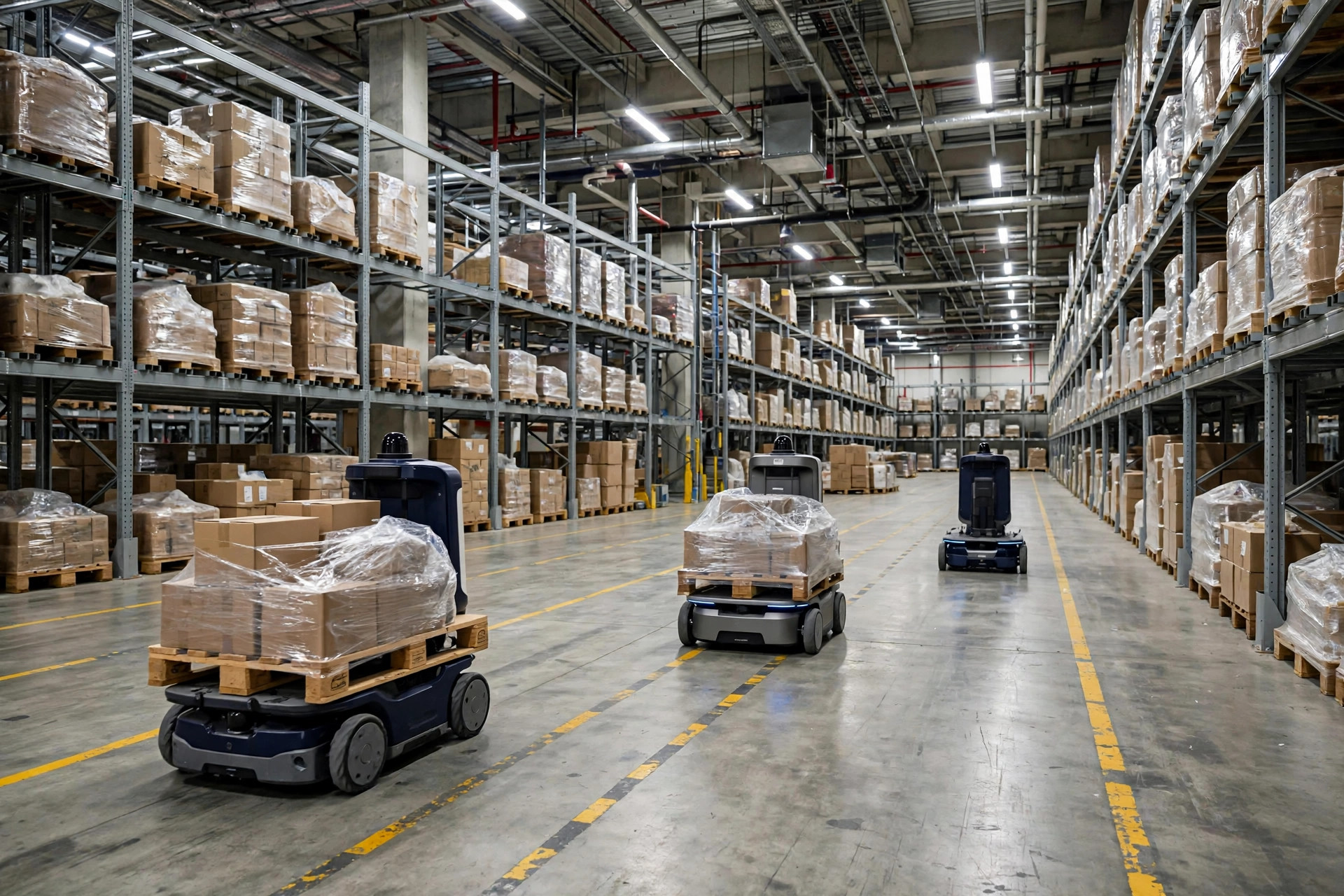
Counterintuitive take first: buying AMRs from three brands without a unified RCS is like hiring three crews of drivers who don't speak to each other. Each crew only listens to its own captain; when they meet at an intersection they blame each other, and your aisle is what gets blocked.
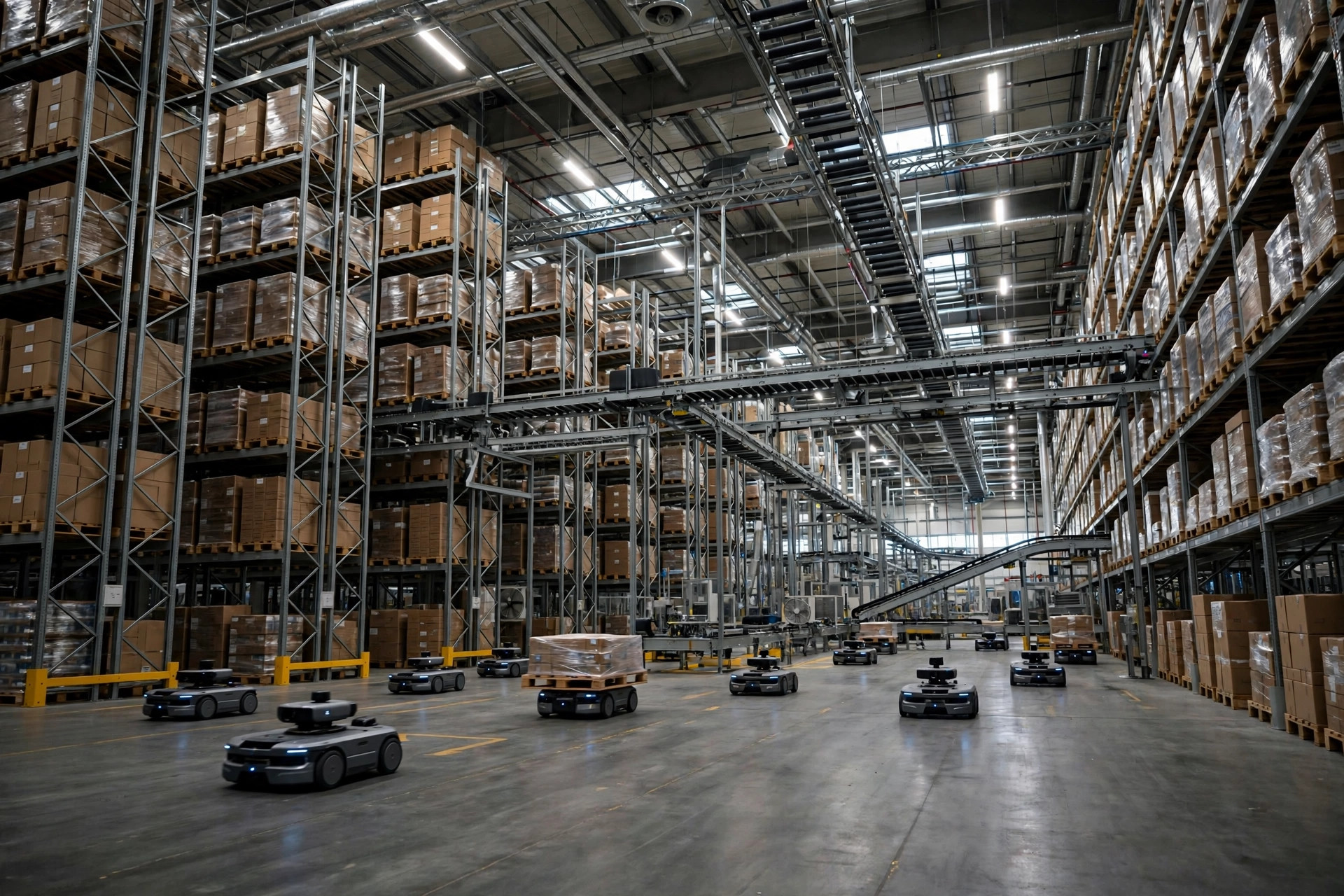
That was the root cause at the Tianjin warehouse in 2024. Two brands, 20-odd robots each, each with its own dispatch software, its own map, its own traffic rules. Brand A's robots believed they had the right of way; Brand B's believed the same. Every afternoon shipping peak: 20–30 minutes of deadlock. Peak season they added 8 more robots and it got worse — more robots, worse jams. Here's the counterintuitive part: until the RCS problem is fixed, adding robots doesn't add throughput. It adds congestion.
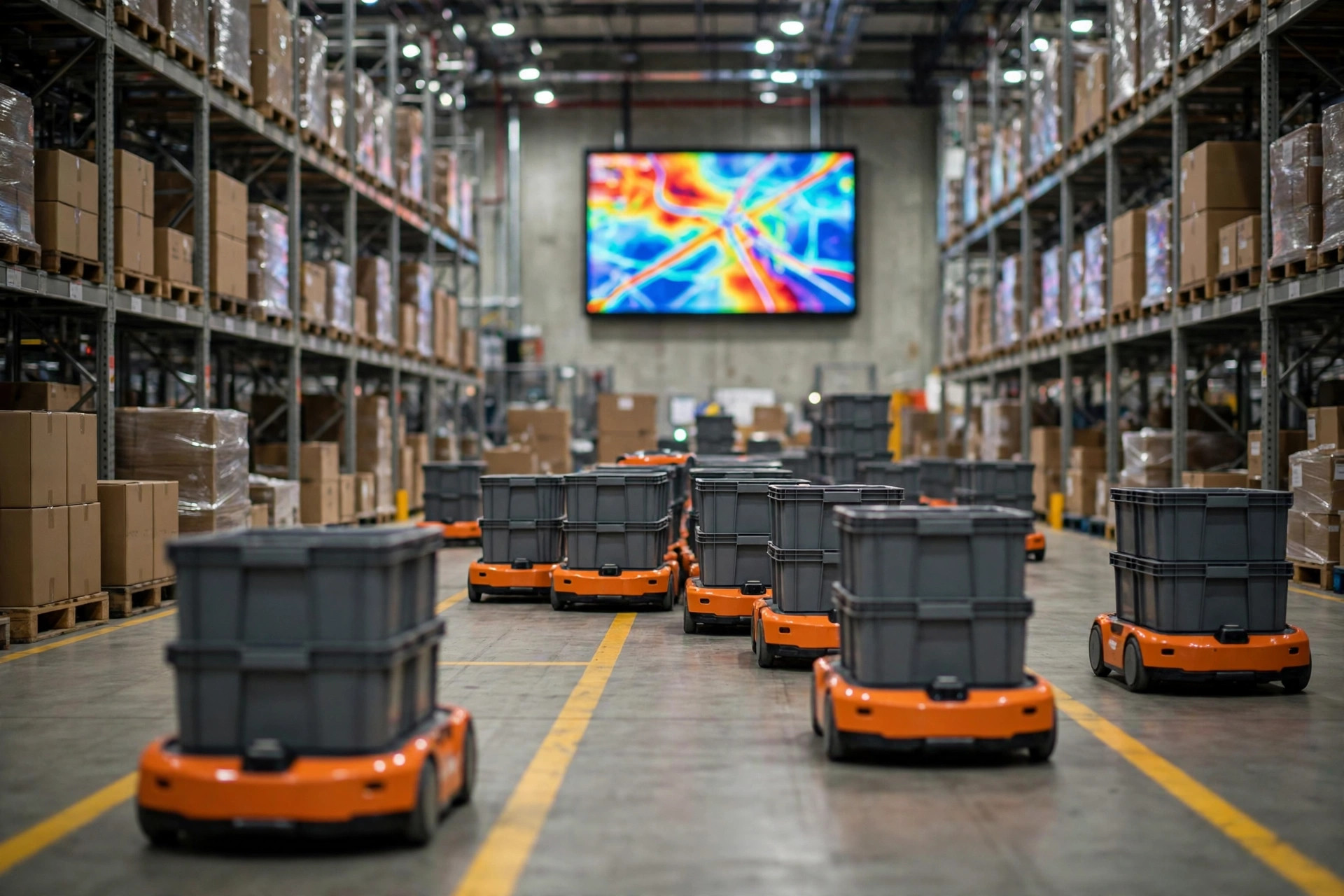
The fix is VDA 5050. Simply put, it's an open interface standard driven by the German automotive industry association that lets robots from different brands take orders from one RCS: one task format, one traffic-control logic. Think of it as issuing the same rulebook to drivers from different countries — doesn't matter where the car was built, red means stop. The Tianjin site later added a VDA 5050-compatible unified RCS, both brands entered the same traffic control, and intersection deadlocks basically disappeared. Trips per robot per shift went up by roughly twenty percent, and those 8 new peak-season robots finally earned their keep. (Robot specs vary by vendor — verify against the manufacturer's published parameters.)
Bullshit-detector moment: if you have 8 robots from one brand and the vendor software runs fine, and someone pitches you a "unified RCS platform" — show them the door. That's a cannon aimed at a mosquito.
The buying line: when an independent RCS is worth it
A decision framework you can use directly:
- Under 10 robots, single brand: vendor software is enough. An independent RCS is money down the drain.
- 10–30 robots, or two brands mixed: look at intersection complexity. Crossing main aisles, charging bottlenecks, multi-floor runs — RCS starts paying for itself. Simple routes that never cross? You can wait.
- 30+ robots, or three brands mixed: an independent RCS is close to mandatory. Skip it and you're signing up for daily traffic jams.
- Fixed equipment + fleet handoffs (conveyors feeding AMRs): no matter how many robots, the WCS/RCS interface boundary must be written into the bid documents — who claims the task, who reports completion, word by word. This is the disaster zone I describe next.
One more thing people miss: charge scheduling. RCS charge management isn't "go charge when empty" — it calculates which robot charges when, for how long, and how many stay online to hold peak capacity. Vendor software usually can't do that math.
Two brains, one warehouse: failures I've seen
2023, an e-commerce warehouse in Guangdong: conveyors and sorter on WCS, 30-plus AMRs on RCS, WMS on top. First week after go-live, the outbound area was chaos: WMS pushed one transport task to both WCS and RCS, and both claimed it — the conveyor delivered the goods, an AMR also drove over to pick them up, the goods got "delivered" twice and the paperwork didn't match. Root cause: the interface boundary was never defined. WMS assumed WCS only handled equipment; WCS assumed it should also take transport tasks. Two hours of downtime the night before peak season. The ops director's face said everything.
The lesson is one sentence: one task, one brain to claim it. When WMS dispatches, the routing rule must be explicit — fixed-equipment legs go to WCS, mobile transport legs go to RCS, and the handoff point (say, the end of a conveyor) must define exactly where WCS's job ends and RCS's begins.
Two more slow-burn failures. One: nobody maintains the map. Racking moved, pallets got staged temporarily, but the RCS map was three months old — robots drove the old map straight into new racking. The RCS map must move with every layout change: change the layout, change the map first. Iron rule. Two: Wi-Fi roaming. A robot switching from one access point to another drops for a few seconds, RCS declares it "lost," and every robot on that route stops to wait for it. Test warehouse wireless coverage and roaming handoff against continuous robot operation — don't grade it on office Wi-Fi standards.
Is the money worth it? Watch this one number
Whether an RCS is worth the money — don't listen to vendor stories. Watch one number: effective transport trips per robot per shift.
Before a unified RCS goes in, pull a week of dispatch logs and calculate the share of time robots spend waiting — waiting on people, waiting on right-of-way, waiting on chargers. If that number is over 20%, most of your fleet's time is being eaten by mutual waiting, and that's exactly what an RCS can take back. Measure again after go-live: if trips are up 15% or more, the money was well spent. No change means the problem was never dispatch — maybe the task pool itself was thin.
One question to take home: in your warehouse, how much of each day do your AMRs spend just... waiting? The number is usually right there on the dispatch screen. Nobody looks at it.
By Da Liu, Automation Engineer