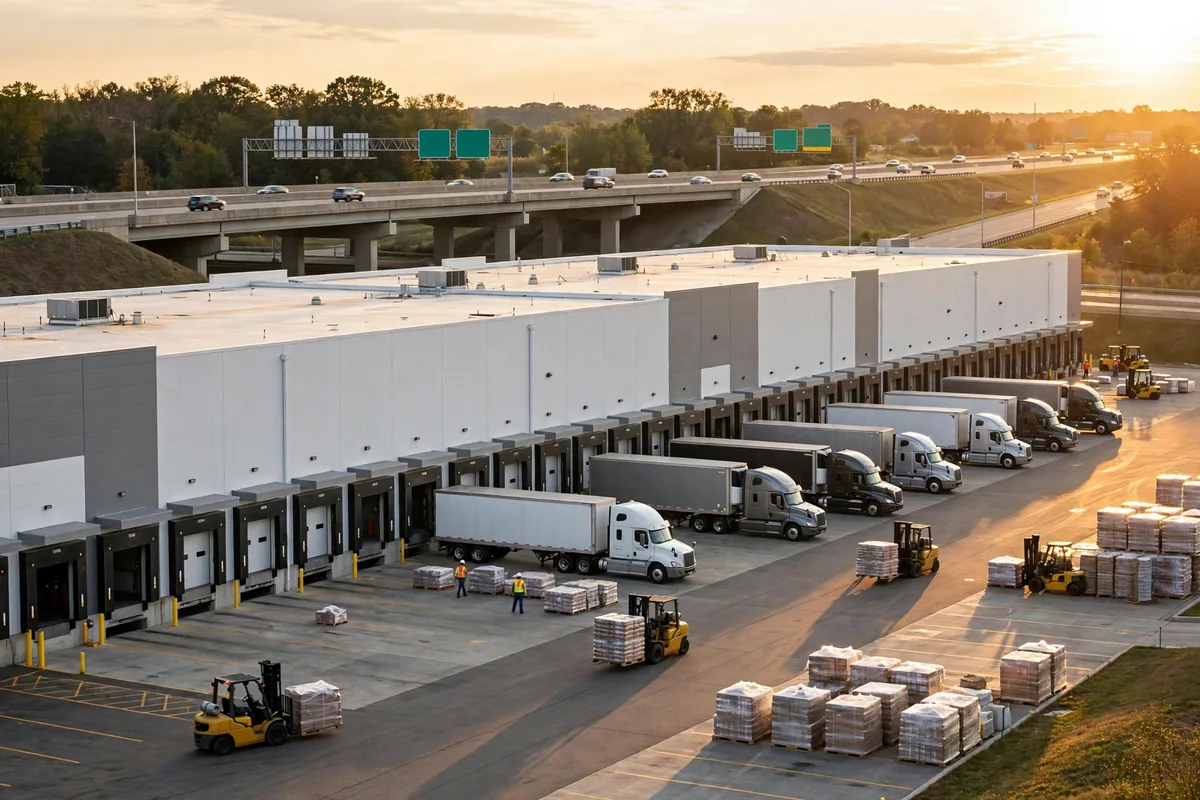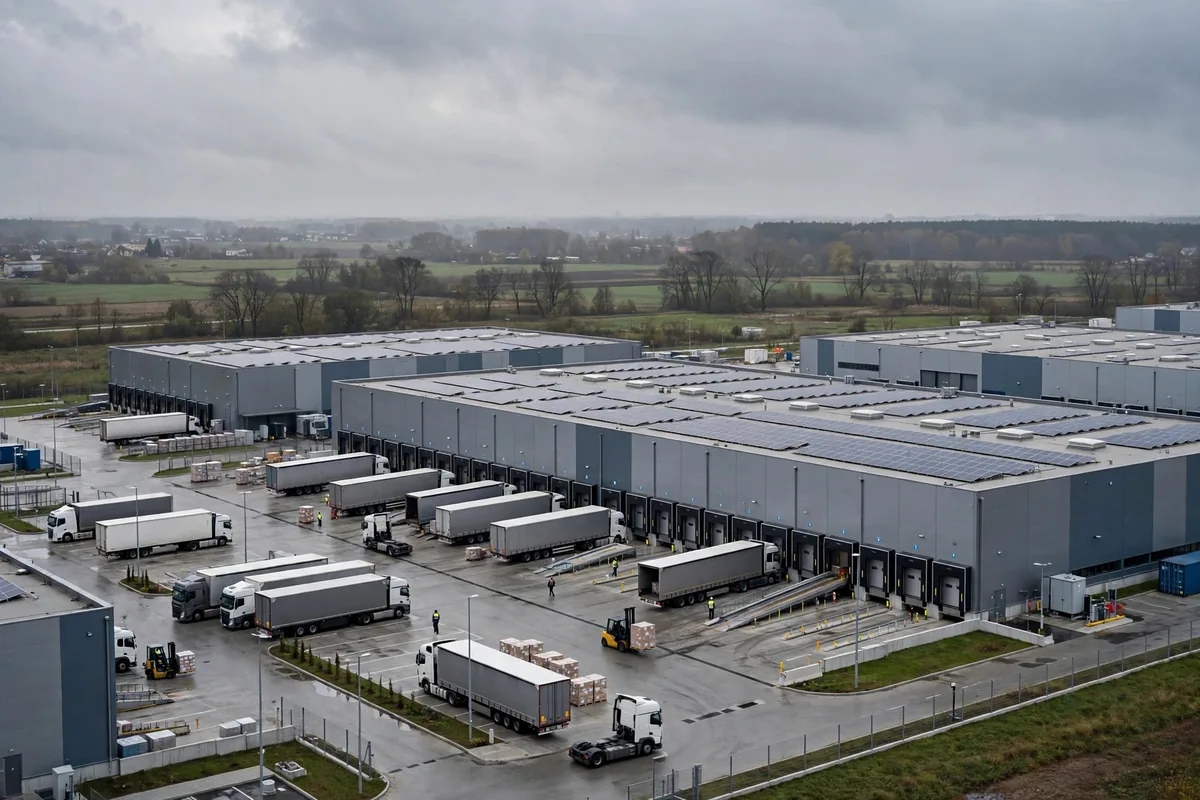
Conclusion first: the poland warehouse logistics market europe story is not a shortage of space, it is a shortage of good space in the right place. JLL's third-quarter 2025 data puts Poland's total warehouse stock at about 37 million square metres, with total demand of 4.55 million square metres in the first three quarters of 2025 and a vacancy rate of 7.8%. Those numbers look comfortable. When you actually go looking for space, you find that warehouses you can move into tomorrow, in the right location, at a price you can defend, are far fewer than the headline suggests. This piece takes the numbers apart and tells you where your leverage is and what to do, step by step.
Poland Warehouse Market Fundamentals: What 37 Million Square Metres Means
Start with the baseline. Poland is Europe's warehouse market second only to Germany, the United Kingdom and France, with total stock of about 37 million square metres. In the first three quarters of 2025, total demand reached 4.55 million square metres, the vacancy rate stood at 7.8%, which works out at about 2.9 million square metres of vacant space, and new deliveries in the same period came to about 1.55 million square metres. The full-year picture from AXI IMMO and Newmark tells the same story from a second angle: total take-up in 2025 was 6.64 million square metres, up 14% year on year and the third-highest on record, renewals made up 52%, new supply was 1.68 million square metres, down 35% year on year and the lowest since 2016, the year-end vacancy rate was 7.4%, and total stock was 36.58 million square metres. The two stock figures differ slightly because the sources count differently. The conclusion does not change.
The conclusion is one sentence: demand is rising while new supply is shrinking. Take-up in 2025 was the third-highest ever, and new supply was the lowest in a decade. That combination means good warehouses are getting scarcer, not more plentiful. A 7.8% vacancy rate looks soft, but the vacant space and the space you actually want are usually not the same buildings.
Look at who is renting. Logistics operators account for about 38% of demand, the largest tenant group. Warsaw accounts for about 23% of national demand, making it the most active market. Illustrative scenario: you are looking for space in Warsaw in October 2025. You are competing in the most active market in the country, where logistics operators, e-commerce players and retailers are all chasing the same kind of warehouse. Here is the counterintuitive part: a 7.8% vacancy rate does not mean "take your pick." It means "pick wrong and you live with it." A large share of the vacant space is older stock in weaker locations, with low clear height and fire protection that no longer meets modern standards. Cheap, but hard to operate. Warehouses that genuinely meet modern operating standards do not stay empty for long.
So do not judge the poland warehouse logistics market europe picture by the vacancy rate alone. Read demand, supply and the renewal share together. Those three lines combined are the real measure of how tight the market is.
Poland Warehouse Rents: Do the Math Before You Open Your Mouth
Rents first. Prime markets run 3.5–5.5 euros per square metre per month, and city warehouses can reach 8 euros. That range is the negotiating battlefield. Worked example: take 10,000 square metres. At 3.5 euros the monthly rent is 35,000 euros. At 5.5 euros it is 55,000 euros, a gap of 20,000 euros a month. A city warehouse at 8 euros runs 80,000 euros a month. Location, clear height, dock equipment and lease length all sit inside that spread.
Here is my step-by-step approach.
Step one, write the requirements list before you visit a single building. Area, clear height, floor load capacity, number of dock doors, fire protection rating, whether the layout supports e-commerce picking. Six items, written down. Skip one and do not go. Without a list, by the third viewing you have forgotten what the first one looked like.
Step two, negotiate with the full-year numbers. Renewals made up 52% of 2025 take-up, which means more than half of all deals were existing tenants renewing. New tenants are really competing for the other half. Put that number on the table and the landlord knows you are not an amateur: you understand that good space does not wait, and you also understand that his building is not your only option.
Step three, price city warehouses on a separate last-mile calculation. City space can reach 8 euros, far above the prime-market range, but it sits close to consumers. Do not compare rent alone; put the last-mile delivery savings into the same calculation. The reverse applies too: if your goods move on trunk routes and never need to sit next to the city, city-warehouse rent is pure waste. I have seen this mistake three times, and every time the tenant compared rent per square metre and forgot total cost.
Step four, trade lease length for terms. A longer lease can buy a rent-free period, a fit-out contribution and better rent-review terms. Every one of those has to be written into the contract and checked line by line. A verbal promise that never reaches the paper does not exist. The most valuable thing at the negotiating table is not confidence, it is data. Quote 4.55 million, 52% and 35% and the landlord's pricing changes on the spot.
| Warehouse type | Rent range | Best for | Watch out for |
|---|---|---|---|
| Prime-market standard warehouse | 3.5–5.5 euros per sqm per month | Trunk transit, regional distribution | New supply is tightening, move early on good stock |
| City warehouse | Up to 8 euros per sqm per month | Urban delivery, e-commerce front stock | Only sign after the last-mile savings are in the total |
| Renewal negotiation | Anchored on current pricing | Existing tenants already in Poland | Renewals are 52% of deals, do not be scared by "no choice" |
Night-Before-Signing Checklist: The Usual Ways Deals Go Wrong
I have seen this mistake three times: a tenant looks at vacant space and never checks the delivery date. New supply fell 35% year on year, and the development pipeline is not keeping up, which means the new warehouse you want may not be ready when you need it. You sign a letter of intent and discover delivery is a quarter later than planned. The night before signing, go through the delivery date, the penalties for late delivery and the early-exit clauses one by one.
Checklist. Tick every item before you sign:
- Delivery date is fixed in the contract, with compensation for late delivery spelled out. Unwritten means non-existent.
- Rent review mechanics are written down: fixed percentage or index-linked, how much per year, and whether the first year has a rent-free period.
- Fire protection and compliance responsibilities are split clearly: who does it, who pays for it, who pays for upgrades.
- The reinstatement standard on exit is defined: returned to what condition, and what the cost cap is.
- Policy numbers are checked against the latest official policy before signing. Tax, subsidies and park policy all change, so verify against the latest official policy first.
The poland warehouse logistics market europe numbers are all on the table: a 37-million-square-metre base, 6.64 million square metres of take-up at a historic level, and 1.68 million square metres of new supply, the lowest in a decade. Your leverage is not in the vacancy rate. It is in how well you know the data: which kind of warehouse is getting scarcer, that renewals took half of all deals, what city warehouses really cost, and which contract clauses you cannot give away. Follow the four steps, tick the checklist the night before signing, and the deal will not blow up on you.
By Lin Xiao, WMS Implementation Consultant