Here's my verdict up front: if your warehouse ships fewer than 3,000 orders a day, stop obsessing over pick path routing. Get your ABC slotting right and move your fast movers next to the shipping dock — that buys you ten times more than any S-shape versus return debate. Path optimization only earns its keep once you're past roughly 5,000 orders a day and your pickers are genuinely walking 6-plus miles (approx., measured) every shift.
That walking figure isn't a guess. Travel eats up more than half of total pick labor time (approx., measured) — the most expensive line item in most warehouses, and the one managers love to ignore because walking doesn't show up on any report. But here's the part the software vendors won't tell you: the routing pattern itself is maybe a third of the problem. Where you slot your SKUs is the other two-thirds. A 20,000-square-foot building with 130-foot aisles won't see more than 30 seconds of difference per order between an S-shape and a return pattern (approx., measured). Meanwhile a hot SKU buried in the far corner costs every picker an extra round trip, and at 2,000 orders a day that's 2.5 miles (approx., measured) of wasted walking. Back in 2018, I was consulting at an 80,000-square-foot 3PL in Ontario, California, where the ops manager wanted to spend $60,000 on a routing optimization module. I talked him out of it, pulled velocity data on his top 200 SKUs, and re-slotted the building by ABC class. Two weeks later labor productivity was up 12% (approx., measured), and nobody ever mentioned the algorithm again.
Quick definitions, so we're speaking the same language.
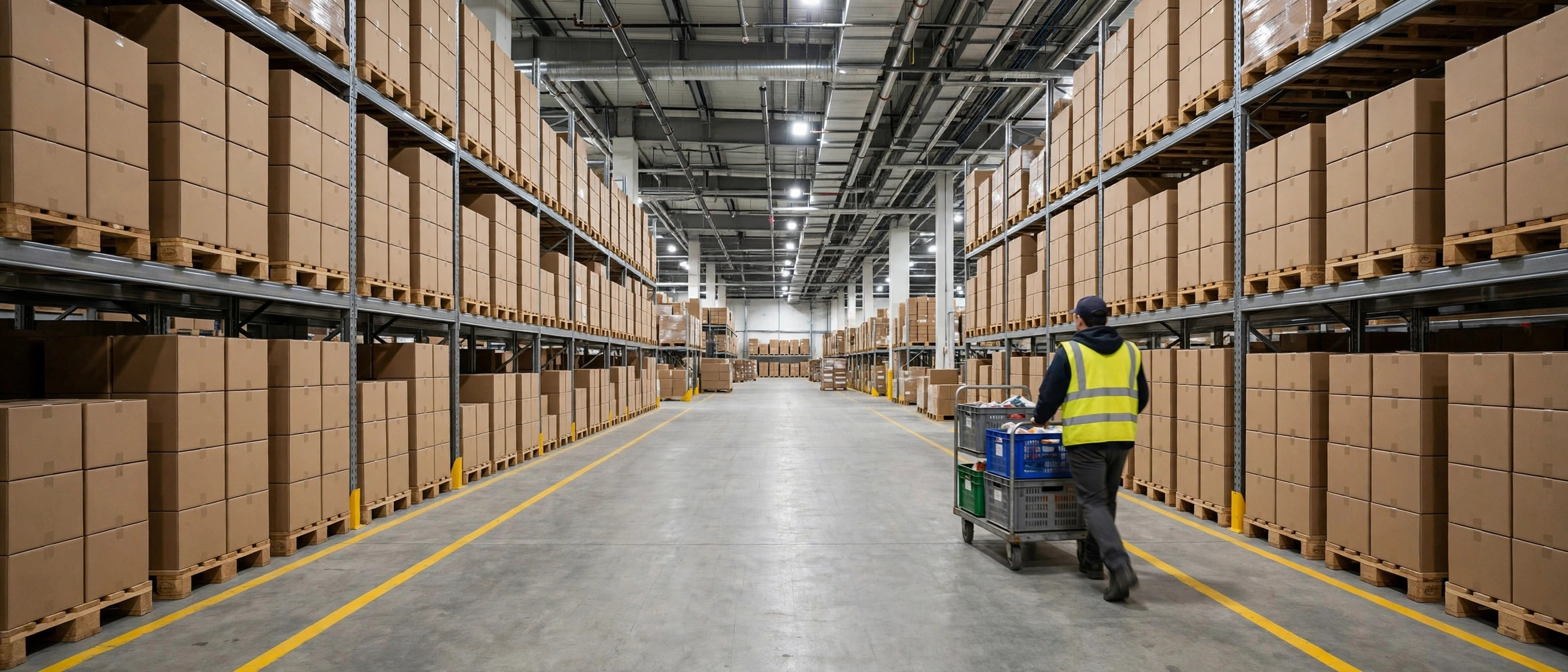
The S-shape — also called traversal — is the plow-the-field method: the picker enters an aisle at one end and exits at the other, sweeping the building aisle by aisle. Dead simple, nearly zero training; a new hire is productive by lunch. It fits short aisles (under 200 feet, in my judgment) with dense pick activity — when one pass down an aisle naturally collects 8 to 10 lines (approx., measured), there's no wasted travel. Its breaking point is aisle length: in a 260-foot aisle, an order with two lines at the far end means 520 feet of walking to pick two items.
The return pattern: don't walk the aisle, walk half of it and come back. It fits long aisles with sparse orders — three lines in the front half, no reason to walk to the back wall. The price is the turn itself. Turning a pick cart is fine; turning a loaded pallet jack in a 10-foot aisle, dozens of times a day, wears out backs and clocks. Measure your turning radius before you commit to return.
Zone relay: split the building into four to six zones, each picker owns one zone, and the tote gets handed downstream until the order is complete. This is the big-league pattern — it can cut individual walking distance by more than half (approx., measured). The price is the merge area: every tote funnels through one consolidation point for checking and packing, which is essentially a whole extra process step you're staffing.
Start with what your building looks like
Before picking a pattern, answer three questions: how long are the aisles, how dense is each wave, and how many orders a day? Aisles under 200 feet with dense waves — S-shape, don't overthink it. Aisles past 200 feet with sparse picks — return wins, and the picker should glance at the pick list before entering: if there's nothing past the midpoint, don't walk there. Past 8,000 orders a day, with six or more pickers working the same wave, that's when zone relay earns its keep.
The classic mistake is a small warehouse copying a big one. A 2,000-order-a-day building split into four zones gives each zone 500 orders — pickers wander their zones waiting for work, and the merge station sits idle. I once saw a 50,000-square-foot warehouse forced into six zones; in the slow season, zones spent half the day waiting on totes from each other, and productivity ran 15% (approx., measured) below a plain S-shape.
When to change the pattern
Routing isn't a lifetime decision. When volume or SKU mix shifts, re-run the math. Three signals I watch, and any one of them is worth redrawing the routes.
The most common one: aisles get longer or orders get thinner. If your S-shape building stretches past 200-foot aisles, or wave density drops below 15% (approx., measured) of slotted locations — fewer than five lines per aisle pass — switch to return. The test is crude but honest: sample a week of pick tickets and measure what share of aisle travel was empty. Past a third (approx., measured), change the pattern.
Another one: people are genuinely wearing out. Pickers walking more than 7.5 miles a day (approx., measured), volume past 8,000 orders — that's when zone relay deserves a real evaluation. The Ontario building made the switch in 2019: seconds per pick line fell from 45 to 28 (approx., measured), the merge station took one extra headcount, and overall labor productivity rose about 18% (approx., measured). Note the season, though — those were peak numbers. When volume dropped 40% (approx., measured) after peak, the merge station sat half-idle and they collapsed back to two zones. Run zone relay with a peak and an off-peak plan; one pattern year-round is a mistake.
And then the SKU mix changes sharply. Land a big client, add 2,000 long-tail SKUs, and suddenly your dense S-shape route is mostly empty travel — either switch to return or carve the new SKUs into their own zone. The reverse applies too: SKU count shrinks, orders get denser, and return can fold back into S-shape, pocketing all those saved U-turns.
Where zone relay actually breaks
Zone relay looks beautiful on a whiteboard and breaks in production, because it's a system — one weak link slows the whole line. Three failure modes I keep seeing.
The relay stalls. The upstream zone outruns the downstream one, totes pile up at the merge, and downstream pickers end up waiting on upstream totes. The fix is unglamorous: check each zone's backlog every two hours and shift people from the fast zone to the slow one. Never assume zones stay balanced on their own — one SKU mix change and the balance is gone.
Hot SKUs cross zones. A bestseller slotted in Zone A means Zones B and C are "borrowing" from A all day — the zones exist on paper only. Fast movers get their own velocity zone hugging the shipping dock, owned by nobody else. Pickers there run at roughly twice the speed of a regular zone (approx., measured), because everything they touch is a bestseller.
The handoff has no standard. Does the tote get sealed before it moves downstream? Which side does the label go on? Where do exceptions go? If the SOP doesn't spell it out, every downstream picker burns a minute per tote hunting for the label — at 3,000 totes a day that's 50 hours (approx., measured) of labor spent reading tape. Mis-shorts roughly double too (approx., measured), because nobody can say which zone lost the item.
Here's your Monday-morning move: print yesterday's 20 pick tickets and trace the walking route on your building layout, one wave per sheet. If the same aisle gets entered three or more times by the same wave, don't redesign the route yet — move the three most frequently picked SKUs to slots within 30 feet of the shipping dock, then re-trace the routes a week later and compare total travel. The exercise costs nothing, and it answers the real question: do you need a better walking pattern, or better slotting? For most warehouses, it's the slotting.