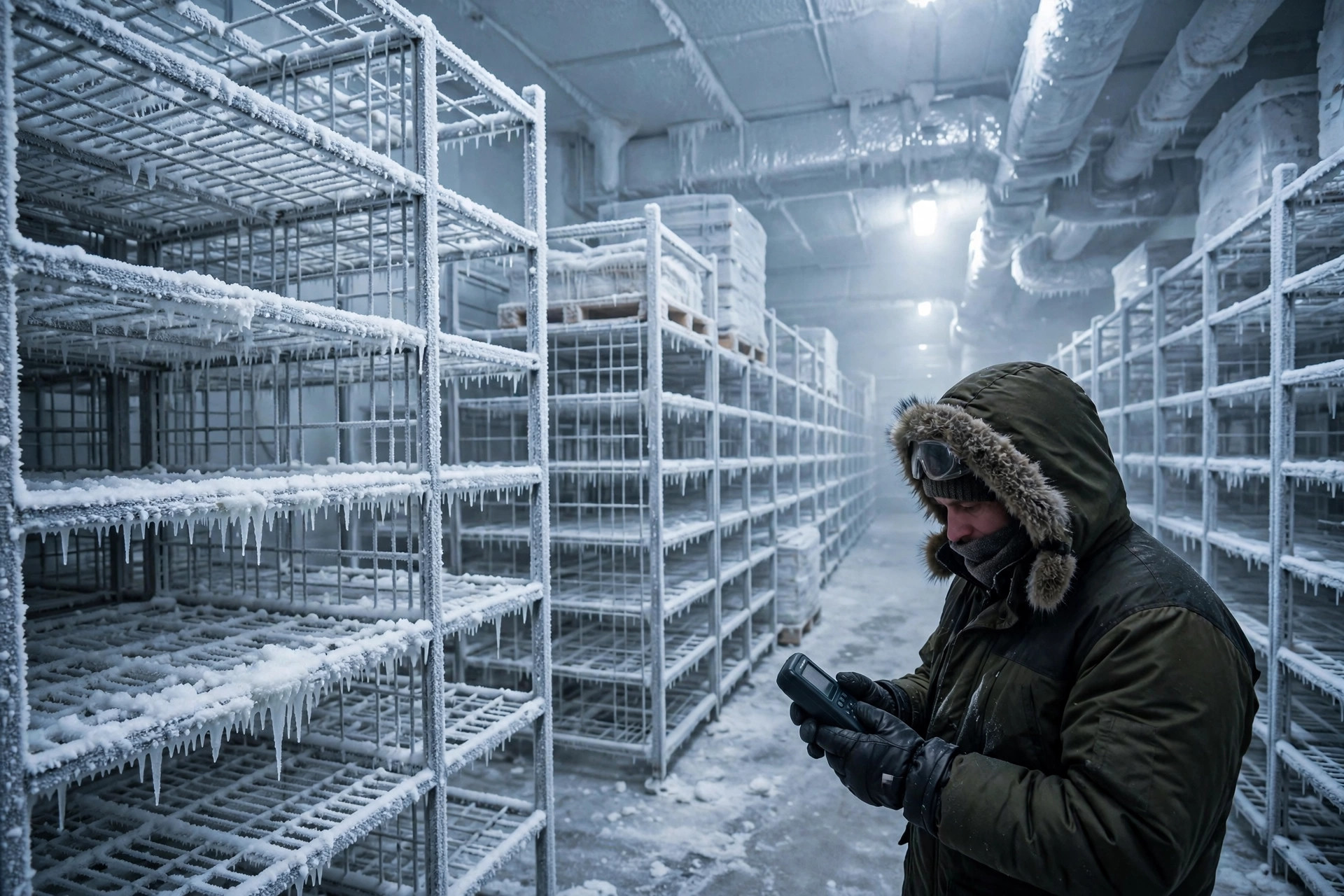
In 2017, I was consulting for a pharmaceutical third-party warehouse in New Jersey when their biggest customer — a generic drug manufacturer — showed up for its annual audit. The facility was 120,000 square feet with a 2–8°C cool room that had completed temperature mapping validation three years earlier. On day two, the auditor walked the cool room, came back, and asked a single question: "These racks are not where your validation report says they are. What's the change control number?" The warehouse manager froze.
Here's what happened. Before peak season, operations had moved three rack rows to free up an aisle and relocated two temperature probes because the cable routing looked cleaner. Nobody filed a change request. It was "just moving things around inside the building." The auditor logged a major observation on the spot, and the customer's head of quality went pale. It took the warehouse nearly six months to close it out — a retrospective risk assessment, a repeat temperature mapping study, a deviation report — and the labor cost of the cleanup was more than ten times what a proper change control would have cost.
This is the part most warehouses get wrong about GMP: change control is not bureaucracy. It is the mechanism that keeps your validated state honest. Everything in your validation report — room layout, rack positions, probe locations, HVAC setpoints, SOP versions, even your calibration vendor — is a locked condition. Move any one of them, and your validation report no longer fully describes reality. That is what "change" means.
The only test that matters: did you touch the validated state?
People assume change control is only for big projects. It's the opposite. The grading I teach warehouse teams is simple. Minor change: it doesn't affect the validated state — replacing a temperature probe with the identical model, fixing a typo in an SOP, reprinting rack labels. A simplified record is enough. Major change: it could affect product quality or the validated state — moving racks, changing a temperature setpoint, replacing an air handler, revising the receiving release process, switching pest control vendors. Full process required.
When you're unsure, always grade up. Filing a minor change through the major process costs you a few extra forms. Treating a major change as minor costs you an audit finding.
Two traps deserve special attention. The first is temperature probe placement. Probe locations in a cool room are not chosen by convenience — they come out of mapping studies run in summer and winter, placed at the documented hot and cold spots. Move a probe a meter for cleaner cable routing and you've personally invalidated the mapping conclusion. The auditor will not accept "the probe is still in the room." The location is no longer the validated location, and you will lose that argument every time.
The second trap is vendor changes. Operations often treats switching calibration companies or pest control providers as a purchasing decision with no quality impact. Under GMP, those vendors are extensions of your quality system — their qualifications and records underpin your validated state. Swap them without change control and you've punched an unwarranted hole in your own quality system.
Keep two concepts separated, because auditors check this: change control governs planned, controlled modifications — things you're about to do. Deviations govern unplanned events — the air handler died at 2 a.m. and the room went out of spec. Filing a deviation as a change, or treating a change as an after-the-fact deviation, reads as a quality system that doesn't understand its own logic. Future changes go through change control; past problems go through deviation investigation. Don't mix them.
One more habit that separates serious operations from paper systems: review your open changes on a schedule. A change record that has been sitting open for four months with no verification is not a controlled change — it's an excuse. Put the open-change list on the monthly quality review agenda, and give every change a target close date at approval time. Changes without deadlines don't get verified; they get forgotten.

Four steps, no shortcuts: request, assess, approve, verify-and-close
The actual process is not complicated. Step one, request: whoever touches the equipment files the request. If operations is moving the racks, operations writes it — not quality, after the fact, "helping out." The request states three things: what will change, why, and when. Step two, assess: quality leads a risk assessment with one core question — does this change affect the validated state? Moving racks affects airflow and temperature distribution, so you schedule a re-mapping. Revising an SOP release step, so you evaluate the impact on batch release. The assessment decides whether the change runs simplified or full, and what verification comes after. Step three, approve: the head of quality signs. Not the warehouse manager, and definitely not the requestor approving their own request — self-approval reads as no approval to an auditor. Step four, verify and close: implement the change, perform whatever verification the assessment called for, file the results, and only then close the change record. The classic failure is doing it backwards — racks already moved, then scrambling to backfill the paperwork. Auditors can smell retroactive documentation from across the room.
Before any change, I tell warehouse managers to run through six questions: Is what I'm touching inside the scope locked by the validation report? Will the validated state still hold after the change? Do I need re-mapping or re-qualification? Do SOPs need revision and retraining? Do calibration and maintenance schedules need updating? Does the customer need advance notice — many large-customer contracts require it for major changes. If you can't answer all six, don't touch anything. File the change first.
Change control is insurance, not red tape. When a temperature excursion happens, or when an auditor asks the hard question, a closed change record with assessment, approval, and verification is what stands between you and a major observation. The New Jersey warehouse learned it the expensive way. The cheaper lesson is this: ask your warehouse today — those racks that got moved last month, what's the change number? If nobody can answer, your change control exists only on paper. Fix it now, while the auditor hasn't arrived yet.