Have you ever opened your shipping platform's transaction history at month-end and found the total noticeably higher than what the labels seemed to cost? The price on each label looked clear at print time, but the extra charges show up later, line by line, under "surcharges."
I have seen this play out many times. During last year's peak season, I visited a 3PL warehouse in Ontario, California that was pushing over 20,000 small parcels a day at its busiest. The operations manager complained that the postage he calculated on the platform never quite matched what was actually deducted. I had him export the last 30 days of transactions and reconcile them one by one. The result stopped him cold: the biggest gaps were all surcharges that never appeared in the quote at label time. And no, the platform was not ripping him off. The price you see when you print a label is based on what you declared. Once the carrier receives the parcel and re-checks it against reality, the difference lands on your account.
Multi-carrier shipping platforms like Pirate Ship, Shippo, ShipStation, Easyship, and Stamps.com exist to put discounted carrier rates in front of you. They generally do not mark up the postage itself: Pirate Ship charges no subscription at all, Shippo offers a free tier for up to 30 labels a month, ShipStation charges by shipment volume starting in the low teens per month, and Easyship has a free allowance too — check each platform's site for current pricing. But none of them will shield you from the carriers' own surcharge rules. To keep your books honest, you need to understand the three surcharges most likely to inflate your bill.
How these three surcharges actually reach your bill
First: the address correction fee — one missing unit number.
The trigger is simple: an incomplete or wrong recipient address. The classic case is an apartment or office missing its Suite or Unit number, a ZIP code off by one digit, or a misspelled street name. UPS and FedEx systems auto-correct the address before delivery, the parcel still goes out, and an "Address Correction" charge lands on your bill. USPS rarely charges this kind of fee; when the address is bad, the parcel usually gets returned or delayed instead. So the cost risk sits mostly with UPS and FedEx — check each carrier's site for the current fee.
How to spot it: search your platform's transaction history or shipment report for "Address Correction." It will never show up in the quote at label time; it only gets posted after the carrier takes the parcel. Most sellers assume the platform made a billing error the first time they see it.
How to avoid it: always run address validation before printing. Platforms like Shippo and ShipStation flag questionable addresses — anything highlighted red needs a manual check. If you import orders in bulk, add an address completeness check to the process: no Suite or Unit field, no complete ZIP, no label. The worst case I saw: a friend running a pet-supply warehouse in Chino, shipping 300 to 500 orders a day, kept leaving the unit number off one apartment building's address. Hundreds of corrections in a single month, every one of them avoidable.
Second: the residential delivery surcharge — the easiest one to miss at quote time.
The trigger: UPS and FedEx ground products add a "Residential Surcharge" for deliveries to home addresses. Two things to keep in mind. First, this is the carrier's rule, not the platform's markup. Second, USPS Ground Advantage and Priority Mail do not charge it. That is why USPS quotes sometimes look dramatically cheaper for the same parcel — the gap is not in the base rate, it is in this surcharge.
How to spot it: look for "Residential Surcharge" on your invoice. Plenty of sellers comparison-shop on a platform, see UPS Ground priced below USPS, click it, and end up paying more on the final bill because this line item was never in the quote.
How to avoid it: treat "residential or commercial" as a fixed filter whenever you compare rates. My rule of thumb: for small parcels going to homes, check USPS quotes first; bring UPS and FedEx into the comparison for commercial addresses. Over time, tag the residential versus commercial status in your customer address database and bake it into your label rules. That eliminates most of the surprises.
Third: the postage adjustment after a weight or dimension mismatch — the most expensive and most common.
The trigger: the weight or dimensions you entered do not match what the carrier actually measures. The carrier re-rates the parcel at the real values and deducts the difference from your account, usually logged as "Adjustment" or "Postage Adjustment." Two scenarios hurt the most: declared weight came in light — say you entered 3 lbs and the parcel actually weighs 3.2; or the box trips dimensional-weight pricing, where a slightly larger carton pushes UPS or FedEx to bill by dimensional weight and the charge jumps a tier. There is no warning cap on these adjustments; you pay whatever the gap is.
How to spot it: pull your transaction history regularly and filter for adjustments. Pirate Ship lets you export the transaction log; ShipStation and Shippo have shipment reports. Export once a week, flag every adjustment, and see whether they cluster around certain SKUs or packing stations — the pattern will tell you where the problem lives.
How to avoid it: a scale and a tape measure are the cheapest money-saving tools in your warehouse. My rule: measure every SKU's real weight and dimensions, keep them on file, and pull numbers only from that file — never from memory. When bulk-importing, build in a small buffer (declare 3.5 lbs when the scale reads 3.2); paying a few extra cents upfront beats getting hit with an adjustment. And watch the dimensional-weight line closely: before switching to a bigger box size, run the dimensional-weight math to see whether it jumps a tier.
Rate-shopping the right way: don't judge by the label-time price
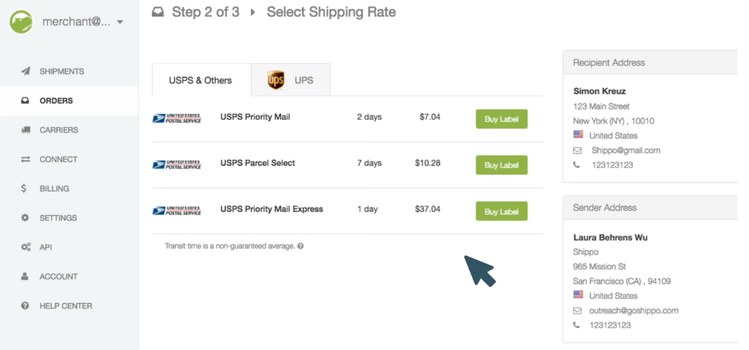
The real difference between platforms is not the interface — it is the all-in cost of the same parcel. My comparison method is crude but it works: take the same shipment — identical weight, dimensions, origin and destination ZIPs, residential or commercial — and run it through the quote screens of two or three platforms, then write down the results. Three details matter. First, use your own real addresses, not the platform's sample data. Second, check whether the USPS quote includes insurance; Priority Mail comes with a certain amount of carrier coverage built in, Ground Advantage does not, and that belongs in the math — check the USPS site for the current coverage. Third, do not compare just one parcel; run the three SKUs you shipped most last month and base your conclusion on that.
Beyond the quotes, keep this checklist handy — claims and account issues are where plenty of sellers get burned:
- Claims rules differ everywhere. USPS lost-parcel claims go through the carrier's process: slow, but free. Third-party insurance sold on platforms is cheap, but the fine print on "delivered but not received" claims is strict — read the terms before you buy. For high-value goods, buy the coverage and don't skimp.
- Voiding labels has a time window. Void a bad label quickly; each platform's label refund rules differ, and wait too long and the money is gone. Check current policies.
- Don't trip the account risk controls. Don't fund your account with someone else's card, don't print discounted labels on behalf of others, and don't commit API keys to public code. Once a platform's risk team flags an account, suspension happens faster than you expect, and appeals are measured in weeks.
- Separate subscription cost from postage. Subscription platforms like ShipStation and Stamps.com need their monthly fee spread across your per-order cost; free options like Pirate Ship or Shippo's free tier carry no such fixed cost. At low volume, that fixed monthly fee can cost more than the postage you saved.
One thing to do this week: log into whatever platform you use, export the last 30 days of transactions, and filter for anything containing "Correction," "Residential," or "Adjustment." Add them up. If those three categories total more than 5% of your postage spend, your label process has leaks — and the address validation plus weight-on-file routine above should go on this week's list. Once the math is honest, the platform actually saves you money.